
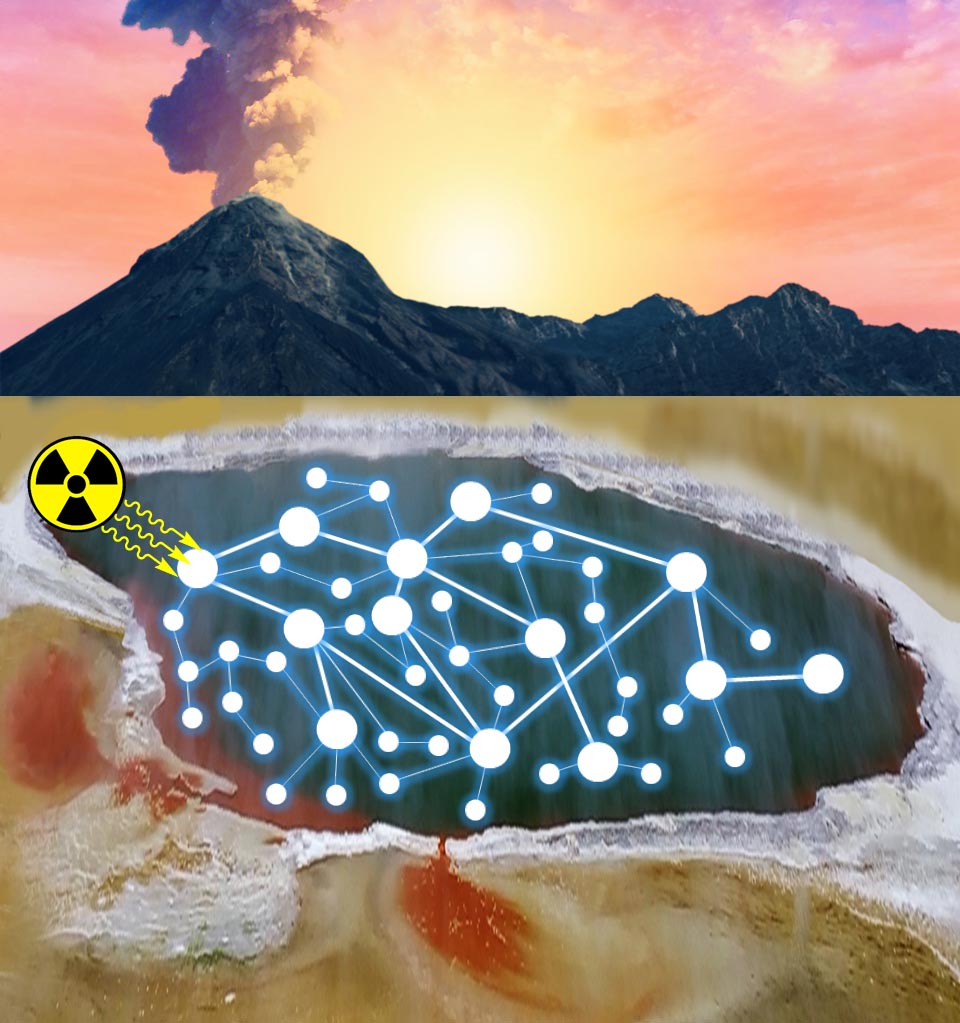
Researchers have long sought to understand the origins of life on Earth. A new study conducted by scientists at the Institute for Advanced Study, the Earth-Life Science Institute (ELSI), and the University of New South Wales, among other participating institutions, marks an important step forward in the effort to understand the chemical origins of life. The findings of this study demonstrate how “continuous reaction networks” are capable of producing RNA precursors and possibly ultimately RNA itself — a critical bridge to life. A link to the paper, published by Proceedings of the National Academy of Sciences.
While many of the mechanisms that propagate life are well understood, the transition from a prebiotic Earth to the era of biology remains shrouded in mystery. Previous experiments have demonstrated that simple organic compounds can be produced from the reactions of chemicals understood to exist in the primitive Earth environment. However, many of these experiments relied on coordinated experimenter interventions. This study goes further by employing a model that is minimally manipulated to most accurately simulate a natural environment.
To conduct this work, the team exposed a mixture of very simple small molecules — common table salt, ammonia, phosphate, and hydrogen cyanide — to a high energy gamma radiation source. These conditions simulate radioactive environments made possible by naturally occurring radioactive minerals, which were likely much more prevalent on early Earth. The team also allowed the reactions to intermittently dry out, simulating evaporation in shallow puddles and beaches. These experiments returned a variety of compounds that may have been important for the origins of life, including precursors to amino acids and other small compounds known to be useful for producing RNA.
The authors use the term “continuous reaction network” to describe an environment in which intermediates are not purified, side products are not removed, and no new reagents are added after the initial starting materials. In other words, the synthesis of molecules occurs in a dynamic environment in which widely varied compounds are continuously being formed and destroyed, and these products react with each other to form new compounds.
Jim Cleaves, frequent IAS visitor and ELSI professor, stated, “These types of continuous reaction networks may be quite common in chemistry, but we are only now beginning to build the tools to detect, measure, and understand them. There is a lot of exciting work ahead.”
Future work will focus on mapping out reaction pathways for other chemical substances and testing whether further cycles of radiolysis followed by dry-down can generate higher order chemical products. The team believes these models can help to determine what primitive planetary environments are most conducive to the formation of complex molecules. These studies could in turn help other scientists identify the best places to look for life beyond Earth.
Reference: “A continuous reaction network that produces RNA precursors” by Ruiqin Yi, Quoc Phuong Tran, Sarfaraz Ali, Isao Yoda, Zachary R. Adam, H. James Cleaves II and Albert C. Fahrenbach, 2 June 2020, Proceedings of the National Academy of Sciences.
DOI: 10.1073/pnas.1922139117
Never miss a breakthrough: Join the SciTechDaily newsletter.
Follow us on Google and Google News.
1 Comment
Sigh. Makes me wish for senior classes in Physical Astronomy I enjoyed for one semester at R-M W C in Lynchburg, VA. I was forever excited about the “Other World” after that…and much more aware of this one.