
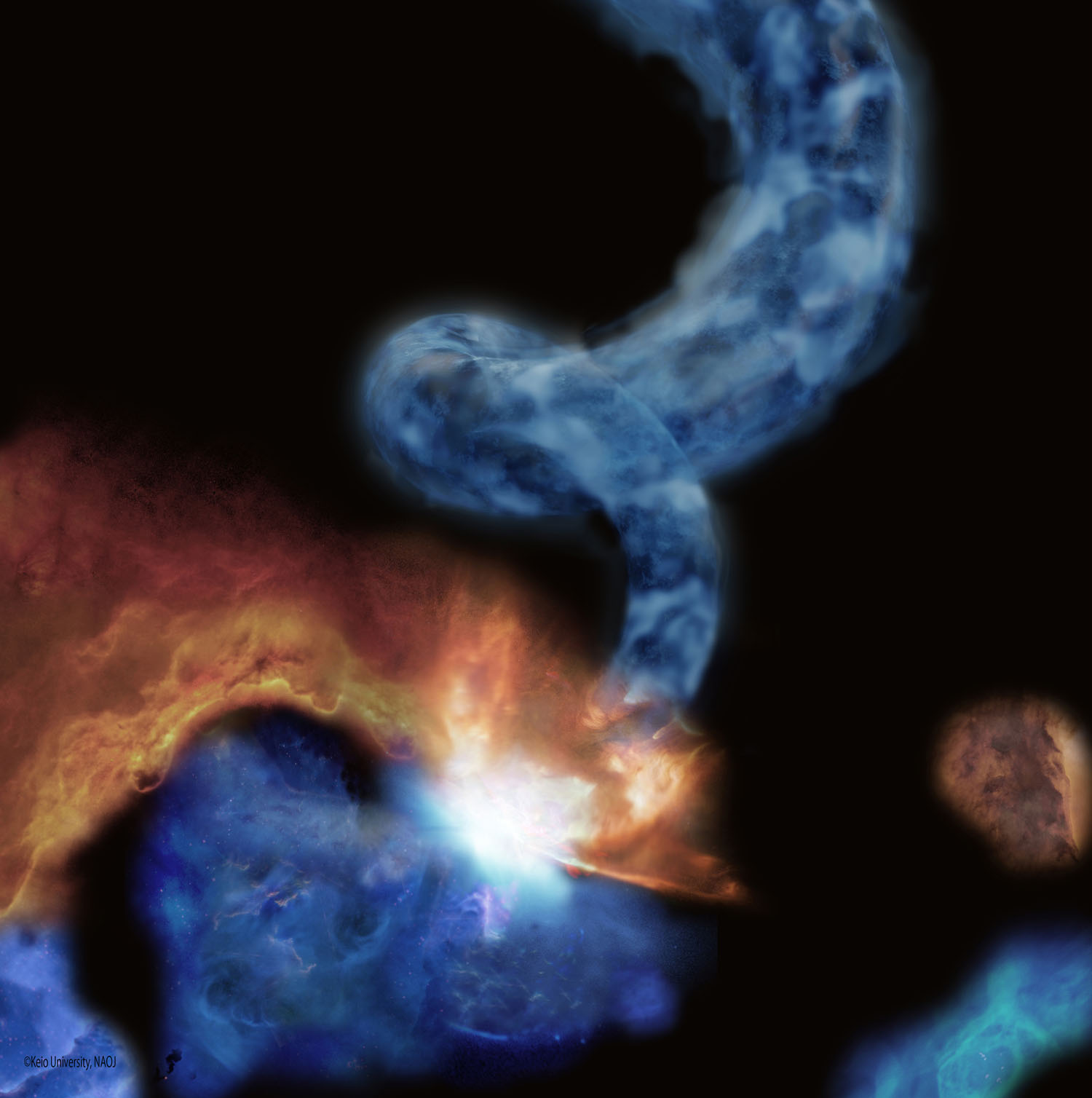
Key precursors for life on Earth are abundant in interstellar molecular clouds and could have arrived on Earth inside comets and meteors.
Nitriles, a class of organic molecules with a cyano group (a carbon atom bound with a triple unsaturated bond to a nitrogen atom) are typically toxic. But paradoxically, they are also a key precursor for molecules essential for life on Earth, such as ribonucleotides, composed of the nucleobases or ‘letters’ A, U, C, and G joined to a ribose and phosphate group, which together make up RNA. Now, a team of scientists from Spain, Japan, Chile, Italy, and the United States show that a wide range of nitriles occurs in interstellar space within the molecular cloud G+0.693-0.027, which is located near the center of the Milky Way galaxy.
“Here we show that the chemistry that takes place in the interstellar medium is able to efficiently form multiple nitriles, which are key molecular precursors of the ‘RNA World’ scenario,” said Dr. Víctor M. Rivilla, a researcher at the Center for Astrobiology of the Spanish National Research Council (CSIC) and the National Institute of Aerospace Technology (INTA) in Madrid, Spain, and first author of the new study.

Possible ‘RNA-Only’ World
According to this scenario, life on Earth was originally based on RNA only, and protein enzymes and DNA evolved later. RNA can fulfill both their functions: catalyzing reactions like enzymes, and storing and copying information like DNA. According to the ‘RNA World’ theory, nitriles and other building blocks for life didn’t necessarily all arise on Earth itself: they might also have originated in space and ‘hitchhiked’ to the young Earth inside comets and meteorites during the ‘Late Heavy Bombardment’ period, between 4.1 and 3.8 billion years ago. In support, nitriles and other precursor molecules for nucleotides, lipids, and amino acids have been found inside contemporary meteors and comets.
Where in space could these molecules have come from? Prime candidates are molecular clouds, which are dense and cold regions of the interstellar medium, and are suitable for the formation of complex molecules. For example, the molecular cloud G+0.693-0.027 has a temperature of around 100 K and is approximately three light-years across, with a mass approximately one thousand times that of our Sun. Although scientists suspect that it might evolve to become a stellar nursery in the future, there’s no evidence that stars are currently forming inside G+0.693-0.027.
“The chemical content of G+0.693-0.027 is similar to those of other star-forming regions in our galaxy, and also to that of solar system objects like comets. This means that its study can give us important insights about the chemical ingredients that were available in the nebula that give rise to our planetary system,” explained Rivilla.
Electromagnetic Spectra Studied
Rivilla and colleagues used two telescopes in Spain to study the electromagnetic spectra emitted by G+0.693-0.027: the 30-meter-wide (98-foot-wide) IRAM telescope Granada, and the 40-meter-wide Yebes telescope in Guadalajara. They detected the nitriles cyanoallene (CH2CCHCN), propargyl cyanide (HCCCH2CN), and cyanopropyne, which hadn’t yet been found in G+0.693-0.027, although they had been reported in 2019 in the TMC-1 dark cloud in the constellations Taurus and Auriga, a molecular cloud with very different conditions than G+0.693-0.027.
Rivilla et al. also found possible evidence for the occurrence in G+0.693-0.027 of cyanoformaldehyde (HCOCN) and glycolonitrile (HOCH2CN). Cyanoformaldehyde was detected for the first time in the molecular clouds TMC-1 and Sgr B2 in the constellation Sagittarius, and glycolonitrile in the Sun-like protostar IRAS16293-2422 B in the constellation Ophiuchus.
Other recent studies have also reported other RNA precursors inside G+0.693-0.027 such as glycolaldehyde (HCOCH2OH), urea (NH2CONH2), hydroxylamine (NH2OH), and 1,2-ethenediol (C2H4O2), confirming that the interstellar chemistry is able to provide the most basic ingredients for the ‘RNA World’.
Nitriles Among Most Abundant Chemical Families in Space
Final author Dr. Miguel A Requena-Torres, a lecturer at Towson University in Maryland, US, concluded: “Thanks to our observations over the past few years, including the present results, we now know that nitriles are among the most abundant chemical families in the universe. We have found them in molecular clouds in the center of our galaxy, protostars of different masses, meteorites, and comets, and also in the atmosphere of Titan, the largest moon of Saturn.”
Second author Dr. Izaskun Jiménez-Serra, likewise a researcher at CSIC and INTA, looked ahead: “We have detected so far several simple precursors of ribonucleotides, the building blocks of RNA. But there are still key missing molecules that are hard to detect. For example, we know that the origin of life on Earth probably also required other molecules such as lipids, responsible for the formation of the first cells. Therefore we should also focus on understanding how lipids could be formed from simpler precursors available in the interstellar medium.”
Reference: “Molecular precursors of the RNA-world in space: new nitriles in the G+0.693-0.027 molecular cloud” by Víctor M. Rivilla, Izaskun Jiménez-Serra, Jesús Martín-Pintado, Laura Colzi, Belén Tercero, Pablo de Vicente, Shaoshan Zeng, Sergio Martín, Juan García de la Concepción, Luca Bizzocchi, Mattia Melosso, Fernando Rico-Villas and Miguel A. Requena-Torres, 2 June 2022, Frontiers in Astronomy and Space Sciences.
DOI: 10.3389/fspas.2022.876870
Never miss a breakthrough: Join the SciTechDaily newsletter.
Follow us on Google and Google News.