
Close Menu
    Facebook X (Twitter) Instagram
    SciTechDaily
    • Biology
    • Chemistry
    • Earth
    • Health
    • Physics
    • Science
    • Space
    • Technology
    Facebook X (Twitter) Pinterest YouTube RSS
    SciTechDaily
    Home»Physics»Controlling the Speed of Light Bullets
    Physics

    Controlling the Speed of Light Bullets

    By Osaka UniversityDecember 20, 2020No Comments2 Mins Read
    Facebook Twitter Pinterest Telegram LinkedIn WhatsApp Email Reddit
    Share
    Facebook Twitter LinkedIn Pinterest Telegram Email Reddit
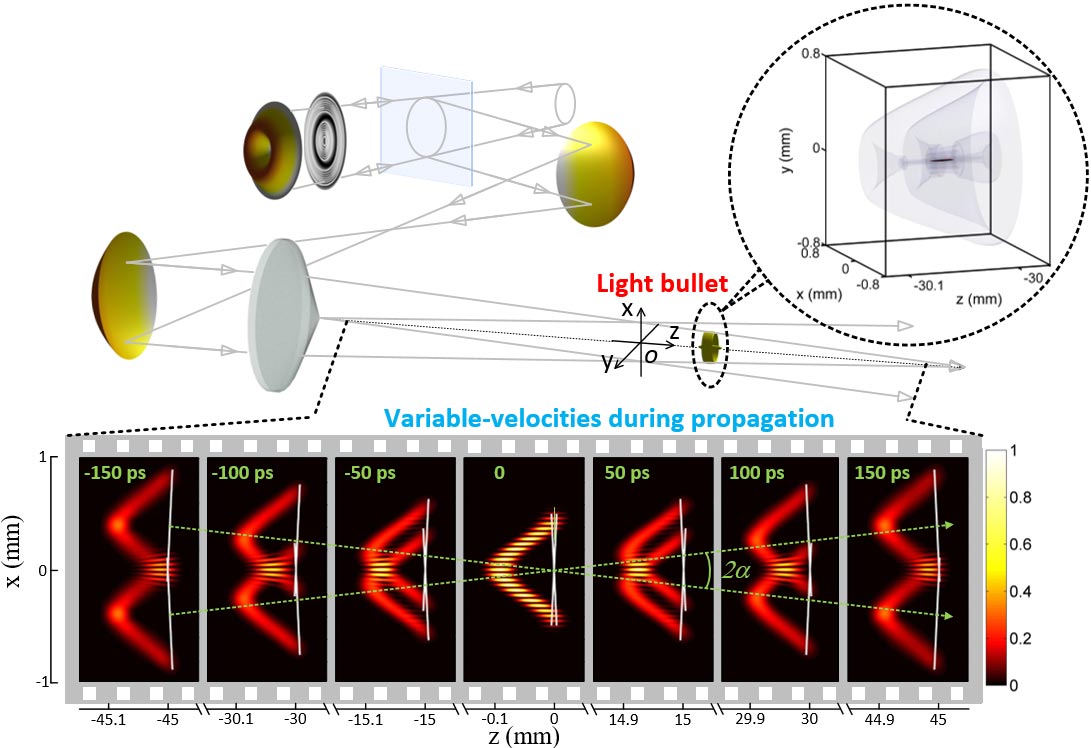
    Flying Light Bullet
    Flying light bullet with variable-velocities (see beam center). Credit: Osaka University

    Researchers from Osaka University accurately and arbitrarily control flying velocities of light bullets, offering new opportunities for optical and physical applications.

    Though it sounds like something straight out of science fiction, controlling the speed of light has in fact been a long-standing challenge for physicists. In a study recently published in Communications Physics, researchers from Osaka University generated light bullets with highly controllable velocities.

    According to Albert Einstein’s principle of relativity, the speed of light is constant and cannot be exceeded; however, it is possible to control the group velocity of optical pulses.

    Currently, the spatiotemporal coupling of optical pulses provides an opportunity to control the group velocity of three-dimensional non-diffraction optical wave-packets, known as “light bullets,” in free space.

    In their previous study (Scientific Reports), this group found that by deforming the pulse-front of optical pulses and keeping the phase-front unchanged, the velocity and the acceleration of the generated flying Bessel-Gaussian (diffraction- and dispersion-free) light bullets can be controlled.

    “However, the problem is that only one determined motion form, for example, superluminal or subluminal for velocity and accelerating or decelerating for acceleration, can be achieved in a single propagation path,” explains corresponding author Zhaoyang Li.

    In this newly improved method, by using the combination of a deformable mirror and a spatial light modulator, the pulse-front of optical pulses can be arbitrarily deformed, which results in light bullets with arbitrarily-variable velocities (and accelerations) during a single propagation path; e.g., subluminal followed by superluminal and/or accelerating followed by decelerating.

    “This non-diffraction light bullet with nearly-programmable flying velocities may bring new opportunities in a wide range of applications, such as free-space communication, bio-imaging, optical detection and processing, particle acceleration and manipulation, radiation generation, among others,” says Zhaoyang Li.

    Reference: “Optical wave-packet with nearly-programmable group velocities” by Zhaoyang Li and Junji Kawanaka, 13 November 2020, Communications Physics.
    DOI: 10.1038/s42005-020-00481-4

    Never miss a breakthrough: Join the SciTechDaily newsletter.
    Follow us on Google and Google News.

    Optics University of Osaka
    Share. Facebook Twitter Pinterest LinkedIn Email Reddit

    Related Articles

    Laser Light Makes a Comeback (Literally): New Phenomenon Discovered

    Engineers Move Toward Using Light Instead of Wires Inside Computers

    Physicists Measure Photons in an Entangled NOON State

    New System Filters Light Waves Based on Direction

    Physicists Develop a New Method to Accelerate Charged Particles

    Cathodoluminescence Used to Probe Metamaterials

    Fastest Laser Blast – 67 Quintillionths of a Second

    Gamma Ray Lens Created Using Amplifying Effect of Virtual Electron-Positron Pairs

    First Universal Quantum Network Prototype Operational

    Leave A Reply Cancel Reply

    • Facebook
    • Twitter
    • Pinterest
    • YouTube

    Don't Miss a Discovery

    Subscribe for the Latest in Science & Tech!

    Trending News

    The Strange “Spacetime Crystal” That Can Suddenly Turn Into a Black Hole

    The Surprising Way Asteroids May Have Helped Life Begin on Earth

    Vast Hidden Structure Discovered Under Miles of Ice in East Antarctica

    A Surprising Discovery Suggests Autism Is Not One Condition

    New Alzheimer’s Discovery Could Change How Scientists Fight the Disease

    Yale Discovery Overturns Long-Held “Evolutionary Dead End” Theory

    UCLA Scientists Uncover a “Hidden Weakness” in Some of the World’s Deadliest Cancers

    Humpback Whale Stuns Scientists With 15,000 Kilometer Journey Across Oceans

    Follow SciTechDaily
    • Facebook
    • Twitter
    • YouTube
    • Pinterest
    • Newsletter
    • RSS
    SciTech News
    • Biology News
    • Chemistry News
    • Earth News
    • Health News
    • Physics News
    • Science News
    • Space News
    • Technology News
    Recent Posts
    • Scientists Discover a Biological Clock Unlike Anything Seen Before
    • This “Zombie” Sea Creature Keeps Growing After Being Cut Apart
    • The Brain May Not Need Full Sleep To Recover, New Research Finds
    • Scientists Reveal the Hidden Way Caffeine Sabotages Sleep
    • Your Gut Microbes May Decide How Many Calories You Really Absorb
    Copyright © 1998 - 2026 SciTechDaily. All Rights Reserved.
    • Science News
    • About
    • Contact
    • Editorial Board
    • Privacy Policy
    • Terms of Use

    Type above and press Enter to search. Press Esc to cancel.