

Studying ancient, supermassive black holes called quasars to illuminate an early moment when galaxies could first be observed.
Dominika Ďurovčíková, a PhD candidate at MIT, is on a quest to understand the universe’s earliest moments by studying distant quasars—massive black holes that emit intense light from billions of years ago. Using advanced tools like the James Webb Space Telescope, she investigates the Epoch of Reionization, a period when light from stars and galaxies first penetrated the dark hydrogen clouds left after the Big Bang.
A Vision for the Stars
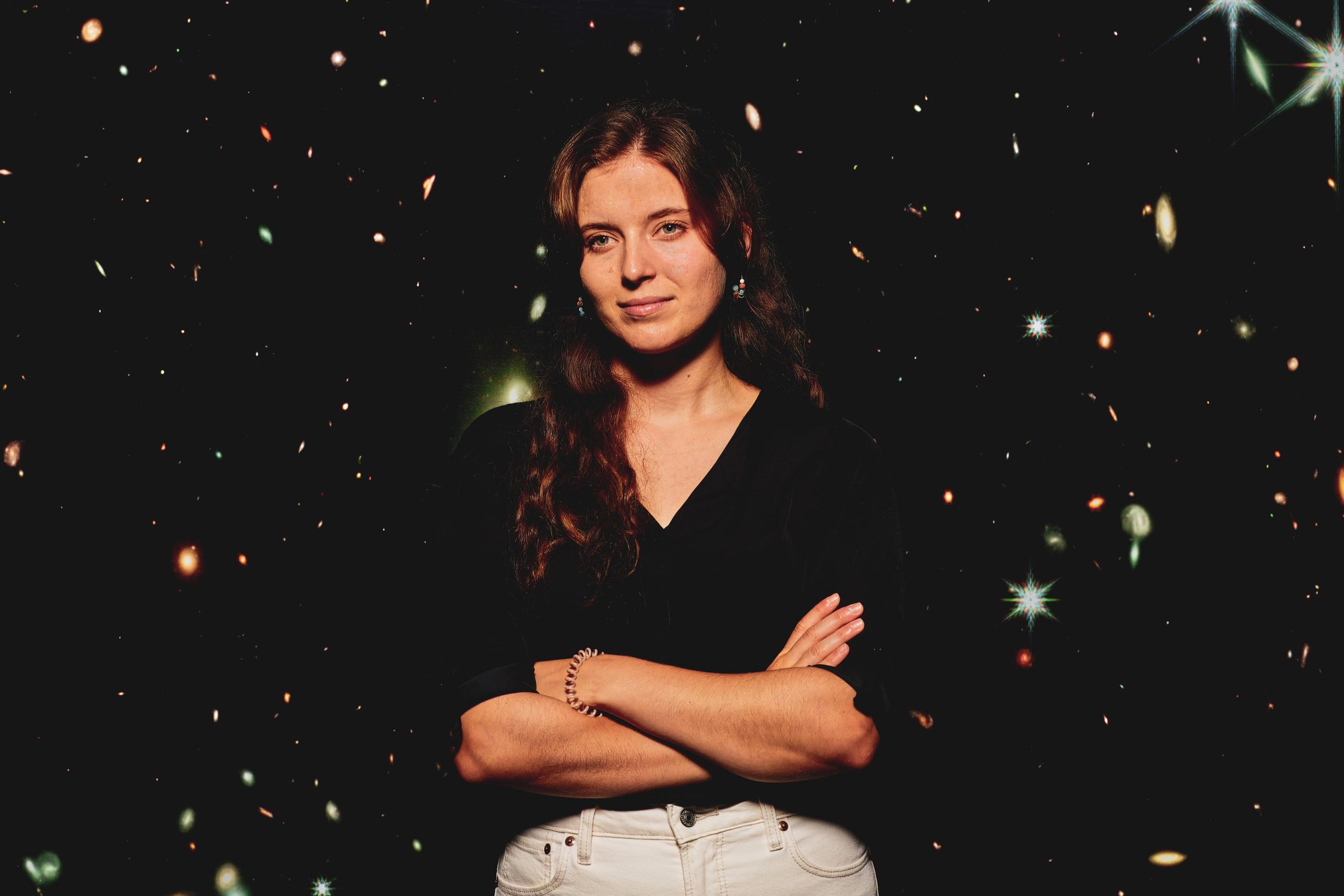
Watching crowds of people hustle along Massachusetts Avenue from her window seat in MIT’s student center, Dominika Ďurovčíková has just one wish.
“What I would really like to do is convince a city to shut down their lights completely, apart from hospitals or whatever else needs them, just for an hour,” she says. “Let people see the Milky Way, or the stars. It influences you. You realize there’s something more than your everyday struggles.”
The Journey Through Astrophysics
Even with a lifetime of gazing into the cosmos under her belt — with the last few years spent pursuing a PhD with professors Anna-Christina Eilers and Robert Simcoe at MIT’s Kavli Institute for Astrophysics and Space Research — she still believes in the power of looking up at the night sky with the naked eye.
Most of the time, however, she’s using tools a lot more powerful than that. The James Webb Space Telescope has begun providing rich data from bodies at the very edge of the universe, exactly where she wants to be looking. With data from the JSWT and the ground-based Magellan telescopes in Chile, Ďurovčíková is on the hunt for distant quasars — ancient, supermassive black holes that emit intense amounts of light — and the farther away they are, the more information they provide about the very early universe.
Unlocking Cosmic Secrets
“These objects are really, really bright, and that means that they’re really useful for studying the universe from very far away,” she says. “They’re like beacons from the past that you can still see, and they can tell you something about the universe at that stage. It’s almost like archaeology.”
Her recent research has focused on what’s known as the Epoch of Reionization. It’s the period of time when the radiation from quasars, stars, galaxies, and other light-emitting bodies were able to penetrate through the dark clouds of hydrogen atoms left over from the Big Bang, and shine their light through space.

“Reionization was a phase transition where all the stuff around galaxies suddenly became transparent,” she says. “Finally, we could see light that was otherwise absorbed by neutral hydrogen.”
One of her goals is to help discover what caused the reionization process to start in the first place. While the astrophysical community has determined a loose time frame, there are many unanswered questions surrounding the Epoch of Reionization, and she hopes her quasar research can help solve some of them.
“The grand hope is that if you know the timing of reionization, that can inform you about the sources that caused it in the first place,” she says. “We’re not quite there, but looking at quasars could be a way to do it.”
Exploring High-Redshift Quasars
The quasars that Ďurovčíková has been most interested in are classified as “high-redshift.” Redshift is a measure of how much a wave’s frequency has decreased, and in an astrophysical context, it can be used to determine how long a wave of light has been traveling and how far away its source is, while accounting for the expansion of the universe.
“The higher the redshift, the closer to the beginning of the universe you get,” Ďurovčíková explains.
Research has shown that reionization began roughly 150 million years after the Big Bang, and approximately 850 million years after that, the dark hydrogen clouds that made up the “intergalactic medium,” or IGM, were fully ionized.
For her most recent paper, Ďurovčíková examined a set of 18 quasars whose light began traveling between approximately 770 million and 950 million years after the Big Bang. She and her collaborators, including scientists from four different countries, sorted the quasars into three “bins” based on distance, to compare the amount of neutral hydrogen in the IGM at different epochs. These amounts helped refine the timing of reionization and confirmed that data from quasars are consistent with data from other types of bodies.
“The story we have so far,” Ďurovčíková says, “is that at some point by redshift 5 or 6, the stuff in between galaxies was overall ionized. However, it’s not clear what type of star or what type of galaxy is more responsible for this global phase transition, which affected the whole universe.”
The Impact of Ancient Black Holes
A closely related facet of her research — and one she’s planning on exploring further as she composes her thesis — is on how these quasars came to be in the first place. They’re so old, and so massive, that they challenge the current conceptions of how old the universe is. The light they generate comes from the immense gravitational force they exert on the plasma they absorb, and if they were already large enough to do that billions of years ago, just how long ago did they start forming?
“These black holes seem to be too massive to be grown in the time that their spectra seem to indicate,” she says. “Is there something in our way that’s obscuring the rest of the growth? We’re looking at different methods to measure their lifetime.”
Eyes Toward the Stars, Feet Grounded on Earth
In the meantime, Ďurovčíková is also working to encourage the next generation of astrophysicists. She says she was fortunate to have encouraging parents and mentors who showed her academic and career paths she hadn’t even considered, and she co-founded a nonprofit organization called Encouraging Women Across All Borders to do the same for students across the globe.
“In your life, you will see a lot of doors,” she says. “There’s doors that you’ll see are open, and there’s doors you’ll see are closed. The biggest tragedy, though, is that there are so many doors that you don’t even know exist.”
She knows the feeling all too well. Growing up in Slovakia meant the primary options were attending university in either Bratislava, the capital, or Prague, in the neighboring Czech Republic. Her love of math and physics inspired her to enroll in the International Baccalaureate program, however, and it was in that program that she met a teacher, named Eva Žitná, who “planted the seeds” that eventually sent her to Oxford for a four-year master’s program.
“Just being in the IB program environment started to open up these possibilities I had not considered before,” she says. “Both my parents and I started talking to Žitná about how this could be an interesting possibility, and somehow one thing led to another.”
While she takes great pleasure in guiding students along the same path she once took, equally as rewarding for her are the moments when she can see people realizing just how big the universe is. As a co-director of the MIT Astrogazers, she has witnessed many such moments. She remembers handing out eclipse glasses at the Cambridge Science Festival in preparation for last October’s partial solar eclipse, and recalls kids and adults alike with their necks craned upward, sharing the same look of wonder on their faces.
“The reason I care is because we all get caught up in small things in life very easily,” she says. “The traffic sucks. The T isn’t working. Then, you look up at the sky and you realize there’s something much more beautiful and much bigger than all these little things.”
Never miss a breakthrough: Join the SciTechDaily newsletter.
Follow us on Google and Google News.
6 Comments
In my model of the universe, in accordance with the theory of a “big bang,” gravity is characterized with externally induced to radiate pulsing angular lines of attractive force (similar to an electromagnet) which can affect individual photons, creating roughly spherical fields of lessening density and strength of gravity lines of force in accordance with the inverse square law of attraction. Therefore, as photons are emitted by their sources they accelerate on widening lines of gravity force (red shift) and decelerate on narrowing lines of gravity force as they arrive to earth (blue shift). Again, as previously commented here and there, both the age and size of the universe still need to be determined, along with the nature of the force that induces gravity to radiate from all objects in the first place. Again, too, it was the pulsing nature of angular lines of attractive force that made particles appear to be waves in the classic double-slit experiments, and the rotation of objects intensifying their fields of gravity that can account for theoretical dark matter.
Correction: Oops! In some haste in my externally imposed state of diminished wellness (physical and mental) I inadvertently reversed the labels of red shift and blue shift. Of course, it is the red shift of light arriving to earth that gives the false impression of an increasingly rapidly expanding universe; why the age and size of the universe still need to be determined. I apologize for that but it doesn’t change my model of radiant pulsing lines of gravity force forming a roughly spherical field that diminishes in density and strength in accordance with the inverse square law of attraction.
I really like her thoughts of gazing at the stars in a darkened sky away from the night lights of the cities I have had the privilege of doing the same star gazing in the wilderness, that is diminishing . The wonder is astonishing to view our galaxy from that point of view several times in my life , what is still bothering me is the perspective science gets of the size of the universe from our vantage point. The thought I experience with all the data we have on hand that quasars are the first photon emitting source of light that is red shift , the quasars are there and we are here we are traveling with the expansion of the universe and quasars are traveling also , the quasars photons should have been developing long after our galaxies position today , the photon would need to be created long after our galaxy has reached its position today for us to view them traveling to us. The Bing Bag is always portrayed as a spark, what if it wasn’t a spark light emitting source and what if time travels faster or before the speed of light from the center of the universe would the center be the darkest dark and formed from a singularity at the quantum scale then reionization took place for the advent of the quasar for photon emitting that we see in the redshift of light today.
An alternative to the Big Bang theory has the Universe existing as infinitely large from the beginning, and what we perceive as as the Big Bang is actually a beyond three dimensional singularity interacting with it at extremely high velocity. Evidence of this sort of activity jump-starting star development is seen with the ‘runaway Black Hole’ vD23. Like the earliest galaxies, vD23 shows evidence of episodic, or ‘bursty’ star development in its wake. The further from the singularity, the less intense and frequent the development. Also, the closer to the singularity, the faster the velocity of the stars compared to those further away, drawing the stars apart at an ever-increasing rate.
The gravity waves from this beyond three dimensional singularity would affect our Universe concurrently, without requiring faster than light speed to function, leading to a possible answer for the cause of Quantum entanglement.
Thoughts?
Despite my own thinking on a preexisting universal ‘space,’ everything in motion and spinning suggests ‘explosion’ within that space to me. My personal model of ‘gravity’ virtually eliminates the possibilities of quantum mechanics, the accelerating expansion of the universe and gravity waves. Nice to find that another can reasonably question outdated establishment dogma.
Thank you.