
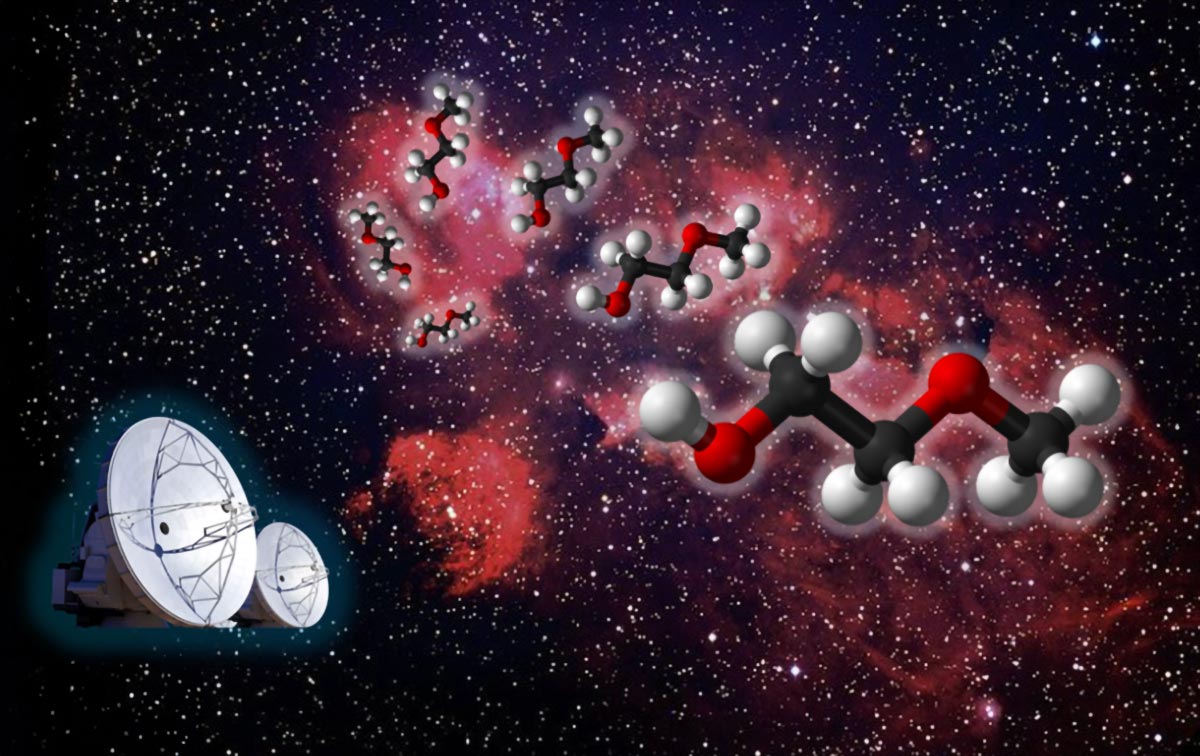
MIT’s discovery of 2-methoxyethanol in space reveals new insights into the development of molecular complexity in space during star formation.
New research from the group of MIT Professor Brett McGuire has revealed the presence of a previously unknown molecule in space. The team’s open-access paper, “Rotational Spectrum and First Interstellar Detection of 2-Methoxyethanol Using ALMA Observations of NGC 6334I,” was published in The Astrophysical Journal Letters.
Zachary T.P. Fried, a graduate student in the McGuire group and the lead author of the publication, worked to assemble a puzzle comprised of pieces collected from across the globe, extending beyond MIT to France, Florida, Virginia, and Copenhagen, to achieve this exciting discovery.
Understanding Space Molecules
“Our group tries to understand what molecules are present in regions of space where stars and solar systems will eventually take shape,” explains Fried. “This allows us to piece together how chemistry evolves alongside the process of star and planet formation. We do this by looking at the rotational spectra of molecules, the unique patterns of light they give off as they tumble end-over-end in space. These patterns are fingerprints (barcodes) for molecules. To detect new molecules in space, we first must have an idea of what molecule we want to look for, then we can record its spectrum in the lab here on Earth, and then finally we look for that spectrum in space using telescopes.”
Searching for Molecules in Space With Machine Learning
The McGuire Group has recently begun to utilize machine learning to suggest good target molecules to search for. In 2023, one of these machine learning models suggested the researchers target a molecule known as 2-methoxyethanol.
“There are a number of ‘methoxy’ molecules in space, like dimethyl ether, methoxymethanol, ethyl methyl ether, and methyl formate, but 2-methoxyethanol would be the largest and most complex ever seen,” says Fried. To detect this molecule using radiotelescope observations, the group first needed to measure and analyze its rotational spectrum on Earth. The researchers combined experiments from the University of Lille (Lille, France), the New College of Florida (Sarasota, Florida), and the McGuire lab at MIT to measure this spectrum over a broadband region of frequencies ranging from the microwave to sub-millimeter wave regimes (approximately 8 to 500 gigahertz).
The data gleaned from these measurements permitted a search for the molecule using Atacama Large Millimeter/submillimeter Array (ALMA) observations toward two separate star-forming regions: NGC 6334I and IRAS 16293-2422B. Members of the McGuire group analyzed these telescope observations alongside researchers at the National Radio Astronomy Observatory (Charlottesville, Virginia) and the University of Copenhagen, Denmark.
Advanced Discoveries and Future Prospects
“Ultimately, we observed 25 rotational lines of 2-methoxyethanol that lined up with the molecular signal observed toward NGC 6334I (the barcode matched!), thus resulting in a secure detection of 2-methoxyethanol in this source,” says Fried. “This allowed us to then derive physical parameters of the molecule toward NGC 6334I, such as its abundance and excitation temperature. It also enabled an investigation of the possible chemical formation pathways from known interstellar precursors.”
Molecular discoveries like this one help the researchers to better understand the development of molecular complexity in space during the star formation process. 2-methoxyethanol, which contains 13 atoms, is quite large for interstellar standards — as of 2021, only six species larger than 13 atoms were detected outside the solar system, many by McGuire’s group, and all of them existing as ringed structures.
“Continued observations of large molecules and subsequent derivations of their abundances allows us to advance our knowledge of how efficiently large molecules can form and by which specific reactions they may be produced,” says Fried. “Additionally, since we detected this molecule in NGC 6334I but not in IRAS 16293-2422B, we were presented with a unique opportunity to look into how the differing physical conditions of these two sources may be affecting the chemistry that can occur.”
Reference: “Rotational Spectrum and First Interstellar Detection of 2-methoxyethanol Using ALMA Observations of NGC 6334I” by Zachary T. P. Fried, Samer J. El-Abd, Brian M. Hays, Gabi Wenzel, Alex N. Byrne, Laurent Margulès, Roman A. Motiyenko, Steven T. Shipman, Maria P. Horne, Jes K. Jørgensen, Crystal L. Brogan, Todd R. Hunter, Anthony J. Remijan, Andrew Lipnicky, Ryan A. Loomis and Brett A. McGuire, 12 April 2024, The Astrophysical Journal Letters.
DOI: 10.3847/2041-8213/ad37ff
Never miss a breakthrough: Join the SciTechDaily newsletter.
Follow us on Google and Google News.