
Close Menu
    Facebook X (Twitter) Instagram
    SciTechDaily
    • Biology
    • Chemistry
    • Earth
    • Health
    • Physics
    • Science
    • Space
    • Technology
    Facebook X (Twitter) Pinterest YouTube RSS
    SciTechDaily
    Home»Science»Discovery of a Bizarre, Winged “Eagle Shark” in the Cretaceous Seas
    Science

    Discovery of a Bizarre, Winged “Eagle Shark” in the Cretaceous Seas

    By CNRSMarch 18, 20212 Comments2 Mins Read
    Facebook Twitter Pinterest Telegram LinkedIn WhatsApp Email Reddit
    Share
    Facebook Twitter LinkedIn Pinterest Telegram Email Reddit
    Eagle Shark
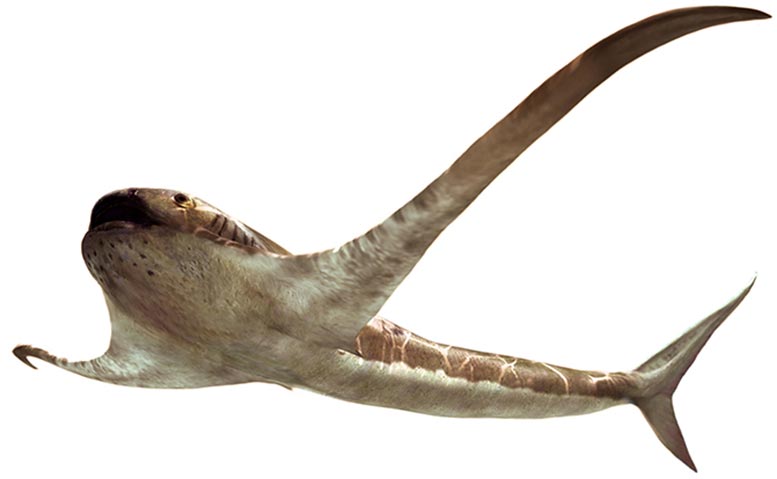
    Artist’s impression showing one eagle shark. Credit: © Oscar Sanisidro

    Scientists discovered a winged, plankton-eating “eagle shark” from 93 million years ago, revealing new insights into shark evolution.

    93 million years ago, bizarre, winged sharks swam in the waters of the Gulf of Mexico. This newly described fossil species, called Aquilolamna milarcae, has allowed its discoverers to erect a new family. Like manta rays, these ‘eagle sharks’ are characterized by extremely long and thin pectoral fins reminiscent of wings. The specimen studied was 1.65 meters long and had a span of 1.90 meters.

    Aquilolamna milarcae had a caudal fin with a well-developed superior lobe, typical of most pelagic sharks, such as whale sharks and tiger sharks. Thus, its anatomical features thus give it a chimeric appearance that combines both sharks and rays.

    With its large mouth and supposed very small teeth, it must have fed on plankton, according to the international research team led by Romain Vullo of the CNRS.
    Fossil of the Aquilolamna Milarcae Shark
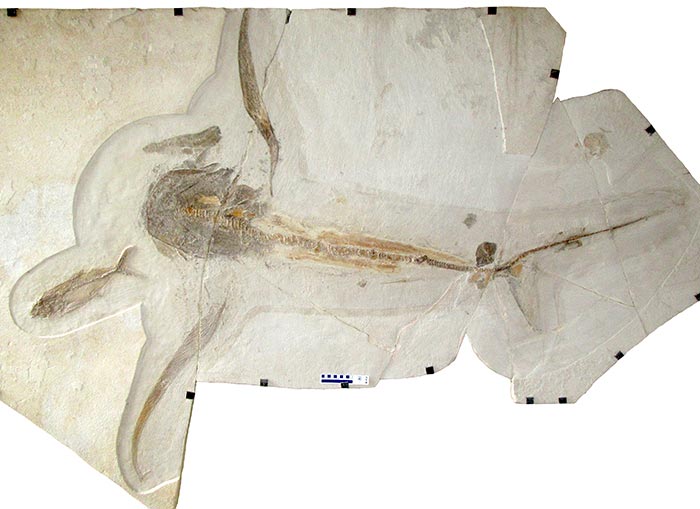
    Fossil of the Aquilolamna milarcae shark found in the limestone of Vallecillo (Mexico). Credit: © Wolfgang Stinnesbeck

    Scientists have identified only one category of large plankton feeders in Cretaceous seasuntil now: a group of large bony fish (pachycormidae), which is now extinct. Thanks to this discovery, they now know that a second group, the eagle sharks, was also present in the Cretaceous oceans.

    The complete specimen was found in 2012 in Vallecillo (Mexico), a locality yielding remarkably preserved fossils. This site, already famous for its many fossils of ammonites, bony fish, and other marine reptiles, is most useful for documenting the evolution of oceanic animals.

    As well as shedding light on the structure of Cretaceous marine ecosystems, the discovery of eagle sharks reveals a new, hitherto unsuspected, facet of sharks’ evolutionary history.

    Reference: “Manta-like planktivorous sharks in Late Cretaceous oceans” by Romain Vullo, Eberhard Frey, Christina Ifrim, Margarito A. González González, Eva S. Stinnesbeck and Wolfgang Stinnesbeck, 18 March 2021, Science.
    DOI: 10.1126/science.abc1490

    Never miss a breakthrough: Join the SciTechDaily newsletter.
    Follow us on Google and Google News.

    CNRS Paleontology Popular Sharks
    Share. Facebook Twitter Pinterest LinkedIn Email Reddit

    Related Articles

    Teenager’s Fossil Find Leads to Discovery of Shark Teeth in 5 Million-Year-Old Whale Skull

    Bigger Than We Thought? Scientists Reveal New Megalodon Size Estimates

    Ancient Predator Unearthed: New Species of 65 Million-Year-Old Fossil Shark Discovered in Alabama

    The Megalodon Makeover: How Science Just Flipped the Script on the Ancient Shark

    Megalodon Was No Cold-Blooded Killer – And That Spelled Its Doom

    New Species of Ancient Shark Discovered

    Pioneering Research Reveals How Teeth Functioned and Evolved in Giant Mega-Sharks

    Body Size of Extinct Gigantic Megatooth Shark – Otodus Megalodon – Indeed off the Charts in the Shark World

    Finally Revealed: Gargantuan True Size of Legendary Prehistoric Mega-Shark Megalodon

    2 Comments

    1. xABBAAA on March 19, 2021 1:28 am

      …how bizarre, I guess it is just the way evolution works… It is our expectation that is short sighted…

      Reply
    2. blake on June 3, 2024 8:14 am

      this is cool

      Reply
    Leave A Reply Cancel Reply

    • Facebook
    • Twitter
    • Pinterest
    • YouTube

    Don't Miss a Discovery

    Subscribe for the Latest in Science & Tech!

    Trending News

    Scientists Discover Bizarre 100-Million-Year-Old Insect With Giant Claws

    Scientists Discover “Good” Gut Microbes That Could Protect Against Autism and ADHD

    Scientists Reveal That Eating Almonds Every Day Could Transform Your Gut, Metabolism, and Appetite

    Scientists May Have Solved Two of Fusion Energy’s Biggest Problems at Once

    Scientists Discover Hidden “Switch” That Burns Fat and Could Treat Bone Disease

    After 50 Years of Mystery, Researchers Identify New Human Blood Group

    Beyond Pain Relief: Scientists Discover a Protein That Could Stop Osteoarthritis in Its Tracks

    Scientists Discover Why Alcohol Prevents the Liver From Healing, Even After You Quit

    Follow SciTechDaily
    • Facebook
    • Twitter
    • YouTube
    • Pinterest
    • Newsletter
    • RSS
    SciTech News
    • Biology News
    • Chemistry News
    • Earth News
    • Health News
    • Physics News
    • Science News
    • Space News
    • Technology News
    Recent Posts
    • Scientists Discover “Immature” Brain Cells That May Defy Alzheimer’s
    • Children of Centenarians Share One Surprising Habit That May Boost Longevity
    • Scientists Discover Cheap, Natural Remedy for High Blood Pressure
    • Archaeologists Discover Prehistoric Mountain Cave Packed With Mysterious Green Mineral
    • This Common Houseplant Is Secretly Using Advanced Geometry
    Copyright © 1998 - 2026 SciTechDaily. All Rights Reserved.
    • Science News
    • About
    • Contact
    • Editorial Board
    • Privacy Policy
    • Terms of Use

    Type above and press Enter to search. Press Esc to cancel.