
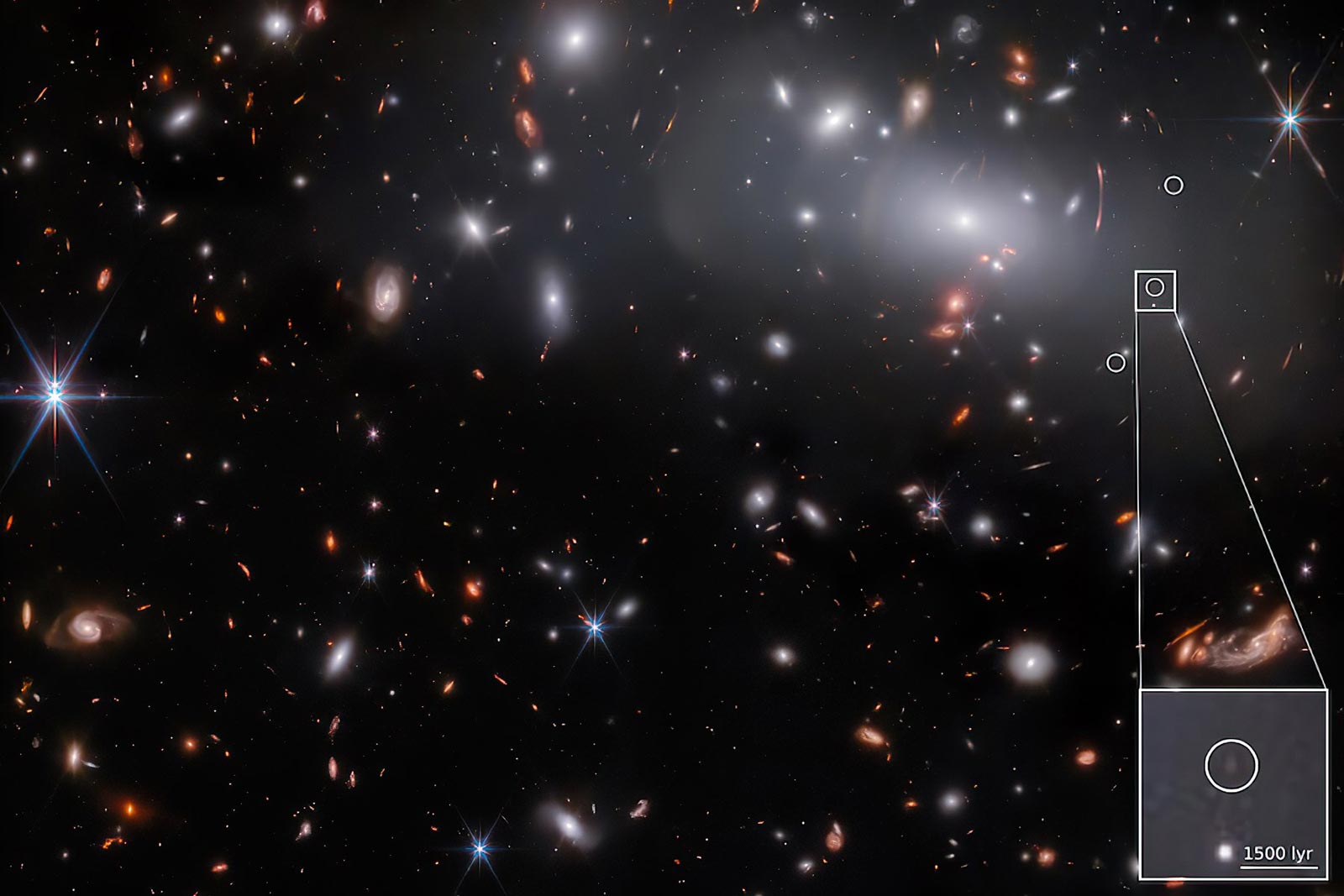
The James Webb Space Telescope has observed a gravitationally lensed galaxy from 510 million years after the Big Bang, revealing insights into the early Universe’s reionization process and the characteristics of the earliest galaxies.
New James Webb Space Telescope (JWST) imaging and spectroscopy observations have revealed a gravitationally lensed galaxy, with strong nebular emission lines, at redshift 9.5 – corresponding to 510 million years after the Big Bang.
Though little is known about galaxies at such early times, emission lines in the spectrum of this distant galaxy allowed the study’s authors to determine some of its physical properties. It is thought that the Universe was once opaque, dominated by dense neutral hydrogen filling intergalactic space.
Light from the earliest galaxies gradually reionized the majority of the gas in the intergalactic medium, transforming the Universe and making it transparent. However, the precise timeline of reionization and the relative contributions of the Universe’s earliest galaxies to this process remain uncertain.
Hayley Williams and colleagues report near-infrared imaging and spectroscopy observations, from JWST, of a distant galaxy magnified by gravitational lensing. The observed galaxy is located at redshift 9.5, corresponding to about 510 million years after the Big Bang and before reionization was complete. The high magnification provided by gravitational lensing enabled the authors to detect the intrinsically faint galaxy and to obtain spectral information with strong nebular emission lines that reveal some of the galaxy’s physical properties.
According to Williams et al., the findings show that the galaxy has a radius of 16.2 parsecs and is much more compact than other galaxies with equivalent luminosity, suggesting a high density of star formation. What’s more, spectrographic analysis shows that the galaxy has an abundance of oxygen and hydrogen.
Reference: “A magnified compact galaxy at redshift 9.51 with strong nebular emission lines” by Hayley Williams, Patrick L. Kelly, Wenlei Chen, Gabriel Brammer, Adi Zitrin, Tommaso Treu, Claudia Scarlata, Anton M. Koekemoer, Masamune Oguri, Yu-Heng Lin, Jose M. Diego, Mario Nonino, Jens Hjorth, Danial Langeroodi, Tom Broadhurst, Noah Rogers, Ismael Perez-Fournon, Ryan J. Foley, Saurabh Jha, Alexei V. Filippenko, Lou Strolger, Justin Pierel, Frederick Poidevin and Lilan Yang, 13 April 2023, Science.
DOI: 10.1126/science.adf5307
The research was supported by the National Science Foundation and NASA through the Space Telescope Science Institute, with additional funding from the United States-Israel Binational Science Foundation and the Spanish State Research Agency.
Never miss a breakthrough: Join the SciTechDaily newsletter.
Follow us on Google and Google News.
3 Comments
Redshift is likely WRONG. See the alternate theory on “light dimming” due to things like dust and other material between us and distant objects. Back then, it was thought that space was nearly completely empty and Redshift was based on that assumption. The problem is we know now that space is not even close to empty, throwing the very basis of that assumption into question. Yet most scientists aren’t even questioning it one tiny bit. They’re so full of their own egos that they MUST BE RIGHT and in so doing are not seeing the forest for the trees.
Everything from Dark Matter to Dark Energy to the Big Bang itself (which never happened as they describe it) is BASED on REDSHIFT ASSUMPTIONS. Think about that. It’s like basing a house on an assumption of solid granite underneath only to discover, it’s actually compacted sand! Nope, we’re going to PRETEND it’s granite and anyone who says it’s not granite despite all the new evidence will be ostracized, fired or their speech “canceled”. It’s ridiculous.
How can an observed property be “wrong”!? I think you mean that general relativistic cosmology, which is the only remaining and accepted physics after many tests, doesn’t suit your personal opinion.
Besides that you indulge in unsubstantiated conspiracy theory – on a science site no less – the infamous “tired light” model was known to be wrong a century ago by the cosmologist originator but offered as an illustration of the early problems with cosmological redshift. Note that it fails to fit observations from the get go [Wikipedia on “tired light”]:
“Tired light is a class of hypothetical redshift mechanisms that was proposed as an alternative explanation for the redshift-distance relationship. These models have been proposed as alternatives to the models that require metric expansion of space of which the Big Bang and the Steady State cosmologies are the most famous examples. The concept was first proposed in 1929 by Fritz Zwicky, who suggested that if photons lost energy over time through collisions with other particles in a regular way, the more distant objects would appear redder than more nearby ones. Zwicky himself acknowledged that any sort of scattering of light would blur the images of distant objects more than what is seen. Additionally, the surface brightness of galaxies evolving with time, time dilation of cosmological sources, and a thermal spectrum of the cosmic microwave background have been observed—these effects should not be present if the cosmological redshift was due to any tired light scattering mechanism.”
Good to see that gravitational lensing helps so soon! The earliest galaxies seems to be earlier than expected and even Webb is a bit stretched to cope with this important cosmological era.
The radius estimate of the early galaxy candidate is ~ 30 pc. Comparing roughly the same measures, the half-light radius of galaxy clusters [GCs] distributes closer to less than 10 pc but tails off at 25 pc [Wikipedia]. An old hypothesis is that GCs are remnants from early galaxy formation, and it is a likely prior that this first find is biased large despite the random lensing factor. In any case it is still a feasible candidate for supporting the hypothesis.