

People taking cholesterol-lowering drugs may fare better than others if they catch the novel coronavirus. A new study hints at why: the virus relies on the fatty molecule to get past the cell’s protective membrane.
To cause COVID-19, the SARS-CoV-2 virus must force its way into people’s cells – and it needs an accomplice. Cholesterol, the waxy compound better known for clogging arteries, helps the virus open cells up and slip inside, Howard Hughes Medical Institute Investigator Clifford Brangwynne’s lab reports.
Without cholesterol, the virus cannot sneak past a cell’s protective barrier and cause infection, the team writes in a preprint posted to bioRxiv. The work, which recreated the early stage of infection in lab-grown cells, has not yet undergone the scientific vetting process of peer review.
“Cholesterol is an integral part of the membranes that surround cells and some viruses, including SARS-CoV-2. It makes sense that it should be so important for infection,” says Brangwynne, a biophysical engineer at Princeton University.
The finding might underlie the better health outcomes seen in COVID-19 patients taking cholesterol-lowering drugs known as statins, he adds. Although scientists haven’t yet established the mechanism responsible, this study and another published last fall suggest the drugs prevent SARS-CoV-2 from getting into cells by denying it cholesterol.
This discovery of cholesterol’s importance could help scientists develop new stopgap measures to treat COVID-19 until most people are vaccinated, Brangwynne says. The work may also shed light on a strange feature of the disease: the formation of giant, compound cells found in the lungs of COVID-19 patients. In their experiments, the scientists saw similar mega cells emerge under the microscope.
Mimicking a Viral Infection
In normal times, Brangwynne’s team studies the physical forces that organize molecules within cells. But in the spring of 2020, his lab, like many others across the world, shifted focus, training their biological expertise on SARS-CoV-2. They began investigating how viral and human proteins interact, and how that interaction lets SARS-CoV-2 enter cells. “We’re not a virology lab, we’ve never worked in this space before, so we started thinking about the tools and approaches we have developed that we could use,” he says.
Brangwynne’s lab often works with lab-grown cells. To mimic SARS-CoV-2 infection, his team engineered such cells to sport one of two molecules, either the viral “spike protein” or the human ACE2 protein. (To cause an infection, the virus must fuse its membrane to a cell’s membrane. This process begins when spike proteins meet their cellular target, ACE2.)
In the lab, the researchers watched as lab-grown cells with these proteins interacted. First, tiny tentacles emerged from cells with ACE2 and stuck to spike proteins on nearby cells. At these points, the two cellular membranes fused and openings formed, letting the cells’ contents mix. Eventually, the two cells melded together – similar to how scientists expect the virus merges with a cell to infect it.
The researchers, including Princeton’s David Sanders, Chanelle Jumper, and Paul Ackerman, tried to disrupt this cell melding. Using an automated system, they tested the effects of about 6,000 compounds, as well as more than 30 tweaks to the spike protein. These experiments and others suggested that if SARS-CoV-2’s membrane lacks cholesterol, the virus cannot enter its target cell.
This isn’t the first evidence implicating cholesterol. The previous study, by a group at the University of California, San Diego, found that the body’s immune response to the virus produces a compound that depletes cholesterol – but in this case from the cell’s own membrane, not the virus’s.
“Cholesterol has been very well studied as an important factor in a large number of viral infections,” says Peter Kasson, a scientist at the University of Virginia who studies the physical mechanisms of viral disease. “The interesting thing is that cholesterol’s role in viral entry varies a lot between viruses.” It’s not clear exactly how cholesterol aids SARS-CoV-2, but understanding that process could offer clues about the biology of infection, says Kasson, who was not involved in the research.
The apparent beneficial effect of statins extends to other viral infections, too. Some research suggests that these drugs impair the influenza virus by depriving it of cholesterol, Kasson says. But that may not be the only way the drugs can alter the course of viral infections, he says. “It’s a little complicated because statins also modify the immune response.”
Mysterious Mega Cells
As Brangwynne’s experiments ran, his team noticed something strange. The cells continued to engulf one another, spilling their contents together like eggs cracked into a bowl. The compound cells, known as syncytia, that appeared under the microscope resemble those found in healthy tissues, such as muscle and the placenta, and in some viral diseases.
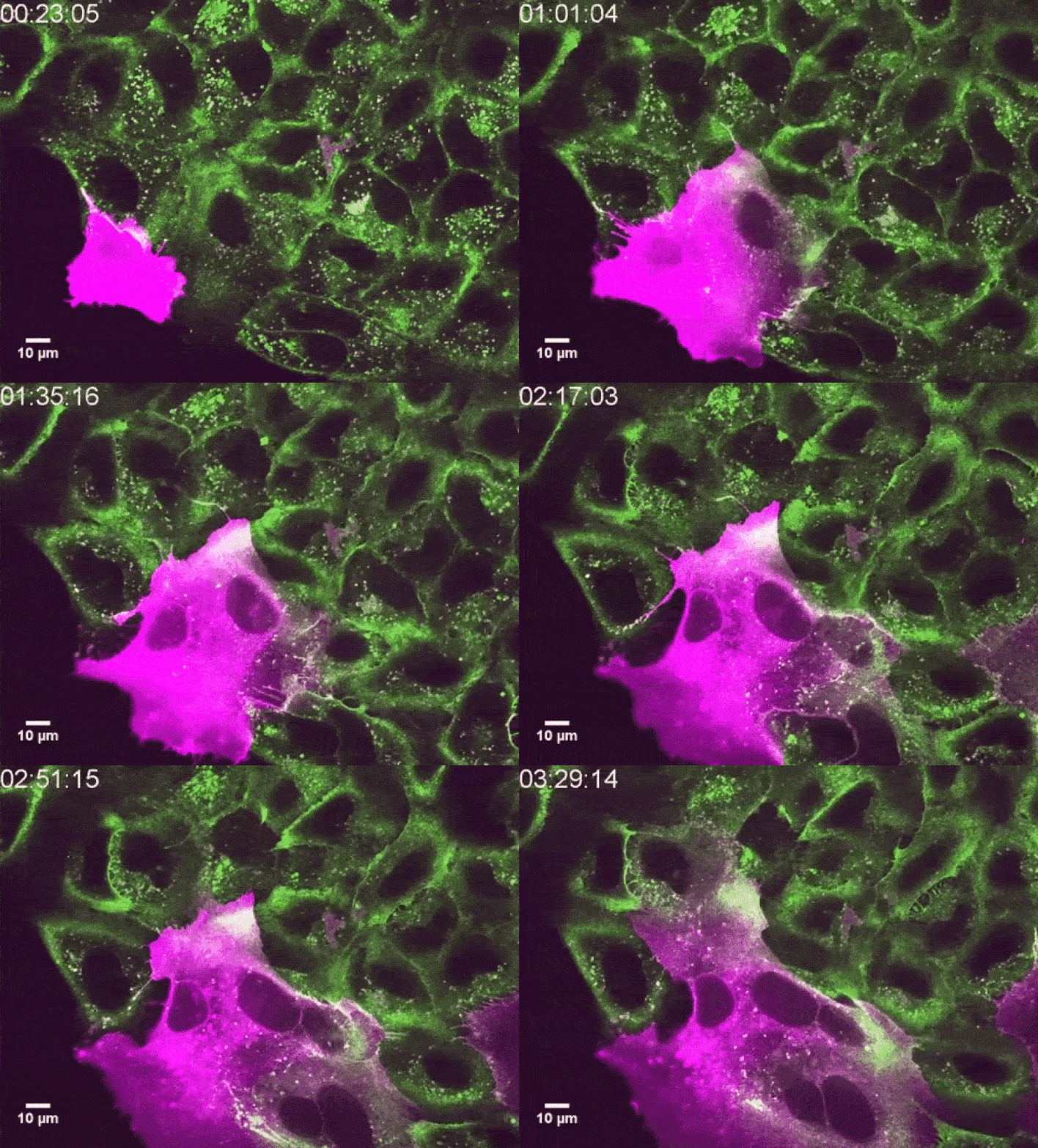
“People already knew that the COVID-19 virus will create syncytia, but the researchers were able to visualize the process beautifully,” says Jennifer Lippincott-Schwartz, a senior group leader at HHMI’s Janelia Research Campus, who was not involved in the research. “Cell-cell fusion is itself a really under-studied area in biology.”
The experiments likely illustrate how mega cells found in patients’ lungs form, she says. “The formation of syncytia can be very injurious in the case of COVID, where it can destroy lung tissues and lead to death.”
Brangwynne says it’s not clear yet whether or not syncytia play a major role in the progression of COVID-19. But, his team writes, the discovery of cholesterol’s contribution could help scientists fight the disease. “Our findings underscore the potential utility of statins and other [similar] treatments.”
Reference: “SARS-CoV-2 Requires Cholesterol for Viral Entry and Pathological Syncytia Formation” by David W. Sanders, Chanelle C. Jumper, Paul J. Ackerman, Dan Bracha, Anita Donlic, Hahn Kim, Devin Kenney, Ivan Castello-Serrano, Saori Suzuki, Tomokazu Tamura, Alexander H. Tavares, Mohsan Saeed, Alex S. Holehouse, Alexander Ploss, Ilya Levental, Florian Douam, Robert F. Padera, Bruce D. Levy and Clifford P. Brangwynne, 14 December 2020, BioRxiv.
DOI: 10.1101/2020.12.14.422737
Never miss a breakthrough: Join the SciTechDaily newsletter.
Follow us on Google and Google News.
2 Comments
That is not good news for people like me, who cannot tolerate statins. My doctor tried me on several and they all caused serious enough bad reactions that I cannot take them ever again. I am waiting to hear from the lipid clinic at my local hospital to see if I am eligible to take a new anti-cholesterol drug that is not a statin. Many people cannot take statins.
I used to take long acting Niacin and it did reduce cholesterol. It can cause a hot rash but you can take a small dose of aspirin and quickly solve that. It is harder to take, I prefer rosuvastatin and have never had a bad reaction to statins in 35 years taking them.