
Close Menu
    Facebook X (Twitter) Instagram
    SciTechDaily
    • Biology
    • Chemistry
    • Earth
    • Health
    • Physics
    • Science
    • Space
    • Technology
    Facebook X (Twitter) Pinterest YouTube RSS
    SciTechDaily
    Home»Space»Hubble Image of the Week – Cosmic Snake with Stars
    Space

    Hubble Image of the Week – Cosmic Snake with Stars

    By SciTechDailyNovember 20, 2017No Comments2 Mins Read
    Facebook Twitter Pinterest Telegram LinkedIn WhatsApp Email Reddit
    Share
    Facebook Twitter LinkedIn Pinterest Telegram Email Reddit
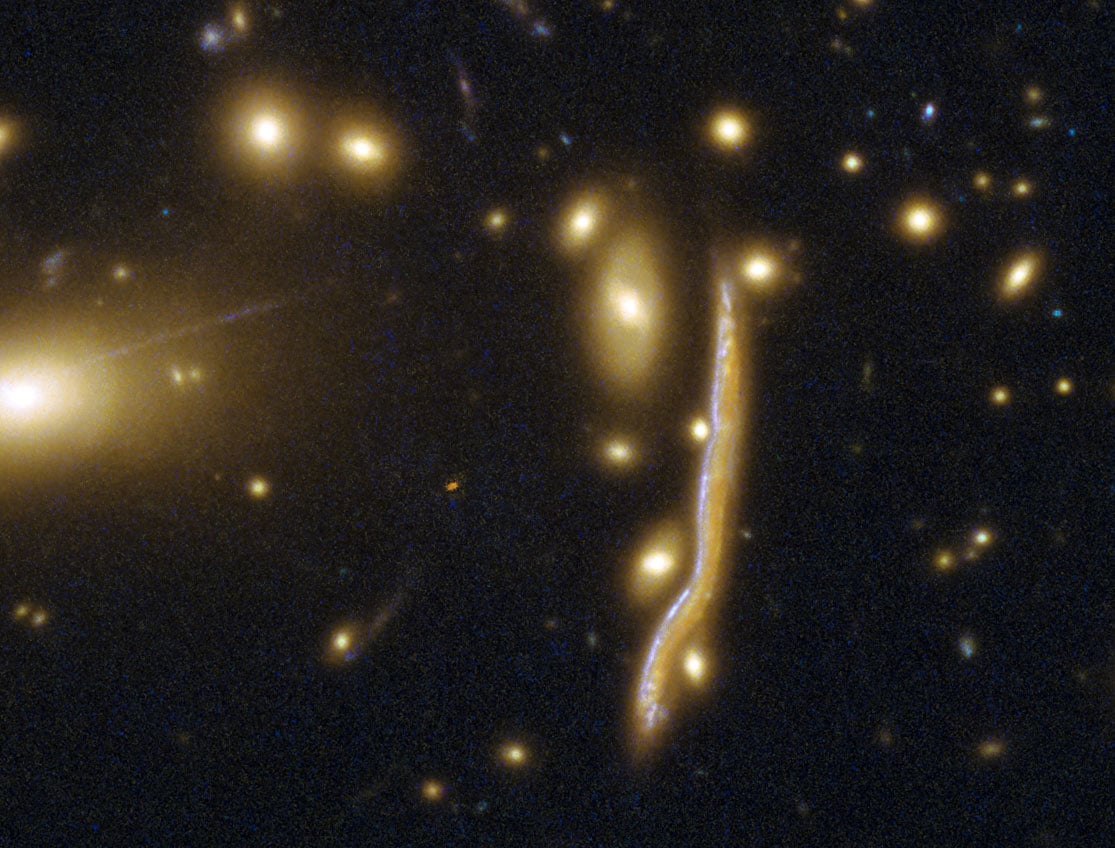
    Hubble Image of the Comic Snake
    Hubble image shows Cosmic Snake galaxy with star-forming clumps, distorted by gravitational lensing. It’s behind MACSJ1206.2-0847 cluster, but visible due to the cluster’s gravity. Credit: ESA/Hubble, NASA

    This Hubble image reveals the Cosmic Snake, a distant galaxy peppered with clumpy regions of intense star formation that appear warped by the effect of gravitational lensing. This giant arc-like galaxy is actually behind the huge galaxy cluster MACSJ1206.2-0847, but thanks to the cluster’s gravity, we can see it from Earth.

    Light from the distant, high-redshift galaxy arrives at Earth, having been distorted by the gigantic gravitational influence of the intervening cluster. Fascinatingly, instead of making it more difficult to perceive cosmological objects, such strong lensing effects improve the resolution and depth of an image by magnifying the background object. Sometimes gravitational lensing can even produce multiple images of the object as light is bent in different directions around the foreground cluster.

    Using Hubble, astronomers recently looked at several such images of the Cosmic Snake, each with a different level of magnification. Using this technique, the galaxy, and its features could be studied on different scales. The highest-resolution images revealed that giant clumps in high-redshift galaxies are made up of a complex substructure of smaller clumps, which contributes to our understanding of star formation in distant galaxies.

    Reference: “The nature of giant clumps in distant galaxies probed by the anatomy of the cosmic snake” by Antonio Cava, Daniel Schaerer, Johan Richard, Pablo G. Pérez-González, Miroslava Dessauges-Zavadsky, Lucio Mayer and Valentina Tamburello, 13 November 2017, Nature Astronomy.
    DOI: 10.1038/s41550-017-0295-x


    Never miss a breakthrough: Join the SciTechDaily newsletter.
    Follow us on Google and Google News.

    Astronomy Hubble Space Telescope
    Share. Facebook Twitter Pinterest LinkedIn Email Reddit

    Related Articles

    A Morphing Spiral Galaxy Amongst Friends

    Hubble Views Magnificent Lopsided Galaxy NGC 2276

    Hubble Captures Fantastic Detail of Eponymous Spiral Galaxy NGC 691

    Spectacular Image Captured by Hubble Shows a Strangely Contorted Spiral Galaxy

    A Distant Spiral in Virgo: Extraordinary Detail Seen in a Galaxy 150 Million Light-Years Away From Earth

    Magnetic Monsters: Hubble Tracks Down Location of Mysterious Radio Signals From Intergalactic Space

    A Menagerie of Galaxies: Hubble Captures a Cluster With Galaxies of All Shapes and Sizes

    How Habitable Are Planets That Orbit Red Dwarfs – The Most Common Type of Stars in the Galaxy?

    Cosmic Silver Lining: Hubble Spots V565 Surrounded by Four Prominent Diffraction Spikes

    Leave A Reply Cancel Reply

    • Facebook
    • Twitter
    • Pinterest
    • YouTube

    Don't Miss a Discovery

    Subscribe for the Latest in Science & Tech!

    Trending News

    Invisible Black Holes Could Be Triggering Supernovae

    Scientists Discover the First Contagious Cancer in a Freshwater Animal

    THC-CBD Treatment Dramatically Reduces Agitation in Dementia Trial

    Scientists Say Love Follows Mathematical Patterns

    “Zombie Cells” Reveal a Hidden Weakness That Could Help Fight Aging

    Alien Signals May Be Hiding in a Radio Band SETI Has Barely Explored

    Earth’s Hidden Thermostat Has Regulated Climate for 60 Million Years

    This 518-Million-Year-Old Creature Reveals How Spiders Got Their Bite

    Follow SciTechDaily
    • Facebook
    • Twitter
    • YouTube
    • Pinterest
    • Newsletter
    • RSS
    SciTech News
    • Biology News
    • Chemistry News
    • Earth News
    • Health News
    • Physics News
    • Science News
    • Space News
    • Technology News
    Recent Posts
    • New Strategy Shows Promise Against the Deadliest Brain Cancer
    • Teen Walks Independently After Treatment Targets the Genetic Root of Epilepsy
    • Hair Loss May Be an Overlooked Side Effect of Ozempic and Mounjaro
    • Nanoreactor Mimics Living Cells To Supercharge Artificial Photosynthesis
    • New Semiconductor Device Turns Light Into a Directed Current
    Copyright © 1998 - 2026 SciTechDaily. All Rights Reserved.
    • Science News
    • About
    • Contact
    • Editorial Board
    • Privacy Policy
    • Terms of Use

    Type above and press Enter to search. Press Esc to cancel.