
Close Menu
    Facebook X (Twitter) Instagram
    SciTechDaily
    • Biology
    • Chemistry
    • Earth
    • Health
    • Physics
    • Science
    • Space
    • Technology
    Facebook X (Twitter) Pinterest YouTube RSS
    SciTechDaily
    Home»Space»Curiosity Team Selects Second Drilling Location on Mars
    Space

    Curiosity Team Selects Second Drilling Location on Mars

    By Guy Webster, Jet Propulsion Laboratory; NASAMay 13, 2013No Comments3 Mins Read
    Facebook Twitter Pinterest Telegram LinkedIn WhatsApp Email Reddit
    Share
    Facebook Twitter LinkedIn Pinterest Telegram Email Reddit
    Curiosity Team Selects Second Drilling Target on Mars
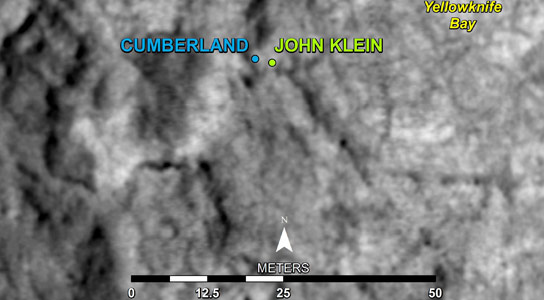
    This map shows the location of “Cumberland,” the second rock-drilling target for NASA’s Mars rover Curiosity, in relation to the rover’s first drilling target, “John Klein,” within the southwestern lobe of a shallow depression called “Yellowknife Bay.” Cumberland, like John Klein, is a patch of flat-lying bedrock with pale veins and bumpy surface texture. The bumpiness is due to erosion-resistant nodules within the rock, which have been identified as concretions resulting from the action of mineral-laden water. North is to the top of the map. The scale bar is 50 meters (164 feet). Cumberland lies about nine feet (2.75 meters) west of John Klein. The base map is part of an image from the High Resolution Imaging Science Experiment (HiRISE) camera on NASA’s Mars Reconnaissance Orbiter. The mapped area is within Gale Crater and north of the mountain called Mount Sharp in the middle of the crater. Credit: NASA/JPL-Caltech/University of Arizona

    Scientists have chosen the second drilling site for the Curiosity rover on Mars.

    The team operating NASA’s Curiosity Mars rover has selected a second target rock for drilling and sampling. The rover will set course to the drilling location in the coming days.

    This second drilling target, called “Cumberland,” lies about nine feet (2.75 meters) west of the rock where Curiosity’s drill first touched Martian stone in February. Curiosity took the first rock sample ever collected on Mars from that rock, called “John Klein.” The rover found evidence of an ancient environment favorable for microbial life. Both rocks are flat, with pale veins and a bumpy surface. They are embedded in a layer of rock on the floor of a shallow depression called “Yellowknife Bay.”

    This second drilling is intended to confirm results from the first drilling, which indicated the chemistry of the first powdered sample from John Klein was much less oxidizing than that of a soil sample the rover scooped up before it began drilling.

    “We know there is some cross-contamination from the previous sample each time,” said Dawn Sumner, a long-term planner for Curiosity’s science team at the University of California at Davis. “For the Cumberland sample, we expect to have most of that cross-contamination come from a similar rock, rather than from very different soil.”

    Although Cumberland and John Klein are very similar, Cumberland appears to have more of the erosion-resistant granules that cause the surface bumps. The bumps are concretions, or clumps of minerals, which formed when water soaked the rock long ago. Analysis of a sample containing more material from these concretions could provide information about the variability within the rock layer that includes both John Klein and Cumberland.

    Mission engineers at NASA’s Jet Propulsion Laboratory in Pasadena, California, recently finished upgrading Curiosity’s operating software following a four-week break. The rover continued monitoring the Martian atmosphere during the break, but the team did not send any new commands because Mars and the sun were positioned in such a way the sun could have blocked or corrupted commands sent from Earth.

    Curiosity is about nine months into a two-year prime mission since landing inside Gale Crater on Mars in August 2012. After the second rock drilling in Yellowknife Bay and a few other investigations nearby, the rover will drive toward the base of Mount Sharp, a 3-mile-tall (5-kilometer-tall) layered mountain inside the crater.

    JPL, a division of the California Institute of Technology, Pasadena, manages the Mars Science Laboratory Project, of which Curiosity is the centerpiece, for NASA’s Science Mission Directorate in Washington.

    Never miss a breakthrough: Join the SciTechDaily newsletter.
    Follow us on Google and Google News.

    Astronomy Curiosity Rover JPL Mars NASA Planetary Science
    Share. Facebook Twitter Pinterest LinkedIn Email Reddit

    Related Articles

    Mineralogy of Martian Soil Is Similar to Soils of Volcanic Origin in Hawaii

    Curiosity Rover Photographs Diverse Rocks

    Curiosity Prepares to Take Its First Scoop of Soil for Analysis

    Curiosity Finds Ancient Streambed on Mars

    NASA’s Curiosity Prepares for Use of Its Arm and Tools

    Curiosity Sends Back Radioed Words and New Telephoto View of Mars

    NASA’s Curiosity Readies for First Drive on Mars

    Color HiRISE Image of Curiosity Rover on Mars

    First 360-Degree Color Panorama From NASA’s Curiosity Mars Rover

    Leave A Reply Cancel Reply

    • Facebook
    • Twitter
    • Pinterest
    • YouTube

    Don't Miss a Discovery

    Subscribe for the Latest in Science & Tech!

    Trending News

    This Alien Planet Has Rock Clouds That Vaporize Before Sunset

    The Simple Habit That Could Lower Your Cancer Risk

    146,000-Year-Old Discovery Rewrites the Story of Human Creativity

    The Type of Alcohol You Drink Could Affect How Long You Live

    This Common Vitamin May Help Stop Prediabetes From Turning Into Diabetes

    Scientists Finally Solve the Mystery of “Clockwork” Earthquakes

    Breakthrough Parkinson’s Drug Targets Disease at Its Genetic Roots

    Just 4 Weeks of Simple Diet Changes Reversed Signs of Aging in Older Adults

    Follow SciTechDaily
    • Facebook
    • Twitter
    • YouTube
    • Pinterest
    • Newsletter
    • RSS
    SciTech News
    • Biology News
    • Chemistry News
    • Earth News
    • Health News
    • Physics News
    • Science News
    • Space News
    • Technology News
    Recent Posts
    • Researchers Reveal the Surprisingly Easy Habit Linked to Longer Healthier Lives
    • Scientists Discover Grapes Can “Reprogram” Your Skin Against Sun Damage
    • Scientists Create “Trojan Horse” Weight Loss Drug That Supercharges Results
    • Cats Have a Unique Kidney Chemistry That Could Be Harming Their Health
    • Scientists Warn Himalayan Rivers Are Becoming Increasingly Unstable
    Copyright © 1998 - 2026 SciTechDaily. All Rights Reserved.
    • Science News
    • About
    • Contact
    • Editorial Board
    • Privacy Policy
    • Terms of Use

    Type above and press Enter to search. Press Esc to cancel.