
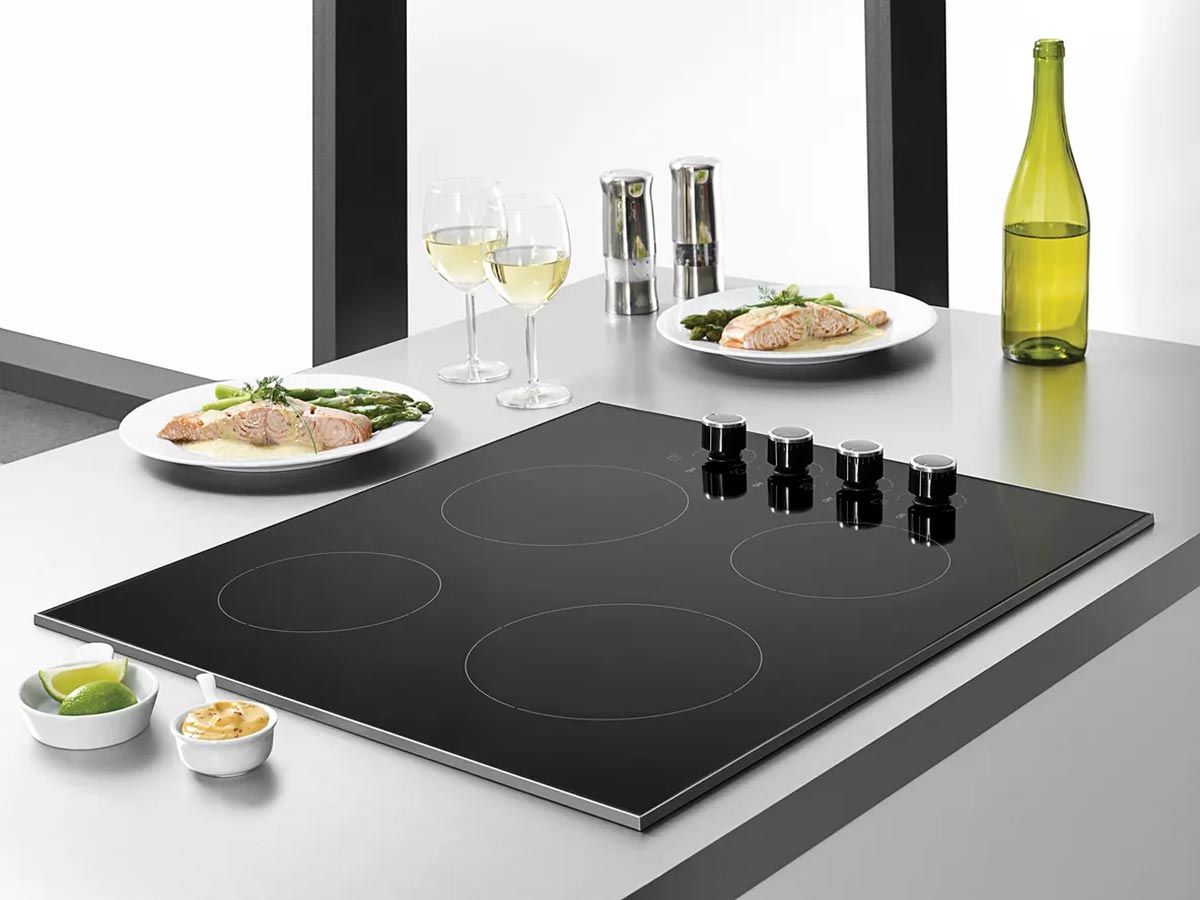
Induction stoves offer clean, efficient cooking and are set to grow as gas bans increase.
To curb climate change, many experts have called for a massive shift from fossil fuels to electricity. The goal is to electrify processes like heating homes and powering cars, and then generate the increased electrical power needs using low- or zero-carbon sources like wind, solar and hydropower.
More than 30 cities in California, including Berkeley and San Francisco, have moved in this direction by banning natural gas service in most new buildings. Currently energy use in buildings generates over 40% of San Francisco’s greenhouse gas emissions.
There are straightforward electric options for heating buildings and hot water and drying clothes, but going electric could be more controversial in the kitchen. Traditional electric stoves are notoriously slow to heat up and cool down. They also pose safety issues because their heating coils can stay hot for tens of minutes after they are shut off.
What is a serious cook to do? One high-tech alternative is magnetic induction. This technology was first proposed over 100 years ago and demonstrated at the 1933 Chicago World’s Fair. Today magnetic induction stoves and cooktops are common in Europe and Asia, but remain a niche technology in the U.S. As more cities and states move toward electrification, here’s a look at how magnetic induction works and its pros and cons for cooking.
Electrical Engineer Bill Kornrumpf describes how magnetic induction cooking works.
Heating Without a Flame
I am an electrical engineer specializing in electromagnetic field research. Much of my work focuses on medical therapy applications – but whether you are exposing human tissue or a pan on a cooktop to electromagnetic fields, the principles are the same.
To understand what electromagnetic fields are, the key principle is that an electric charge creates a field around it – essentially, a force that extends in all directions. Think of static electricity, which is an electric charge often produced by friction. If you rub a balloon on your hair, the friction will charge the balloon with static electric charge; then when you lift the balloon away from your head your hair will rise, even if the balloon isn’t touching it. The balloon is pulling on your hair with an attractive electric force.
Moving electric charges, like electricity flowing through wire, produce magnetic fields – zones of magnetic force around the current’s path. The Earth has a magnetic field because electric currents are flowing in its molten core.
Magnetic fields can also produce electric fields and this is why we use the term electromagnetic fields. This concept was discovered in the 1830s by English scientist Michael Faraday, who showed that if an electrically conductive material, such as a wire, is placed in a moving magnetic field, an electric field is created in the conductor. We call this magnetic induction. If the conductor is formed into a loop, an electric current will flow around the loop.
Faraday’s discovery formed the basis for the development of electric motors. His work also demonstrated a way to heat materials without using a traditional heat source such as fire.
Where Does the Heat Come From?
All materials have resistance, which means that when electric current flows through them, the flow will be hindered at least somewhat. This resistance causes some of the electric energy to be lost: The energy turns into heat, and as a result, the conductor warms up. In my biomedical research we investigate using radio frequency magnetic fields to heat up tissues in the body to help the tissue heal.
Instead of conventional burners, the cooking spots on induction cooktops are called hobs, and consist of wire coils embedded in the cooktop’s surface. For maximum efficiency, engineers want as much as possible of the magnetic field energy produced by each hob to be absorbed by the cookware sitting on it. The magnetic field will create an electric field in the bottom of the cookware, and because of resistance the pan will heat up, even though the hob does not.
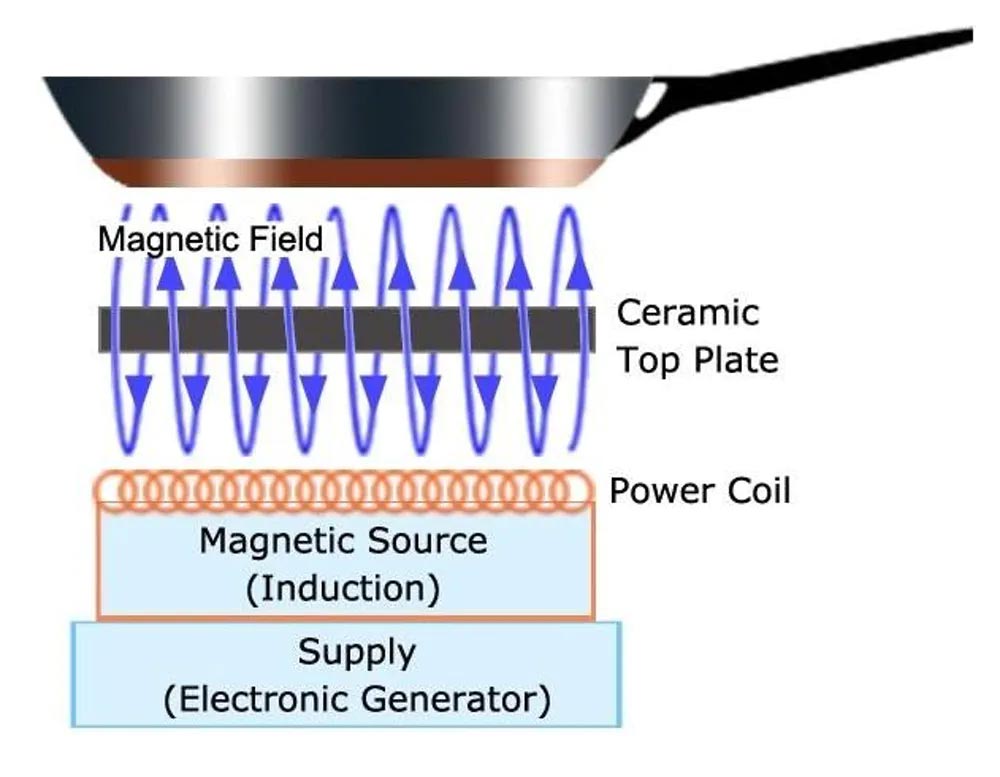
For the best performance, magnetic induction stoves and cooktops need to operate at a high magnetic field frequency – typically, 24KHz. They also require pots made from materials that magnetic fields do not readily pass through. Metals with high iron or nickel content absorb magnetic fields, so they are the most efficient options for induction cooking. Iron absorbs magnetic fields more readily than nickel and is far less expensive, so iron-based materials are most commonly used for magnetic induction cookware.
More Responsive and Safer, but More Expensive
Since induction cooktops require something to absorb magnetic fields in order to produce heat, they are intrinsically safer than a traditional electric cooktop. Placing your hand on the hob will not heat up your hand to any noticeable extent. And since these systems heat cookware without directly heating the hob, the hobs cool quickly after the cookware is removed, which reduces the risk of burns.
The cookware itself tends to warm up and cool down quickly, and temperature control is very accurate – one of the key properties that cooks value in gas stoves. Another plus is that induction cooktops commonly have smooth surfaces – often glass or ceramic – so they are easy to clean.
Modern induction cooktops are as energy-efficient as traditional electric stoves and about twice as efficient as gas stoves. But this does not necessarily mean they are less expensive to operate. In many parts of the U.S. natural gas is far cheaper than electricity, sometimes by a factor of three or four. This partly explains the broader acceptance of induction cooktops in Europe, where until recently natural gas was much more expensive than electricity.
Electricity and Natural Gas Are the Most-Used Energy Sources in US Homes
Natural gas and oil are mainly used for space heating and water heating. Electricity powers heating devices and many more uses, including refrigerators, lights and appliances.
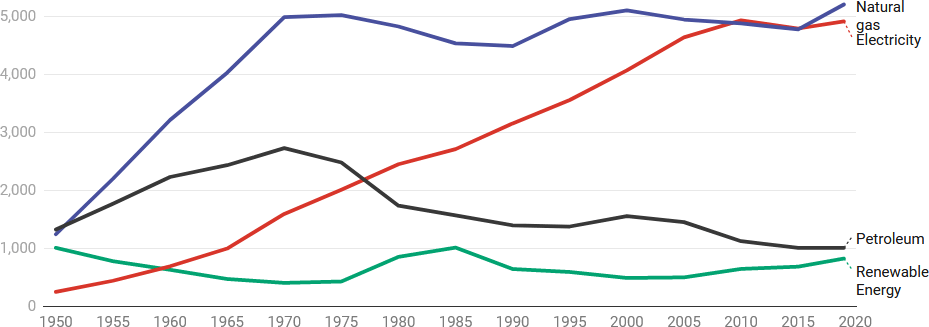
Chart: The Conversation, CC BY-ND Source: U.S. Energy Information Administration
Another factor that has influenced adoption is that induction stoves and cooktops typically cost more than traditional gas or electric stoves, although not substantially so. And cooks will have to replace aluminum, copper, nonmagnetic stainless steel and ceramic pots, none of which work effectively on induction cooktops. One quick check is that if a magnet sticks to the bottom of a pot, the pot will work on an induction cooktop.
Despite these factors, I expect that natural gas use reduction ordinances will lead to greatly expanded use of magnetic induction stoves and cooktops. These measures typically focus on newly constructed buildings, so they will not require expensive conversions of existing homes.
Young singles and families who move into these new residences may not yet have acquired a lot of cookware, and are likely to appreciate the safety associated with magnetic induction, especially if they have children. And early adopters who are willing to pay more for electricity from green sources, or for a hybrid or electric car, may not be upset about paying a few hundred dollars more for a magnetic induction cooktop and pans that work with it.
At the national level, the U.S. may adopt some form of carbon pricing in the near future, which would raise the cost of natural gas. And there is also growing concern about indoor air pollution from gas appliances. More than a century after it was first proposed, magnetic induction cooking’s day in the sun may have arrived.
Written by Kenneth McLeod, Professor of Systems Science, and Director, Clinical Science and Engineering Research Laboratory, Binghamton University, State University of New York.
Adapted from an article originally published on The Conversation.
Never miss a breakthrough: Join the SciTechDaily newsletter.
Follow us on Google and Google News.
6 Comments
Burning fossil fuels to make electricity completely negates this thought. Your fantasizing again.
“… generate the increased electrical power needs using low- or zero-carbon sources like wind, solar and hydropower.”
None of these are truly “zero-carbon” energy sources. While they don’t produce CO2 as a direct by-product of producing electricity, manufacturing wind mills, solar panels, and dams produces CO2! For starters, the manufacturing of cement produces an estimated 5% of all anthropogenic CO2, and wind mills and solar panels have concrete platforms that support the devices. Dams use a huge amount of concrete! Beyond that, the activities of mining, crushing, beneficiating, smelting, refining, fabricating, and transporting the materials used in the alternatives to fossil fuels produce CO2. That is unlikely to change much in the near-term.
We should note that California has been having rolling blackouts either because of insufficient electrical power for the air conditioning demand, or out of an abundance of caution when there are windy conditions in the Summer. With more emphasis on fossil fuels being replaced by electricity, that will be exacerbated!
“In my biomedical research we investigate using radio frequency magnetic fields to heat up tissues in the body to help the tissue heal.” That should be “electromagnetic fields.”
Because body tissues are nowhere near as good conductors as metals, I suspect that the major heating is the result of dielectrophoretic kinetic-heating, rather than ohmic heating, because water has a large dielectric constant, and there are few free charges in body tissues, except on a microscopic scale. That is to say, the alternating electric field causes the movement of water molecules through what is known as dielectrophoresis, and the resulting vibration heats the molecules and their surroundings. Try putting your hand (a good high-voltage rubber glove is recommended) near a 60 Hz high-voltage source and you can feel the vibration in your fingers.
What is omitted in the article is the carbon footprint of generating the electricity is present even if you use wind turbines and solar. Also, it should be well known that the cost of alternative energy sources like solar and wind go up exponentially as they become higher percentages of the base load (because of their (un)reliability and the need for backup energy sources). Finally, if for instance you use a natural gas plant to generate electricity and then convert that electricity to heat, you have two conversions (and losses) involved (Gas to electricity and then electricity to heat). When you directly use natural gas you have only one transition (gas to heat). That is why natural gas in the home is so cheap and effective for heating (and why it is so much cheaper). The way to sort these things out is to have a carbon tax that reflects accurately the carbon footprint of each source of energy. Then let the market sort it out (markets are very effective at doing this once all the costs are accounted).
Endless articles promoting only solar, wind and zeroing nuclear right off the table.
US primary energy use is about 3TW which some dream of making all electric at about 1TWe for same benefit. If it isn’t base load at the inputs like fossil fuels and nuclear, then the cost of making it so at the outputs will be a problem.
If we use natural gas with maybe 70% gas and 30% some mix of solar, wind and hydro, we are mostly ignoring the CO2 issue, so what’s the point.
If we use daily battery cycles for about 1/2 of the intermittent electric production we need 24B/2 kWhr of daily storage for night use. Current 1kWhr batteries are about $400 so total cost is about $4.8T which might last 3 years or 1000 cycles. For more cycles we over provision storage as Tesla does in their EVs or over provision the inputs so less storage needed. Batteries are never going to get hugely cheaper, they are not like semiconductor devices but it seems people think so.
If we use CO2 neutral storage, we could convert all excess production to hydrogen and back again, 2 conversions that might be 15-20% round trip efficient. But it gets worse, the low capacity factor intermittent energy should be used live as much as possible, so only the excess peak tops will be converted to chemical energy, the new capacity factor is now even lower. So solar wind avg CF is already 15-30%, now multiply by 15% for the round trip conversion, and reduce further because only the peaks will be converted. This means the input energy will have to be at least doubled for the final output to be base load. This means very expensive hydrogen plants will only run in the summer and or windy seasons. Here in the US NE, summer solar is 5x the winter production, that means at least 1/6 of all solar needs to be time shifted without loss. Most greens seem not to be aware of energy translation, capacity factors and the way solar, wind and hydro actually work and that batteries are always free.
Alternatively we could just build about 1TWe of Molten Salt (or even liquid Sodium) Reactors for full electric economy. Better still fall back half way and go half electric and use the rest to make hydrogen via the S-I process using just the high temperature heat. Use the hydrogen as a gas substitute, or as an input to synfuels and other industrial heat processes.
Price per ton for catalysts, Platinum about $40M, Iodine about $26K, plain Sulfur about $50.
So solar+wind peak unused energy conversion with very low CF uses Platinum or similar metal.
But nuclear with 100% CF uses common Sulfur and Iodine.
The thing about the electric dream economy is that wondrous amounts of the rarest elements are needed at every turn. The grid should not be made out of iPhones, it should be familiar to 1960’s engineers with new physics but not expensive materials. The MSR was developed in the 60s.
Oh BTW, the oceans contain about 1/2 ton of uranium for each of 10B people, enough to last a millennia or so. Fusion another wet dream might even work by then.
I got an induction range when I remodeled the kitchen 4 years ago, and I absolutely love it. I wouldn’t want to go back. One thing not often mentioned is that because the heat goes pretty much directly into the cookware, clean up is much easier than gas or resistive electric. It’s also fast, responsive, and keeps the kitchen significantly cooler than my in-laws gas range.