
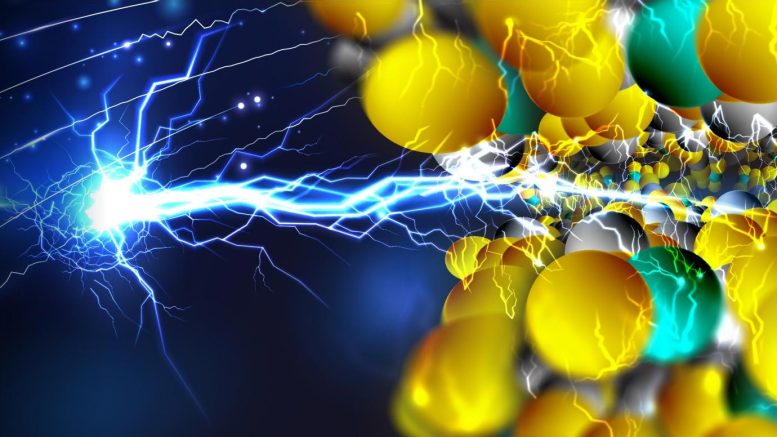
‘Like conductive Play-Doh’: breakthrough could point way to a new class of materials for electronic devices.
University of Chicago scientists have discovered a way to create a material that can be made like a plastic, but conducts electricity more like a metal.
The research shows how to make a kind of material in which the molecular fragments are jumbled and disordered, but can still conduct electricity extremely well. It was published on October 26 in the journal Nature.
This goes against all of the rules we know about conductivity—to a scientist, it’s kind of like seeing a car driving on water and still going 70 mph. But the finding could also prove to be extraordinarily useful. Often, on the way to inventing something revolutionary, the process first starts with discovering a completely new material.
“In principle, this opens up the design of a whole new class of materials that conduct electricity, are easy to shape, and are very robust in everyday conditions,” said John Anderson, an associate professor of chemistry at the University of Chicago and the senior author on the study. “Essentially, it suggests new possibilities for an extremely important technological group of materials,” said Jiaze Xie (PhD’22, now at Princeton), the first author on the paper.
‘There Isn’t a Solid Theory To Explain This’
If you’re making any kind of electronic device, whether it be an iPhone, a solar panel, or a television, conductive materials are absolutely essential. Metals, such as copper, gold, and aluminum, are by far the oldest and largest group of conductors. Then, about 50 years ago, scientists were able to create conductors made out of organic materials, using a chemical treatment known as “doping,” which sprinkles in different atoms or “impurities” throughout the material. The fact that these materials are more flexible and easier to work with than conventional metals makes them attractive, but the problem is that they aren’t particularly stable and may lose their conductivity if exposed to moisture or if the temperature rises too high.
However, fundamentally, both organic and traditional metallic conductors share a common characteristic. They are made up of straight, closely packed rows of atoms or molecules. This means that electrons can easily flow through the material, much like cars on a highway. In fact, scientists thought a material had to have these straight, orderly rows in order to conduct electricity efficiently.
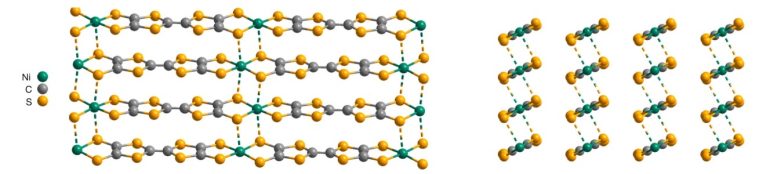
Then Xie began experimenting with some materials that were discovered years ago, but largely ignored since. He strung nickel atoms like pearls into a string of molecular beads made of carbon and sulfur, and began testing.
Stability and Conductivity in a Disordered Structure
To the scientists’ astonishment, the material easily and strongly conducted electricity. What’s more, it was very stable. “We heated it, chilled it, exposed it to air and humidity, and even dripped acid and base on it, and nothing happened,” said Xie. That is enormously helpful for a device that has to function in the real world.
But the most striking thing to the scientists was that the molecular structure of the material was disordered. “From a fundamental picture, that should not be able to be a metal,” said Anderson. “There isn’t a solid theory to explain this.”
A New Design Principle for Future Electronics
Xie, Anderson, and their lab worked with other scientists around the university to try to understand how the material can conduct electricity. After tests, simulations, and theoretical work, they think that the material forms layers, like sheets in a lasagna. Even if the sheets rotate sideways, no longer forming a neat lasagna stack, electrons can still move horizontally or vertically—as long as the pieces touch.
The end result is unprecedented for a conductive material. “It’s almost like conductive Play-Doh—you can smush it into place and it conducts electricity,” Anderson said.
To the scientists’ astonishment, the material easily and strongly conducted electricity.
The scientists are excited because the discovery suggests a fundamentally new design principle for electronics technology. Conductors are so important that virtually any new development opens up new lines for technology, they explained.
One of the material’s attractive characteristics is new options for processing. For example, metals usually have to be melted in order to be made into the right shape for a chip or device, which limits what you can make with them, since other components of the device have to be able to withstand the heat needed to process these materials.
The new material has no such restriction because it can be made at room temperature. It can also be used where the need for a device or pieces of the device to withstand heat, acid or alkalinity, or humidity has previously limited engineers’ options to develop new technology.
The team is also exploring the different forms and functions the material might make. “We think we can make it 2D or 3D, make it porous, or even introduce other functions by adding different linkers or nodes,” said Xie.
Reference: “Intrinsic glassy-metallic transport in an amorphous coordination polymer” by Jiaze Xie, Simon Ewing, Jan-Niklas Boyn, Alexander S. Filatov, Baorui Cheng, Tengzhou Ma, Garrett L. Grocke, Norman Zhao, Ram Itani, Xiaotong Sun, Himchan Cho, Zhihengyu Chen, Karena W. Chapman, Shrayesh N. Patel, Dmitri V. Talapin, Jiwoong Park, David A. Mazziotti and John S. Anderson, 26 October 2022, Nature.
DOI: 10.1038/s41586-022-05261-4
Other authors on the paper include University of Chicago graduate students Norman Zhao, Garrett Grocke, Ram Itani, Baorui Cheng, Tengzhou Ma (PhD’21, now at Applied Materials), Simon Ewing (PhD’22, now at Intel) and Jan-Niklas Boyn (PhD’22, now at Princeton); postdoctoral researcher Xiaotong Sun; UChicago Director of X-ray Research Facilities Alexander S. Filatov; Himchan Cho (formerly a postdoctoral researcher at UChicago, now at Korea Advanced Institute of Science and Technology); UChicago Profs. Shrayesh N. Patel, Dmitri V. Talapin, Jiwoong Park, and David A. Mazziotti; and Zhihengyu Chen and Prof. Karena Chapman of Stonybrook University.
Funding: Army Research Office, a directorate of U.S. Army Combat Capabilities Development Command Army Research Laboratory; U.S. Department of Energy; National Science Foundation.
Never miss a breakthrough: Join the SciTechDaily newsletter.
Follow us on Google and Google News.
10 Comments
Does it have BPA, Bis GMA or other ‘plastic’ components?
Are you kidding me? Water is conductive because it contains trace metals. These researchers should be ashamed of themselves for such nonsense “discoveries”
is it transparent aluminum?
That’s the ticket, laddie.
Energy generation will be changed dramatically. Nuclear energy possibly has become obsolete. Imagine the ramifications for batteries used in EV’s. As the car moves through the atmosphere it could generate its own electricity. Enough to power the vehicle for perpetuity.
Can it be used in a 3D printer?
How WELL does it conduct? What are its magnetic properties, its inductance, intrinsic capacitance, its conductivity? I remember a story decades ago about researches at the Bechtel Institute in Columbus, OH making a superconductive glass. Never heard of it since.
Just curious, has a eutectic melting point been established? If so is it consistent between batches?
Does the materials conductivity% remain consistent throughout various shaping formations?
Finally, have any heat treatment processes such as normalization and established or attempted in order to reset the structure to a more unified condition?
i am gonna kill myself
Hi