
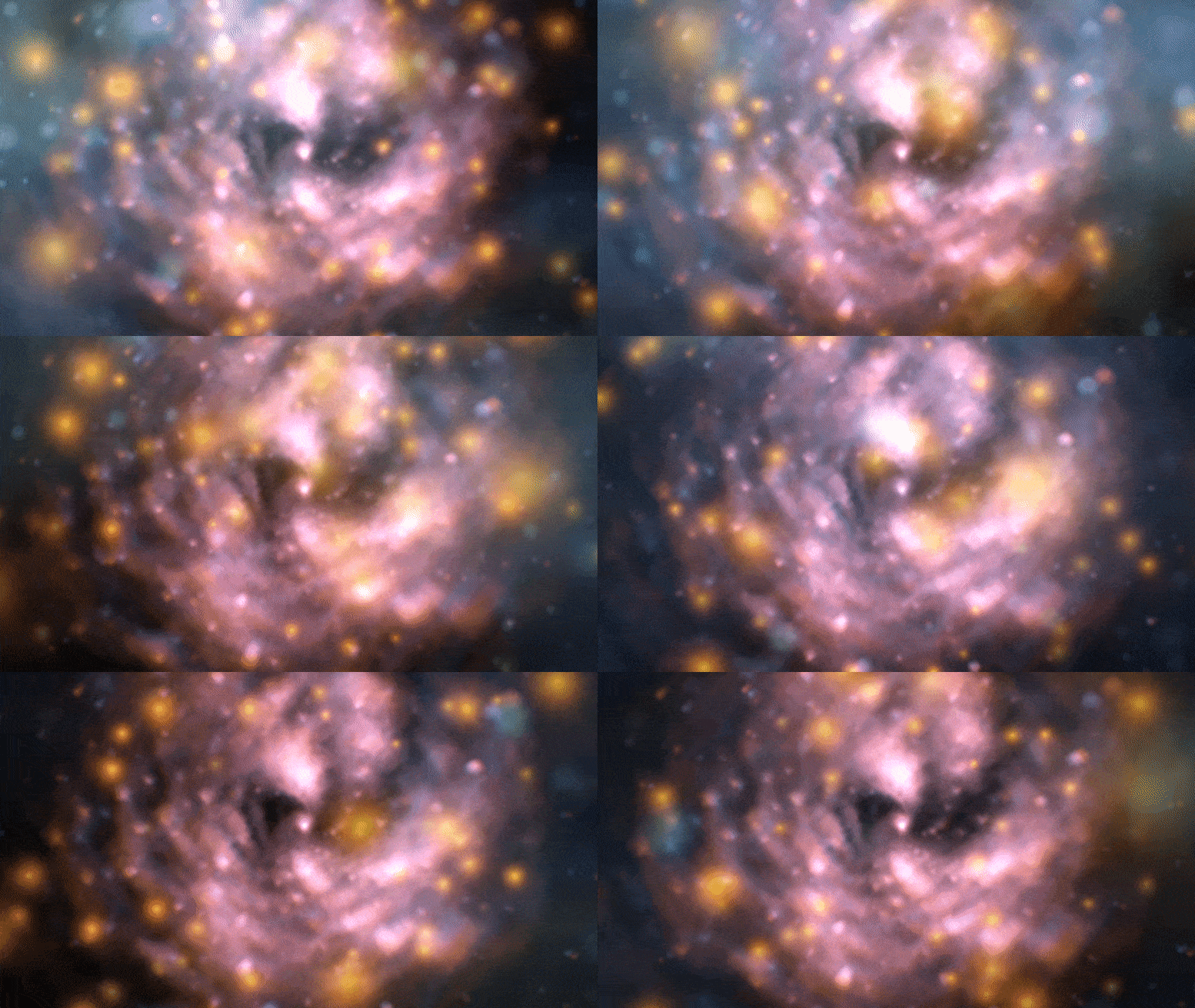
UC Riverside-led study points to a seed black hole produced by a dark matter halo collapse.
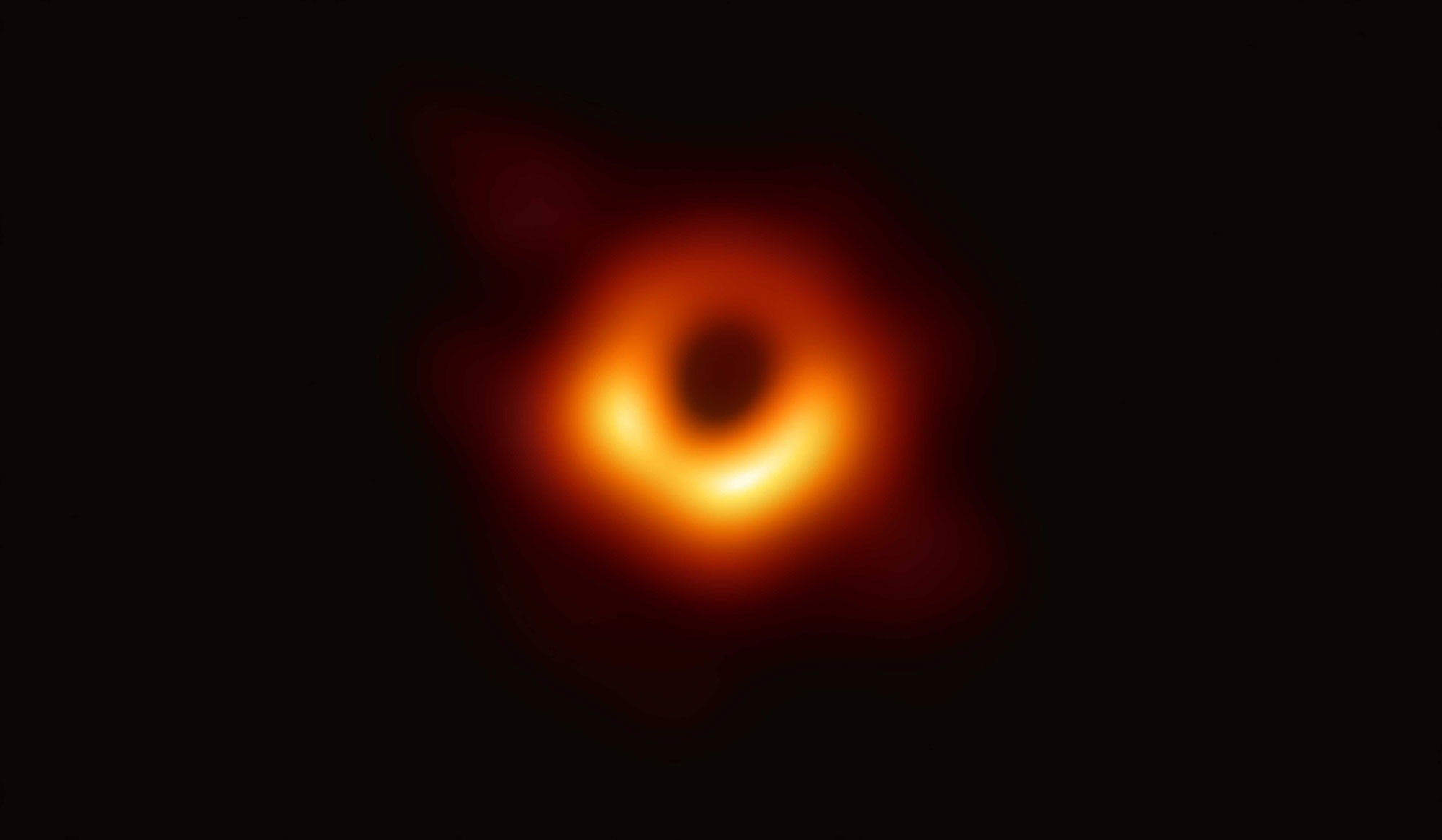
Supermassive black holes, or SMBHs, are black holes with masses that are several million to billion times the mass of our sun. The Milky Way hosts an SMBH with a few million times the solar mass. Surprisingly, astrophysical observations show that SMBHs already existed when the universe was very young. For example, billion-solar-mass black holes were found when the universe was just 6% of its current age, 13.7 billion years. How do these SMBHs in the early universe originate?
A team led by a theoretical physicist at the University of California, Riverside, has come up with an explanation: a massive seed black hole that the collapse of a dark matter halo could produce.
Dark matter halo is the halo of invisible matter surrounding a galaxy or a cluster of galaxies. Although dark matter has never been detected in laboratories, physicists remain confident this mysterious matter that makes up 85% of the universe’s matter exists. Were the visible matter of a galaxy not embedded in a dark matter halo, this matter would fly apart.
“Physicists are puzzled why SMBHs in the early universe, which are located in the central regions of dark matter halos, grow so massively in a short time,” said Hai-Bo Yu, an associate professor of physics and astronomy at UC Riverside, who led the study that appears in Astrophysical Journal Letters. “It’s like a 5-year-old child that weighs, say, 200 pounds. Such a child would astonish us all because we know the typical weight of a newborn baby and how fast this baby can grow. Where it comes to black holes, physicists have general expectations about the mass of a seed black hole and its growth rate. The presence of SMBHs suggests these general expectations have been violated, requiring new knowledge. And that’s exciting.”
A seed black hole is a black hole at its initial stage — akin to the baby stage in the life of a human.
Self-Interacting Dark Matter and Gravothermal Collapse
“We can think of two reasons,” Yu added. “The seed — or ‘baby’ — black hole is either much more massive or it grows much faster than we thought, or both. The question that then arises is what are the physical mechanisms for producing a massive enough seed black hole or achieving a fast enough growth rate?”
“It takes time for black holes to grow massive by accreting surrounding matter,” said co-author Yi-Ming Zhong, a postdoctoral researcher at the Kavli Institute for Cosmological Physics at the University of Chicago. “Our paper shows that if dark matter has self-interactions then the gravothermal collapse of a halo can lead to a massive enough seed black hole. Its growth rate would be more consistent with general expectations.”
In astrophysics, a popular mechanism used to explain SMBHs is the collapse of pristine gas in protogalaxies in the early universe.
“This mechanism, however, cannot produce a massive enough seed black hole to accommodate newly observed SMBHs — unless the seed black hole experienced an extremely fast growth rate,” Yu said. “Our work provides an alternative explanation: a self-interacting dark matter halo experiences gravothermal instability and its central region collapses into a seed black hole.”
The explanation Yu and his colleagues propose works in the following way:
Dark matter particles first cluster together under the influence of gravity and form a dark matter halo. During the evolution of the halo, two competing forces — gravity and pressure — operate. While gravity pulls dark matter particles inward, pressure pushes them outward. If dark matter particles have no self-interactions, then, as gravity pulls them toward the central halo, they become hotter, that is, they move faster, the pressure increases effectively, and they bounce back. However, in the case of self-interacting dark matter, dark matter self-interactions can transport the heat from those “hotter” particles to nearby colder ones. This makes it difficult for the dark matter particles to bounce back.
Viscosity and Angular Momentum Dissipation
Yu explained that the central halo, which would collapse into a black hole, has angular momentum, meaning, it rotates. The self-interactions can induce viscosity, or “friction,” that dissipates the angular momentum. During the collapse process, the central halo, which has a fixed mass, shrinks in radius and slows down in rotation due to viscosity. As the evolution continues, the central halo eventually collapses into a singular state: a seed black hole. This seed can grow more massive by accreting surrounding baryonic — or visible — matter such as gas and stars.
“The advantage of our scenario is that the mass of the seed black hole can be high since it is produced by the collapse of a dark matter halo,” Yu said. “Thus, it can grow into a supermassive black hole in a relatively short timescale.”
Baryonic Matter Accelerates the Collapse Process
The new work is novel in that the researchers identify the importance of baryons—ordinary atomic and molecular particles — for this idea to work.
“First, we show the presence of baryons, such as gas and stars, can significantly speed up the onset of the gravothermal collapse of a halo and a seed black hole could be created early enough,” said Wei-Xiang Feng, Yu’s graduate student and a co-author on the paper. “Second, we show the self-interactions can induce viscosity that dissipates the angular momentum remnant of the central halo. Third, we develop a method to examine the condition for triggering general relativistic instability of the collapsed halo, which ensures a seed black hole could form if the condition is satisfied.”
Over the past decade, Yu has explored novel predictions of dark matter self-interactions and their observational consequences. His work has shown that self-interacting dark matter can provide a good explanation for the observed motion of stars and gas in galaxies.
“In many galaxies, stars and gas dominate their central regions,” he said. “Thus, it’s natural to ask how the presence of this baryonic matter affects the collapse process. We show it will speed up the onset of the collapse. This feature is exactly what we need to explain the origin of supermassive black holes in the early universe. The self-interactions also lead to viscosity that can dissipate angular momentum of the central halo and further help the collapse process.”
Reference: “Seeding Supermassive Black Holes with Self-Interacting Dark Matter: A Unified Scenario with Baryons” by Wei-Xiang Feng, Hai-Bo Yu and Yi-Ming Zhong, 16 June 2021, The Astrophysical Journal Letters.
DOI: 10.3847/2041-8213/ac04b0
The study was funded by the U.S. Department of Energy; NASA; the Kavli Institute for Cosmological Physics; and the John Templeton Foundation.
Never miss a breakthrough: Join the SciTechDaily newsletter.
Follow us on Google and Google News.
12 Comments
Dark matter is now understood to be smoothly distributed throughout our Universe. Dark matter is the spacetime fabric. Dark matter is also now understood to be pushed out by stars. The dark matter displaced by the quarks the Sun consists of, pushing back and exerting pressure toward the Sun, keeps the Earth in orbit about the Sun. The dark matter displaced by the quarks a galaxy consists of, pushing back and exerting pressure toward the galaxy, causes the stars to orbit the galactic center at the rate in which they do.
Curved spacetime is a geometrical representation of gravity.
Displaced dark matter is the physical manifestation of gravity.
What is referred to geometrically as curved spacetime physically exists as displaced dark matter.
A galaxy’s halo is not a clump of dark matter traveling with the galaxy. A galaxy’s halo is dark matter that is displaced by the galaxy.
The ‘missing mass’ associated with dark matter is the mass of the dark matter connected to and neighboring a galaxy which is displaced by the galaxy.
The galaxies which are mistaken for missing dark matter are too diffuse to displace the dark matter to such an extent as to cause the lensing of the light as it passes by the galaxy.
Well, that is not what science understands – we can see that dark matter is just that and is lumpy [ https://www.nasa.gov/feature/goddard/2020/hubble-detects-smallest-known-dark-matter-clumps/ ].
Maybe you should try to understand what science understands – it is easy to find out.
‘Dark Matter More Ubiquitous Than We Ever Thought’
> “dark matter is smooth, distributed more evenly throughout space than we thought”
‘Dark matter is on the move: Scientists find the elusive material can be pushed out of a galaxy’s center by star formation’
> “‘The dark matter at the centres of star-forming dwarfs appears to have been “heated up” and pushed out.’”
Dark matter is smoothly distributed and pushed out by stars
You repeat your unsourced claim, and don’t respond to the conflict with what we see (as seen in the link to science I gave you).
That is not a way to understand the world, or comment on science.
What is mistaken for clumps of dark matter is the state of displacement of the dark matter.
Dense ordinary matter leads to displaced dark matter, mistakenly referred to as clumped dark matter.
Diffuse ordinary matter leads to not displaced dark matter, mistakenly referred to as missing dark matter.
… like when you lay in the bed and the sheet is beet wrinkled?
… like, when the one is in its own bed and the sheet in the bed is wrinkled…
Wait, Wait. “During the collapse process, the central halo, which has a fixed mass, shrinks in radius and slows down in rotation due to viscosity.” There would have to be a whole lot of energy to dissipate for something the slow down in rotation as it shrinks. This is silly on it’s face.
Indeed!
Unfortunately self-interacting collisional dark matter gas that can collapse by transporting heat away do not match cosmological observations.
“But what about alternative dark matter models like warm dark matter (WDM) and self-interacting dark matter (SIDM)? As we briefly touched in the beginning, they are partly conceived to resolve the cusp-core problem. In fact, WDM and SIDM are also mass-dependent like the DC14 model, but not in exactly the same way. So, how do they fare in predicting the velocity function and the Tully-Fisher relation for galaxies? Figure 3, our last figure of the day, shows exactly this. Despite doing better than the NFW profile, both WDM and SIDM are not able to fit the velocity function and Tully-Fisher relation as well as we expect.”
[ https://astrobites.org/2015/06/12/the-labor-of-outflows-against-dark-matter-halo/ ]
It’s going to over worn the black hole from halo physics then black hole would create super nova event if it collapse the halo it could be the neutron star thats coming from energy particles.
Energy is not particles (outside of general relativity mass-energy equivalence).