
Pasadena Conference to Include New Insight into Dwarf Planet Ceres
As NASA’s Dawn spacecraft prepares to wrap up its groundbreaking 11-year mission, which has included two successful extended missions at Ceres, it will continue to explore — collecting images and other data.
Within a few months, Dawn is expected to run out of a key fuel, hydrazine, which feeds thrusters that control its orientation and keeps it communicating with Earth. When that happens, sometime between August and October, the spacecraft will stop operating, but it will remain in orbit around dwarf planet Ceres.
Dawn is the only spacecraft to orbit two deep-space destinations. It has given us new, up-close views of Ceres and Vesta, the largest bodies between Mars and Jupiter. During 14 months in orbit from 2011 to 2012, Dawn studied Vesta from its surface to its core. It then pulled off an unprecedented maneuver by leaving orbit and traveling through the main asteroid belt for more than two years to reach and orbit Ceres, which it has been investigating since 2015.
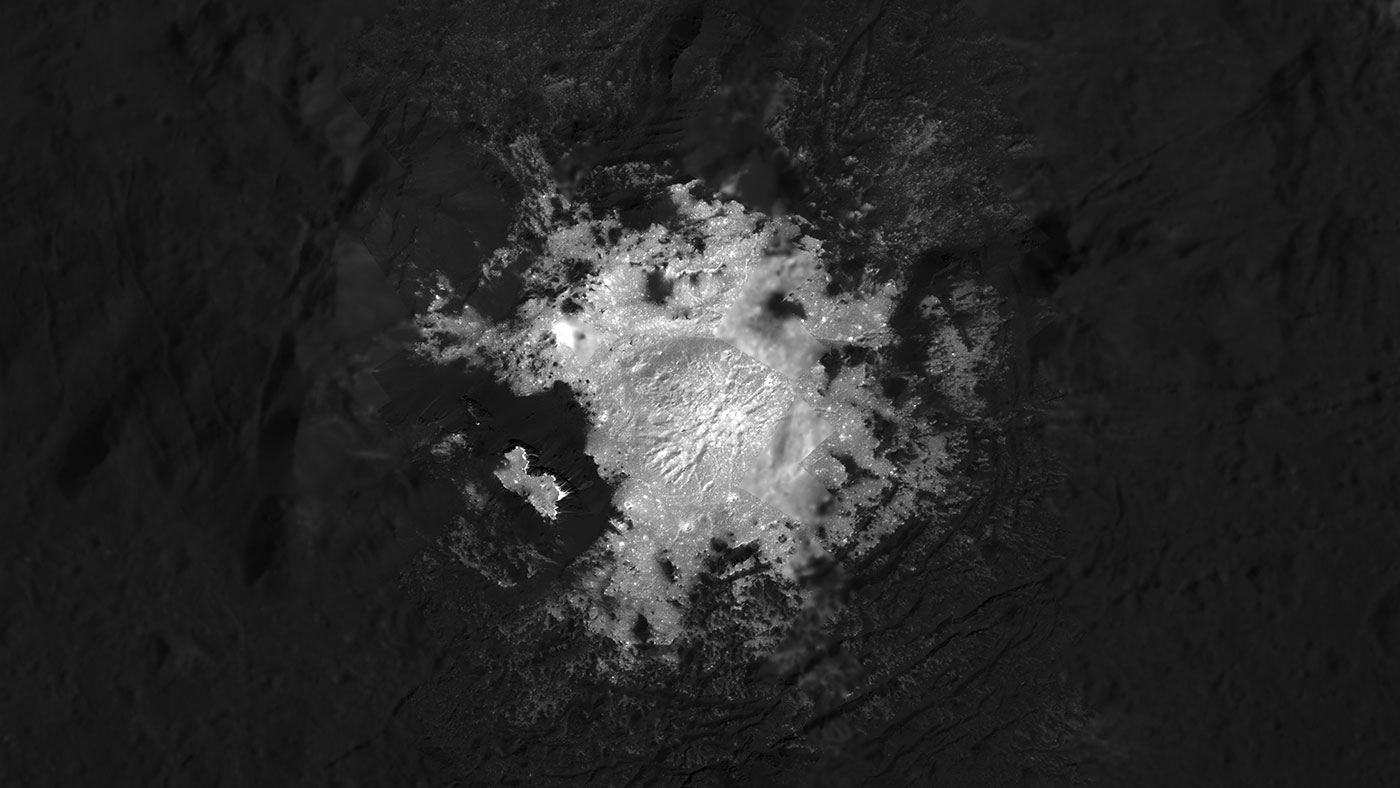
At Ceres, the spacecraft discovered brilliant, salty deposits decorating the dwarf planet like a smattering of diamonds. The science behind these bright spots is even more compelling: they are mainly sodium carbonate and ammonium chloride that somehow made their way to the surface in a slushy brine from within or below the crust.
These discoveries were fueled by the tremendous efficiency of ion propulsion. Dawn wasn’t the first spacecraft to use ion propulsion, familiar to science-fiction fans as well as space enthusiasts, but it pushed the limits of this advanced propulsion’s capabilities and stamina.
“Dawn’s unique mission to orbit and explore two strange new worlds would have been impossible without ion propulsion,” said Marc Rayman of NASA’s Jet Propulsion Laboratory, Pasadena, California, who has served as Dawn’s mission director, chief engineer and project manager. “Dawn is truly an interplanetary spaceship, and it has been outstandingly productive as it introduced these fascinating and mysterious worlds to Earth.”
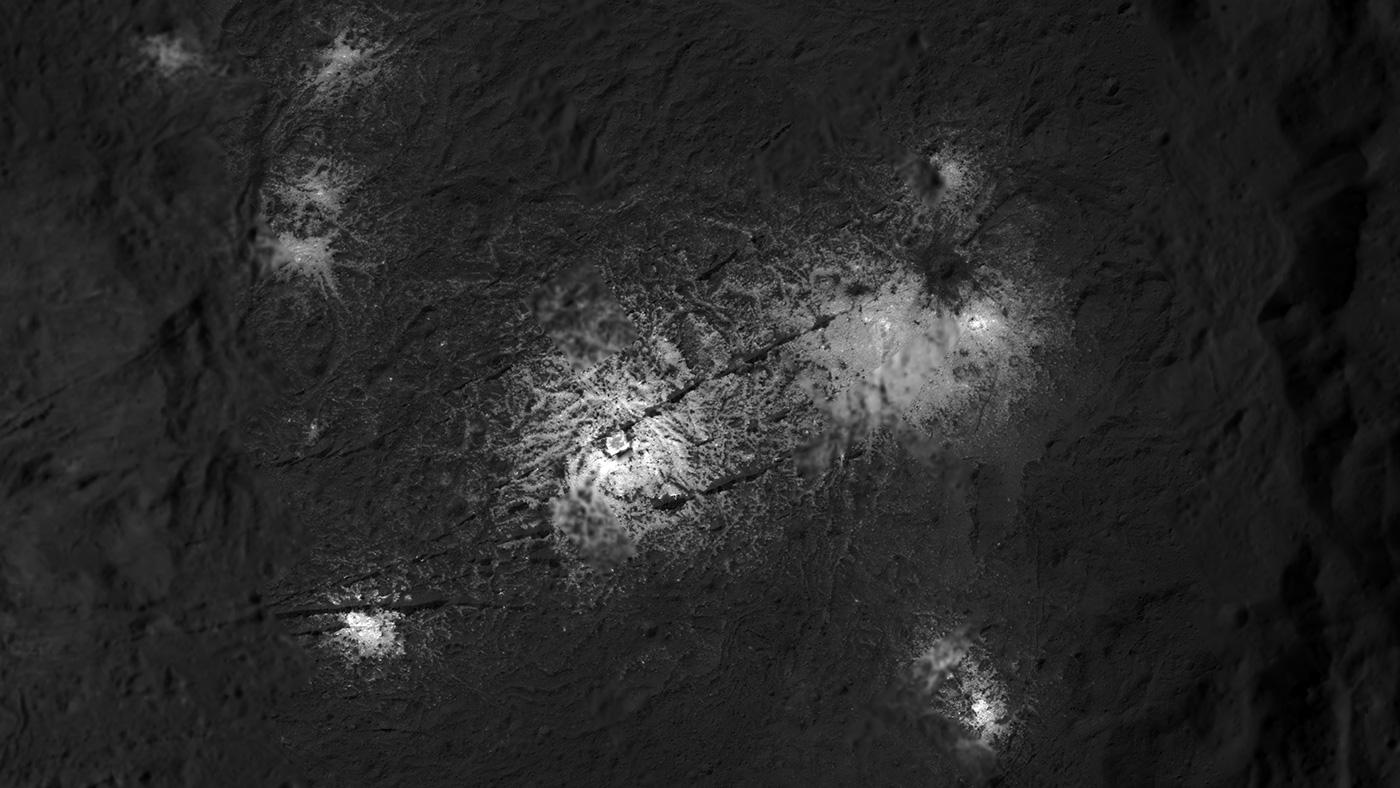
These days, near the end of Dawn’s second extended mission at Ceres, the spacecraft continues to wow us week after week, with very close photos shot from only 22 miles (35 kilometers) above the dwarf planet — about three times the altitude of a passenger jet.
But Wait, There’s More: New Science to Come
Although the Dawn mission is winding down, the science is not. Besides the high-resolution images, the spacecraft is collecting gamma ray and neutron spectra, infrared and visible spectra, and gravity data. The observations focus on the area around Occator and Urvara craters, with the main goal of understanding the evolution of Ceres, and testing for possible ongoing geology.
“The new images of Occator Crater and the surrounding areas have exceeded expectations, revealing beautiful, alien landscapes,” said Carol Raymond of JPL, principal investigator of the Dawn mission. “Ceres’ unique surface appears to be shaped by impacts into its volatile-rich crust, resulting in intriguing, complex geology, as we can see in the new high-resolution mosaics of Cerealia Facula and Vinalia Faculae.”
The first results of this mission phase, which started in early June, are being presented this week at the Committee on SPAce Research (COSPAR) meeting in Pasadena. Raymond and JPL scientist Jennifer Scully will offer new information on the relationships between bright and dark materials on the floor of Occator Crater, which show impact processes, landslides and cryovolcanism.
Dawn scientists are using new high-resolution data from Dawn to test and refine hypotheses about Occator crater’s formation and evolution. “Observations, modeling and laboratory studies helped us conclude that the bright spots are either formed by impacts interacting with the crust, or that a reservoir of briny melt contributed to their formation,” said Scully.
The new images so far support the hypothesis that exposure of subsurface material in that region is ongoing, and that it is geologically active, feeding from a deep reservoir. Eleonora Ammannito of the Italian Space Agency, deputy lead for the Dawn visible and infrared mapping spectrometer, will present updated maps at the conference showing the distribution of briny materials across Ceres’ surface.
Also at COSPAR, Dawn flight team member Dan Grebow of JPL will describe Dawn’s final orbit, designed to abide by NASA’s planetary protection protocols.
Low-altitude images collected by Dawn are posted regularly to the mission’s web page here.
The Dawn mission is managed by JPL for NASA’s Science Mission Directorate in Washington. Dawn is a project of the directorate’s Discovery Program, managed by NASA’s Marshall Space Flight Center in Huntsville, Alabama. JPL is responsible for overall Dawn mission science. Orbital ATK Inc., in Dulles, Virginia, designed and built the spacecraft. The German Aerospace Center, Max Planck Institute for Solar System Research, Italian Space Agency and Italian National Astrophysical Institute are international partners on the mission team.
Never miss a breakthrough: Join the SciTechDaily newsletter.
Follow us on Google and Google News.