
Close Menu
    Facebook X (Twitter) Instagram
    SciTechDaily
    • Biology
    • Chemistry
    • Earth
    • Health
    • Physics
    • Science
    • Space
    • Technology
    Facebook X (Twitter) Pinterest YouTube RSS
    SciTechDaily
    Home»Space»New Images by NASA’s Dawn Spacecraft Show Mysterious Bright Spots on Ceres
    Space

    New Images by NASA’s Dawn Spacecraft Show Mysterious Bright Spots on Ceres

    By Elizabeth Landau, NASA's Jet Propulsion LaboratoryMay 11, 20151 Comment3 Mins Read
    Facebook Twitter Pinterest Telegram LinkedIn WhatsApp Email Reddit
    Share
    Facebook Twitter LinkedIn Pinterest Telegram Email Reddit
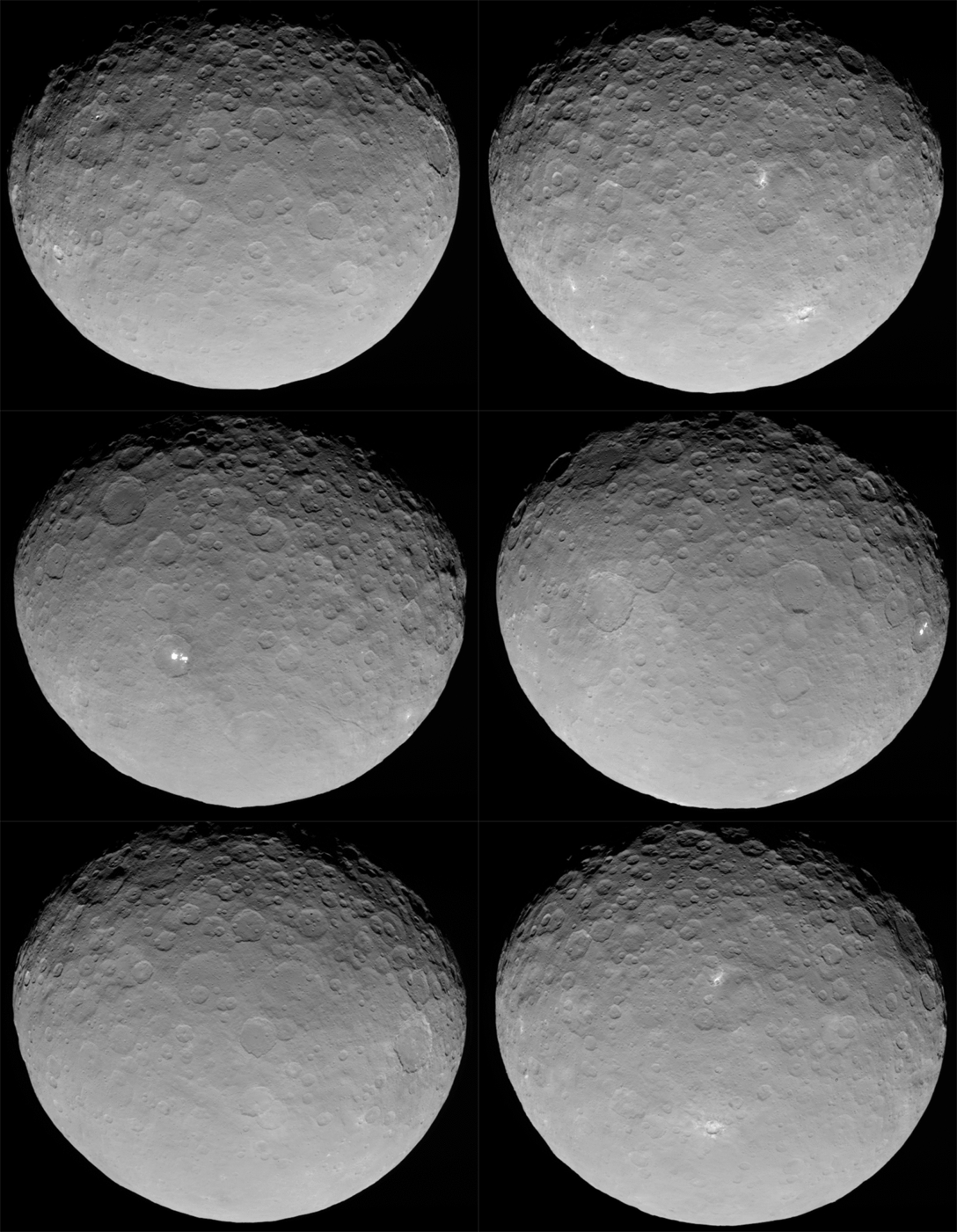
    Ceres Animation Showcases Bright Spots
    This animation shows a sequence of images taken by NASA’s Dawn spacecraft on May 4, 2015, from a distance of 8,400 miles (13,600 kilometers), in its RC3 mapping orbit. The image resolution is 0.8 miles (1.3 kilometers) per pixel. Credit: NASA/JPL-Caltech/UCLA/MPS/DLR/IDA

    A new sequence of images taken by NASA’s Dawn spacecraft shows the mysterious bright spots on the dwarf planet Ceres. The images were taken on May 3 and 4, 2015 from a distance of 8,400 miles (13,600 kilometers).

    In this closest-yet view, the brightest spots within a crater in the northern hemisphere are revealed to be composed of many smaller spots. However, their exact nature remains unknown.

    “Dawn scientists can now conclude that the intense brightness of these spots is due to the reflection of sunlight by highly reflective material on the surface, possibly ice,” said Christopher Russell, principal investigator for the Dawn mission from the University of California, Los Angeles.

    These images offer scientists new insights into crater shapes and sizes, and a host of other intriguing geological features on the surface. The image resolution is 0.8 miles (1.3 kilometers) per pixel.

    Dawn has now concluded its first mapping orbit, in which it completed one 15-day full circle around Ceres while making a host of new observations with its scientific instruments. On May 9, the spacecraft powered on its ion engine to begin the month-long descent toward its second mapping orbit, which it will enter on June 6. In this next phase, Dawn will circle Ceres about every three days at an altitude of 2,700 miles (4,400 kilometers) — three times closer than the previous orbit. During this phase, referred to as Dawn’s survey orbit, the spacecraft will comprehensively map the surface to begin unraveling Ceres’ geologic history and assess whether the dwarf planet is active. The spacecraft will pause twice to take images of Ceres as it spirals down into this new orbit.

    Dawn is the first mission to visit a dwarf planet, and the first to orbit two distinct solar system targets. It studied giant asteroid Vesta for 14 months in 2011 and 2012, and arrived at Ceres on March 6, 2015.

    Dawn’s mission is managed by JPL for NASA’s Science Mission Directorate in Washington. Dawn is a project of the directorate’s Discovery Program, managed by NASA’s Marshall Space Flight Center in Huntsville, Alabama. UCLA is responsible for overall Dawn mission science. Orbital ATK Inc., in Dulles, Virginia, designed and built the spacecraft. The German Aerospace Center, Max Planck Institute for Solar System Research, Italian Space Agency, and Italian National Astrophysical Institute are international partners on the mission team.

    Never miss a breakthrough: Join the SciTechDaily newsletter.
    Follow us on Google and Google News.

    Astronomy Ceres Dawn Spacecraft NASA Planetary Science
    Share. Facebook Twitter Pinterest LinkedIn Email Reddit

    Related Articles

    What’s Creating Those Unusual Bright Spots on Ceres? Dawn Heads Toward Low-Altitude Mapping Orbit

    Dawn Spacecraft Reveals New Maps and Insights about Ceres

    New Up-Close View of the Bright Spots on Ceres

    NASA’s Dawn Spacecraft Delivers Sharper Images Ceres

    New NASA Video Highlights Dwarf Planet Ceres

    NASA’s Dawn Reveals Topography of Dwarf Planet Ceres

    Ceres Spots Remain a Mystery in Latest Dawn Images

    New Fly Over Video Shows a Unique Perspective of Ceres

    A New View of Ceres, Dawn Shows Finer Detail

    1 Comment

    1. John on May 16, 2015 5:19 pm

      Very interesting, some people have even said that the spots where evidence of aliens! of course there is a logical explanation!

      Reply
    Leave A Reply Cancel Reply

    • Facebook
    • Twitter
    • Pinterest
    • YouTube

    Don't Miss a Discovery

    Subscribe for the Latest in Science & Tech!

    Trending News

    Breakthrough Bowel Cancer Trial Leaves Patients Cancer-Free for Nearly 3 Years

    Natural Compound Shows Powerful Potential Against Rheumatoid Arthritis

    100,000-Year-Old Neanderthal Fossils in Poland Reveal Unexpected Genetic Connections

    Simple “Gut Reset” May Prevent Weight Gain After Ozempic or Wegovy

    2.8 Days to Disaster: Scientists Warn Low Earth Orbit Could Suddenly Collapse

    Common Food Compound Shows Surprising Power Against Superbugs

    5 Simple Ways To Remember More and Forget Less

    The Atomic Gap That Could Cost the Semiconductor Industry Billions

    Follow SciTechDaily
    • Facebook
    • Twitter
    • YouTube
    • Pinterest
    • Newsletter
    • RSS
    SciTech News
    • Biology News
    • Chemistry News
    • Earth News
    • Health News
    • Physics News
    • Science News
    • Space News
    • Technology News
    Recent Posts
    • After 37 Years, the World’s Longest-Running Soil Warming Experiment Uncovers a Startling Climate Secret
    • NASA Satellite Captures First-Ever High-Res View of Massive Pacific Tsunami
    • ADHD Isn’t Just a Deficit: Study Reveals Powerful Hidden Strengths
    • Scientists Uncover “Astonishing” Hidden Property of Light
    • Scientists Discover Stem Cells That Could Regrow Teeth and Bone
    Copyright © 1998 - 2026 SciTechDaily. All Rights Reserved.
    • Science News
    • About
    • Contact
    • Editorial Board
    • Privacy Policy
    • Terms of Use

    Type above and press Enter to search. Press Esc to cancel.