
New research highlights the role of microorganisms in protecting corals from heat stress.
Researchers discovered for the first time a single-celled microbe that can help corals survive ocean-warming events like bleaching. The new study, led by scientists at the University of Miami Rosenstiel School of Marine, Atmospheric, and Earth Science and the Institute of Evolutionary Biology (IBE: CSIC-UPF) in Barcelona, offers new information on the role microbes might play in helping corals withstand end-of-century warming projections.
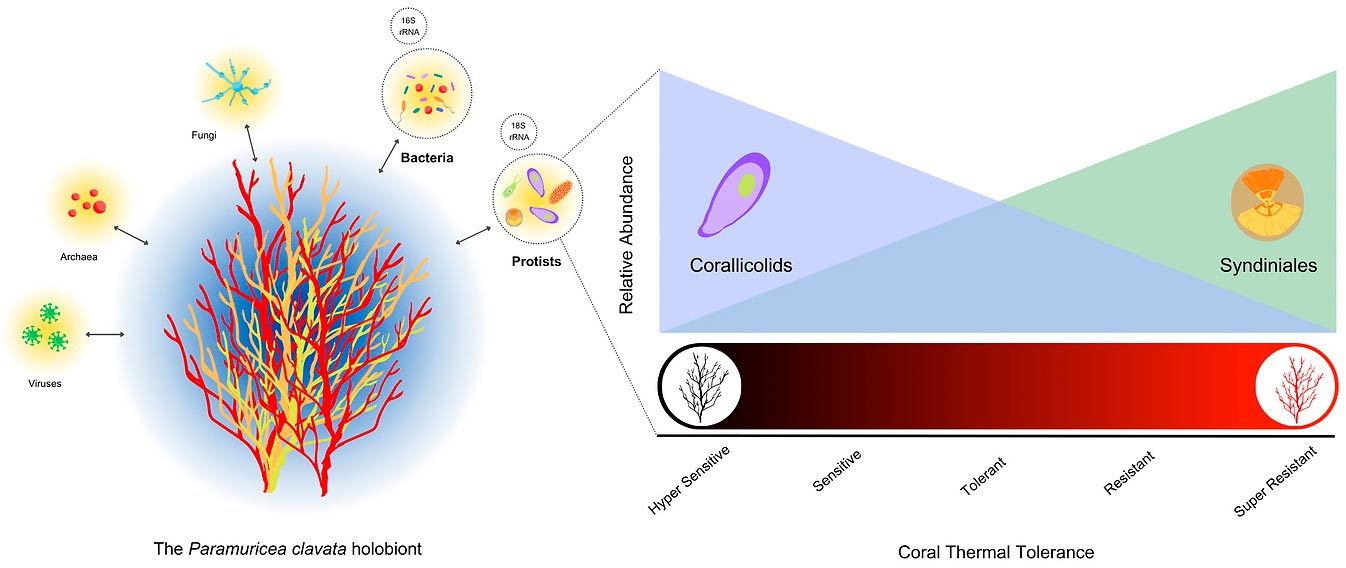
They found that the abundance of certain protists within the coral microbiome — the diverse microorganisms that live within corals — can inform scientists as to whether a coral will survive heat stress. These findings have important implications for corals across the globe as they face more frequent ocean warming events especially those without zooxanthellae, the symbiotic algae that is expelled from a coral during warm water-induced bleaching.
“This is the first time that a non-algae microbe has been shown to influence the ability of corals to survive a heat-stress event,” said the study’s senior author Javier del Campo, an adjunct assistant professor at the Rosenstiel School and principal investigator of the IBE, a joint center of the Spanish National Research Council (CSIC) and University Pompeu Fabra (UPF). “As corals face more and more heat-stress events due to climate change, a better understanding of all the microbes that may influence survivability can inform conservation practitioners as to which corals they should prioritize for intervention.”
To conduct the study, the international team of researchers collected coral samples from across the Mediterranean to analyze their microbiome and conduct heat-stress experiments. They amplified and sequenced two types of rRNA to look at the bacteria and protists found in the microbiome of one species of soft coral, the violescent sea-whip (Paramuricea clavata), before subjecting them to a natural heat stress in the lab to examine signs of mortality.
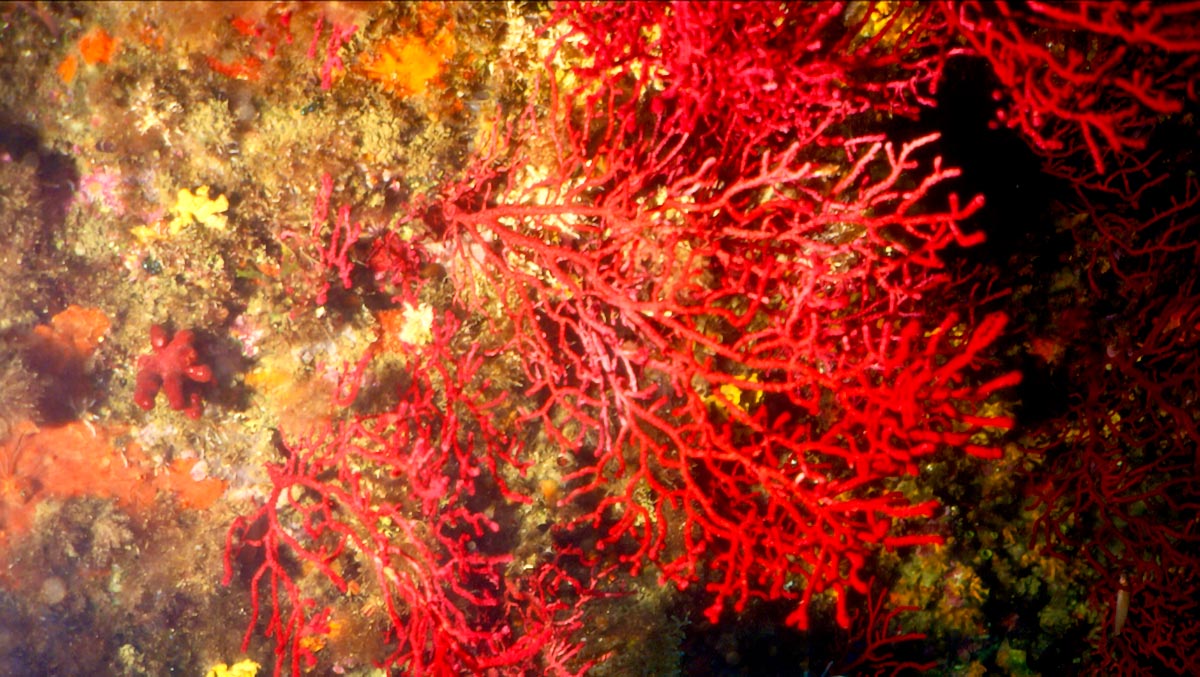
Paramuricea clavata is an important architect of the Mediterranean temperate reefs that is currently threatened by mass mortality events related to global warming.
They found that a group of parasitic single-celled protists — called Syndiniales —are more common in corals that survive heat stress, while Corallicolids, a group of protist closely related to the parasite that causes malaria in humans is more common in corals that die from heat stress.
Protists, or single-cell eukaryotes, are less studied than bacteria in most host organisms but may have a major influence on the health of their coral host, according to the researchers
“The microbiome is a vital component of coral host health and we should study all members of it from the bacteria to the protists,” said del Campo.
The study, titled “Differential apicomplexan presence predicts thermal stress mortality in the Mediterranean coral Paramuricea clavata” was recently published in the journal Environmental Microbiology.
Reference: “Differential apicomplexan presence predicts thermal stress mortality in the Mediterranean coral Paramuricea clavata” by Anthony M. Bonacolta, Jordi Miravall, Daniel Gómez-Gras, Jean-Baptiste Ledoux, Paula López-Sendino, Joaquim Garrabou, Ramon Massana and Javier del Campo, 10 December 2023, Environmental Microbiology.
DOI: 10.1111/1462-2920.16548
The study’s authors include: Anthony Bonacolta and Javier del Campo from the Rosenstiel School and the Institute of Evolutionary Biology (IBE: CSIC-UPF); Jordi Miravall, Paula López-Sendino, Joaquim Garrabou, and Ramon Massana from the Institut de Ciències del Mar-CSIC in Barcelona, Spain; Daniel Gómez-Gras from the University of Hawai‘i at Mānoa; and Jean-Baptiste Ledoux from the Universidade do Porto in Portugal.
The study was supported by grant from the University of Miami, Agencia Estatal de Investigación (PID2020-118836GA-I00), Departament de Recerca i Universitats de la Generalitat de Catalunya (Project 2021 SGR 00420), Severo Ochoa Centre de Excellence (CEX2019-000928-S), Ministério da Educação e Ciência, Fundação para a Ciência e a Tecnologia (2021.00855) and European Union Futuremares (SEP-210597628).
Never miss a breakthrough: Join the SciTechDaily newsletter.
Follow us on Google and Google News.