
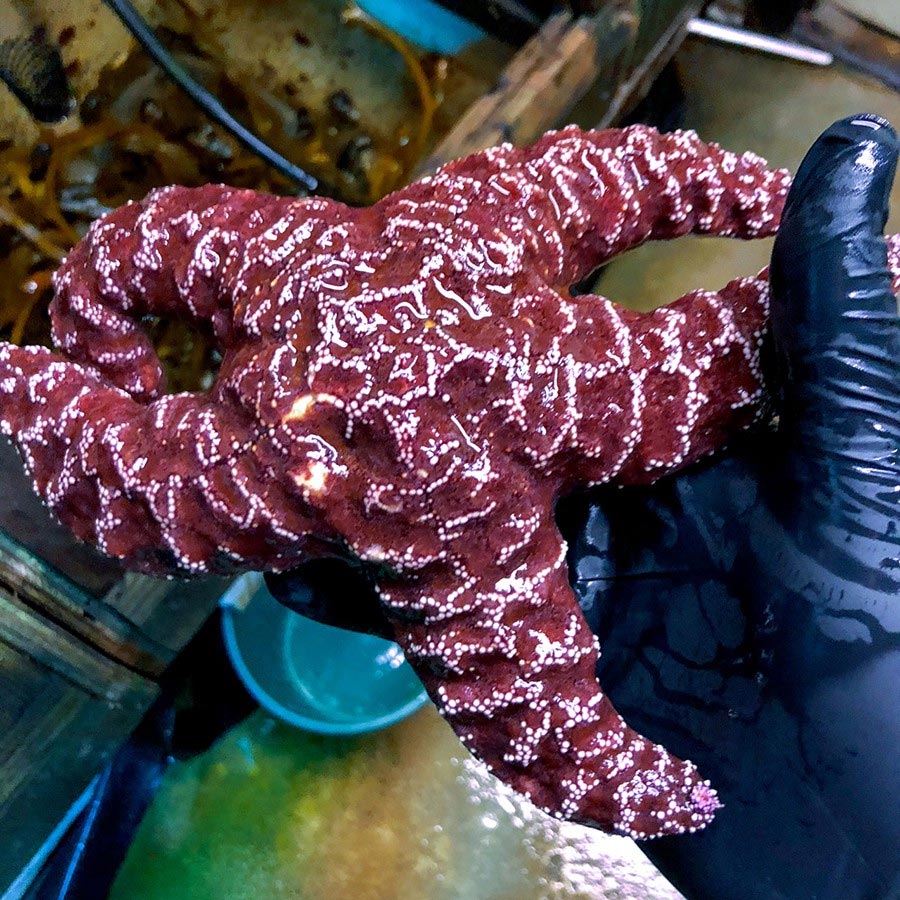
Sea star wasting disease may stem from oxygen loss due to bacterial overgrowth, not just pathogens.
For more than seven years, a mysterious wasting disease has nearly killed off sea star populations around the world. Some of these species stand at the brink of extinction.
New Cornell-led research suggests that starfish, victims of sea star wasting disease (SSWD), may actually be in respiratory distress – literally “drowning” in their own environment – as elevated microbial activity derived from nearby organic matter and warm ocean temperatures rob the creatures of their ability to breathe.
“As humans, we breathe, we ventilate, we bring air into our lungs and we exhale,” said Ian Hewson, professor of microbiology in the College of Agriculture and Life Sciences. “Sea stars diffuse oxygen over their outer surface through little structures called papulae, or skin gills. If there is not enough oxygen surrounding the papulae, the starfish can’t breathe.”
The research, “Evidence That Microorganisms at the Animal-Water Interface Drive Sea Star Wasting Disease,” was published on January 6, 2021, in the journal Frontiers in Microbiology.
Microbial Activity Disrupts Oxygen Levels
According to Hewson, ocean conditions lead to the production of unusual amounts of organic material, which he said prompts bacteria to thrive. As bacteria consume the organic matter, they deplete the oxygen in the water – creating a low-oxygen micro-environment that surrounds starfish and leads to deflation, discoloration, puffiness, and limb twisting or curling.
“It’s a cascade of problems that starts with changes in the environment,” Hewson said, explaining that most of the organic matter comes from microscopic algae exudation (a discharge), zooplankton excretion and egestion, and from decaying animal carcasses. This stimulates a group of bacteria called copiotrophs, which survive on carbon and rapidly consume organic matter, he said.
The copiotrophs respire, he said, so while absorbing the organic matter, they deplete oxygen in the sea star’s watery space.
The Illusion of Contagion
“It’s organic matter concentrations in the water,” he said. “If you have a dead and rotting starfish next to starfish that are healthy, all of that dead one’s organic matter drifts and fuels the bacteria, creating a hypoxic environment. It looks like disease is being transmitted.”
Hewson said that while more scientific work must be done, “This reframes the discussion about marine disease ecology, which has focused on pathogenic disease,” he said. “We should now include microorganisms that don’t directly cause the pathology, since they may hold a key to affecting sea star health.”
Reference: “Evidence That Microorganisms at the Animal-Water Interface Drive Sea Star Wasting Disease” by Citlalli A. Aquino, Ryan M. Besemer, Christopher M. DeRito, Jan Kocian, Ian R. Porter, Peter T. Raimondi, Jordan E. Rede, Lauren M. Schiebelhut, Jed P. Sparks, John P. Wares and Ian Hewson, 6 January 2021, Frontiers in Microbiology.
DOI: 10.3389/fmicb.2020.610009
In addition to Hewson, Cornellians on this research include Christopher M. DeRito, researcher, Department of Microbiology; Ian R. Porter, assistant clinical professor, College of Veterinary Medicine; Jordan E. Rede, graduate student, Department of Microbiology; and Jed P. Sparks, professor, Department of Ecology and Evolutionary Biology.
Other contributors are Citlalli A. Aquino, graduate student, San Francisco State University; Ryan M. Besemer, undergraduate student, University of North Carolina at Wilmington; Jan Kocian, diver and photographer; Peter Raimondi, professor, University of California Santa Cruz; Lauren M. Schiebelhut, postdoctoral researcher, University of California, Merced; and John P. Wares, professor, University of Georgia.
The research was supported by the National Science Foundation and the U.S. Geological Survey.
Never miss a breakthrough: Join the SciTechDaily newsletter.
Follow us on Google and Google News.
1 Comment
We still may have some time to stop this whole stuff. If we provide some huge amount of Chemical components in Some of the Coral reefs… This may stop. Though We still have to think for the wellbeing of other thousands of Marine species also.