
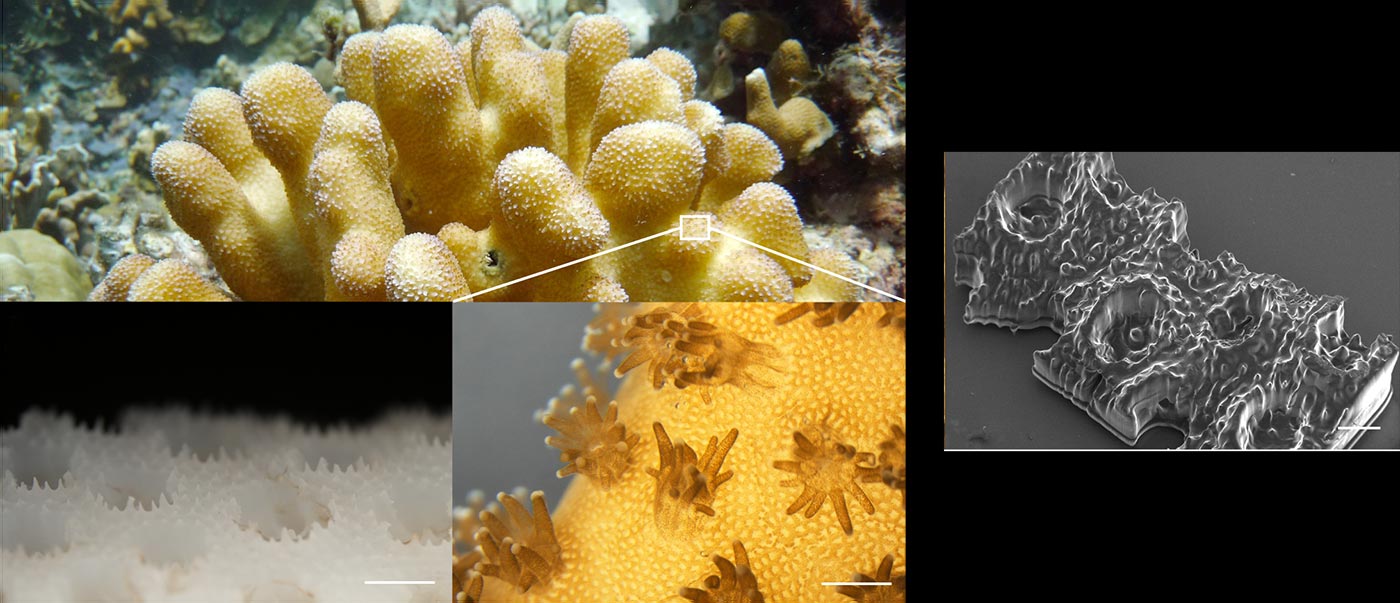
Researchers at the University of California San Diego (UCSD) and the University of Cambridge have 3D-printed coral-inspired structures that are capable of growing dense populations of microscopic algae. The work, published April 9, 2020, in Nature Communications, could lead to the development of compact, more efficient bioreactors for producing algae-based biofuels. It could also help researchers develop new techniques to repair and restore coral reefs.
In tests, the printed coral structures grew a commercial strain of microalgae, Marinichlorella kaistiae, up to 100 times more densely than natural corals.
“Corals are one of the most efficient organisms at using, capturing, and converting light to generate energy. And they do so in extreme environments, where light is highly fluctuating and there’s limited space to grow. Our goal here was to use corals as inspiration to develop more productive techniques for growing microalgae as a form of sustainable energy,” said first author Daniel Wangpraseurt, a marine scientist at the University of Cambridge.

To build the coral structures, Wangpraseurt teamed up with UC San Diego nanoengineering professor Shaochen Chen, whose lab specializes in a rapid, 3D bioprinting technology capable of reproducing detailed structures that mimic the complex designs and functions of living tissues. Chen’s method can print structures with micrometer-scale resolution in just minutes.
This is critical for replicating structures with live cells, Chen said.
“Most of these cells will die if we were to use traditional extrusion-based or inkjet 3D printing processes because these methods take hours. It would be like keeping a fish out of the water; the cells that we work with won’t survive if kept too long out of their culture media. Our process is high throughput and offers really fast printing speeds, so it’s compatible with human cells, animal cells, and even algae cells in this case,” he said.
The 3D-printed corals are built to capture and scatter light more efficiently than natural corals. They consist of cup-shaped, artificial skeletons that support coral-like tissue. The skeleton is made up of a biocompatible polymer gel, called PEGDA, embedded with cellulose nanocrystals. The coral tissue consists of a gelatin-based polymer hydrogel, called GelMA, mixed with living algae cells and cellulose nanocrystals.
On the surface are tiny cylindrical structures that act as coral tentacles, which increase the surface area for absorbing light. Nanocrystals embedded in the skeleton and coral tissue, along with the corals’ cup shape, also improves light absorption and enable more light to be focused onto algae cells so that they photosynthesize more efficiently.
In future studies, Chen and Wangpraseurt will build on this work to better understand the symbiosis between algae and corals. Their ultimate goal is to apply their findings to help coral reef restoration projects.
Read Bionic 3D-Printed Corals to Optimize Bioenergy and Help Coral Reefs for more on this study.
Reference: “Bionic 3D printed corals” Daniel Wangpraseurt, Shangting You, Farooq Azam, Gianni Jacucci, Olga Gaidarenko, Mark Hildebrand, Michael Kühl, Alison G. Smith, Matthew P. Davey, Alyssa Smith, Dimitri D. Deheyn, Shaochen Chen and Silvia Vignolini, 9 April 2020, Nature Communications.
DOI: 10.1038/s41467-020-15486-4
This study was funded by the European Union’s Horizon 2020 research and innovation program (702911-BioMIC-FUEL), the European Research Council (ERC-2014-STG H20202 639088), the David Phillips Fellowship, the National Institutes of Health (R21HD090662 and R01EB021857), the National Science Foundation (1907434), the Carlsberg Foundation and the Villum Foundation (00023073).
Never miss a breakthrough: Join the SciTechDaily newsletter.
Follow us on Google and Google News.