
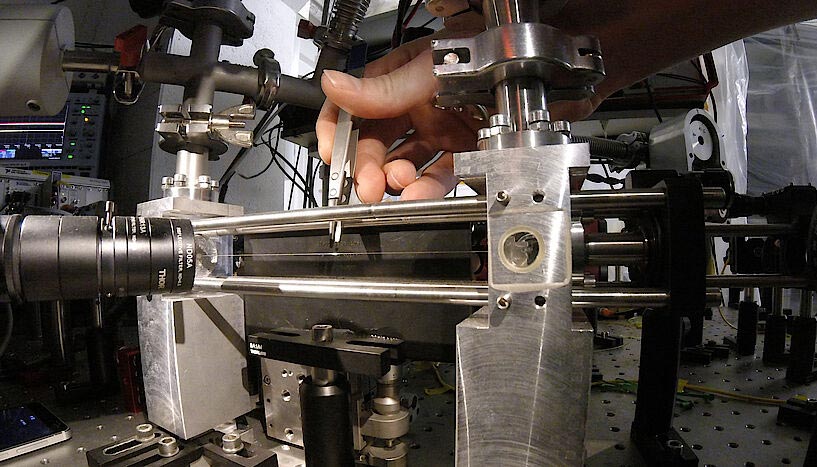
Researchers at the Universities Vienna and Stuttgart have investigated a version of Maxwell’s demon embodied by a delayed feedback force acting on a levitated microparticle. They confirmed new fundamental limits that time delay imposes on the demon’s actions which are not covered by the standard laws of thermodynamics. The team of scientists published their new study in the journal Nature Communications.
A Maxwell’s demon is a hypothetical intelligent being capable of detecting and reacting to the motions of individual molecules. In his thought experiment, James Clerk Maxwell imagined a demon that controls a small door connecting two chambers of gas molecules. By letting pass only the fast hot molecules in one chamber, the demon separates cold from hot molecules therefore decreasing the disorder, entropy, of the system in apparent contradiction with the second law of thermodynamics.
Nowadays, the thought experiment of Maxwell’s demon can be realized by e.g. a microparticle subjected to feedback control. This means that the position of a particle is measured, the information is stored and used to extract energy from the microparticle by applying a suitable feedback force. In previous studies, however, the reaction time of the demon had never been considered. This has an impact on the performance of the demon and should be taken into consideration in realistic scenarios.
Building on a recent theoretical study by M.L. Rosinberg and T. Munakata, an international collaboration of researchers at the University of Vienna (Austria) and at the University of Stuttgart (Germany) have now investigated the effect of time delay in a thermodynamic approach to Maxwell’s demon. The scientists used a microparticle which was optically levitated by laser light. The particle oscillates in an optical tweezer in vacuum while being exposed to random collisions with the surrounding gas, called Brownian motion. The demon realized by an electronic circuit acquires information about the microparticle by tracking its position, and applies, after a certain delay, a corresponding feedback force on the microparticle using a second laser. From their experiment, the scientists were able to determine thermodynamic quantities such as exchanged heat and entropy flow. Their results successfully confirm the novel version of the second law including time delay. “We have used a thermodynamics approach to understand the role of time delays in realistic feedback loops. Here, levitated microparticles are an ideal testbed that offers excellent control on the particle dynamics” says Maxime Debiossac, lead author of the study.
As a consequence of the new study, the entropy flow puts new limits on the extracted energy, or in other words, on how efficiently a demon can work. In addition to quantifying this efficiency, the scientists observed that for very long delays the demon causes some random motion of the particle which is different from the usual Brownian motion. “Our results indicate thermodynamic limits that will also affect those experiments that rely on feedback to bring mechanical systems into the quantum regime,” says Nikolai Kiesel, head of the team from the University of Vienna, “we are now very curious about the consequences our research will have for that regime.”
Reference: “Thermodynamics of continuous non-Markovian feedback control” by Maxime Debiossac, David Grass, Jose Joaquin Alonso, Eric Lutz and Nikolai Kiesel, 13 March 2020, Nature Communications.
DOI: 10.1038/s41467-020-15148-5
Never miss a breakthrough: Join the SciTechDaily newsletter.
Follow us on Google and Google News.