
Researchers have shown that surprisingly large metal particles can behave according to quantum mechanics, existing in multiple states at once.
Can a tiny piece of metal exist in a quantum state spread across multiple locations at once? Researchers at the University of Vienna say yes.
Writing in Nature, scientists from the University of Vienna and the University of Duisburg-Essen report that even relatively large nanoparticles made of thousands of sodium atoms still obey the laws of quantum mechanics. Their work represents one of the most rigorous tests yet of quantum behavior at a near macroscopic scale.
Matter as a wave
Quantum theory shows that matter, like light, can act as both a particle and a wave. This dual behavior has been confirmed many times in experiments with electrons, atoms, and small molecules, often using interference or double-slit setups. In everyday life, however, objects such as dust or stones appear to follow predictable paths and occupy definite positions, consistent with classical physics.
The Vienna team, led by Markus Arndt and Stefan Gerlich, has now shown that this wave-like behavior also applies to much larger metallic particles. Their sodium clusters measure about 8 nanometers in diameter (about 0.0000003 inches) and have a mass exceeding 170,000 atomic mass units, making them heavier than most proteins. Even so, the researchers were able to detect clear quantum interference patterns from these particles.
“Intuitively, one would expect such a large lump of metal to behave like a classical particle,” says lead author and doctoral student Sebastian Pedalino. “The fact that it still interferes shows that quantum mechanics is valid even on this scale and does not require alternative models.”
“Schrödinger’s metal lump”
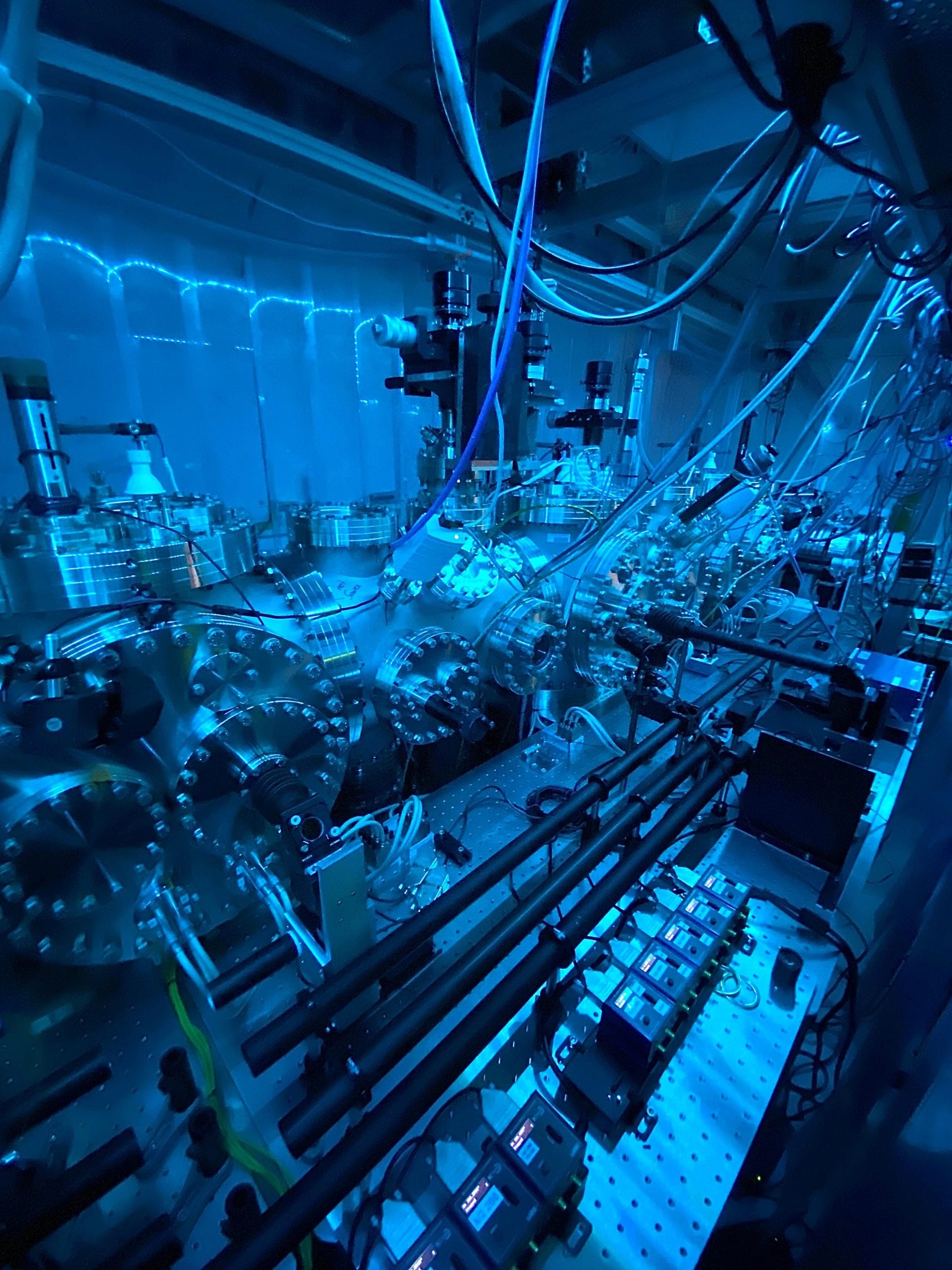
To carry out the experiment, the team created cold sodium clusters containing between 5,000 and 10,000 atoms. These clusters passed through three diffraction gratings formed by ultraviolet laser beams. The first laser fixed each cluster’s position in a repeating pattern spaced one ten-thousandth of a millimeter apart, with a precision of about 10 nm. This setup placed the particles into a superposition, meaning they could take multiple paths through the system at once.
As these paths overlapped, they produced a striped interference pattern that matched predictions from quantum theory. The results show that the particles do not have a single defined position while in flight. Instead, their spread in space is many times larger than their actual size.
Physicists describe this behavior as a Schrödinger cat state, referencing Erwin Schrödinger’s famous thought experiment a cat that is both alive and dead at the same time. In this case, the analogy applies to metal particles. As the researchers put it, “every piece of metal is here and not here.”
New scale achieved in the University of Vienna laboratory
The theoretical framework behind this work builds on two decades of research in near-field interferometry by Klaus Hornberger (University of Duisburg Essen), a co-author of the study. Hornberger and Stefan Nimmrichter (then University of Vienna) also introduced the concept of macroscopicity, which allows scientists to compare how strongly different experiments test quantum theory across systems such as nano-oscillators, atomic interferometers, and nanoacoustic resonators.
In this study, the team achieved a macroscopicity value of μ = 15.5, about ten times higher than previous experiments. For comparison, reaching a similar level with electrons would require maintaining a quantum superposition for roughly 100 million years. The nanoparticles in this experiment achieved it in about one hundredth of a second.
Outlook and applications
The study aims to shed light on why quantum effects appear so unusual, while everyday objects behave in familiar ways. Future experiments will explore even larger particles and different materials, offering more stringent tests of quantum theory.
With improved equipment, the researchers hope to increase their results by several orders of magnitude. The Vienna interferometer is also a highly sensitive force sensor that can currently measure forces in the range of 10-26 N and will be even more sensitive in the future. This opens up new perspectives for precision measurements, such as electrical, magnetic, or optical properties of isolated nanoparticles—an exciting addition to established methods in nanotechnology.
Reference: “Probing quantum mechanics with nanoparticle matter-wave interferometry” by Sebastian Pedalino, Bruno E. Ramírez-Galindo, Richard Ferstl, Klaus Hornberger, Markus Arndt and Stefan Gerlich, 21 January 2026, Nature.
DOI: 10.1038/s41586-025-09917-9
Funding: Der Gordon & Betty Moore Foundation grant GMBF10771, Fonds zur Förderung Wissenschaftlicher Forschung, FWF, MUSCLE #32542-N
Never miss a breakthrough: Join the SciTechDaily newsletter.
Follow us on Google and Google News.
9 Comments
As I’ve written several times before, the juxtaposition of photons, electrons, some molecules and now clumps of sodium atoms in double-slit/interferometer experiments is easily explained with lines of gravity force being pulsing, angular and coherent, induced by some still scientifically unidentified higher force to radiate out from all matter to the extremes of the universe. Furthermore, the ways I’ve tried to prove that have been with rotating wheels and aluminum disks in now four (most recent, June, 2025; https://odysee.com/@charlesgshaver:d/5Gravity:c) online videos since 2012. Generally, my focus has been on how rotation increases the strength of gravity in rotating objects, eliminating any need for dark matter to explain the unexpected velocities of outer objects in spiral galaxies. Now, I’m just backtracking to the misinterpretation of the 1801 Thomas Young double-slit experiments; no duality of particles and waves, just pulsing angular lines of gravity force redirecting the not too massive particles in the experiments.
Are you inferring that angular momentum impacts graviton polarization, thus fudging our gravity measurements on large-scale cosmology? That’s an interesting thought…
No, Nathan, I’m stating and demonstrating that gravity is similar to electromagnetism except that by being induced to radiate outward by some higher form of pulsing radiant energy it is intensfied in rotating objects in terms of increased moments of impacted mass per measures of time (e.g., kilograms/second?) even at ground level in earth’s own ambient field. I don’t believe gravitons exist, any more than dark matter or gravity waves, minimally, do. Yes, “thus fudging our gravity measurements on large-scale cosmology.”
How can you be in two places at once when you’re not anywhere at all?
Could this experiment also relate to multiple or twin universes with identical “states?” I think so even though we can’t prove it currently. Just a “gut” feeling.
The benefits of doing this with things as large as bullets………………….why bother with machine guns?
Hmmm. Now find the resonant frequency of any part or all of a cancer cell(s) and quantum extract (replaced with saline) that out of a person. Boom quantum surgery field is born. Hehehe; but seriously, why not.
I’m reminded of what Tu Shun remarked: “Form is not void because it is void.” Our inability to conceive of, and perceive actual “reality” is what has blinded us to our real location in the infinite web of “existence.” An entirely new view of our science is called for, and the obvious quantum nature of what goes on in our cell structure is a message.
The Quantum world is moving closer.