
Close Menu
    Facebook X (Twitter) Instagram
    SciTechDaily
    • Biology
    • Chemistry
    • Earth
    • Health
    • Physics
    • Science
    • Space
    • Technology
    Facebook X (Twitter) Pinterest YouTube RSS
    SciTechDaily
    Home»Earth»Discovery of Metamorphic Rock Microdiamonds Has Geologists Questioning Japan’s History
    Earth

    Discovery of Metamorphic Rock Microdiamonds Has Geologists Questioning Japan’s History

    By Kumamoto UniversitySeptember 4, 20202 Comments3 Mins Read
    Facebook Twitter Pinterest Telegram LinkedIn WhatsApp Email Reddit
    Share
    Facebook Twitter LinkedIn Pinterest Telegram Email Reddit
    Microdiamond Crystals
    Since the crystals of microdiamond are finer than 1 micron, they were confirmed by the latest analytical techniques such as Raman spectroscopy, soft X-ray spectroscopy, and transmission electron microscopy.
    a: Electron micrograph of micro diamond aggregate
    b: Single crystals and crystallographic orientation of microdiamonds
    c: Electron diffraction pattern of microdiamond
    Credit: Professor Tadao Nishiyama

    A collaboration of researchers based in Kumamoto University, Japan have discovered microdiamonds in the Nishisonogi metamorphic rock formation in Nagasaki Prefecture, Japan. Microdiamonds in metamorphic rocks are important minerals because they form in continental collision zones and show that the crust has penetrated deeper than 120 km below the surface. This is the second area in the world, after the Italian Alps, that shows microdiamonds can form in metamorphic rock through subduction of oceanic plates.

    In recent years, microdiamonds have received a great deal of attention because they have been discovered in metamorphic rocks around the world and it has become clear that they are formed in collisions between continents. It was thought that Japan would not produce such microdiamonds because it is not a continental collision zone, but an oceanic plate subduction zone. However, the first microdiamonds from metamorphic rocks in Japan were found in the Nishisonogi metamorphic rock formation in the west coast of Nagasaki Prefecture.
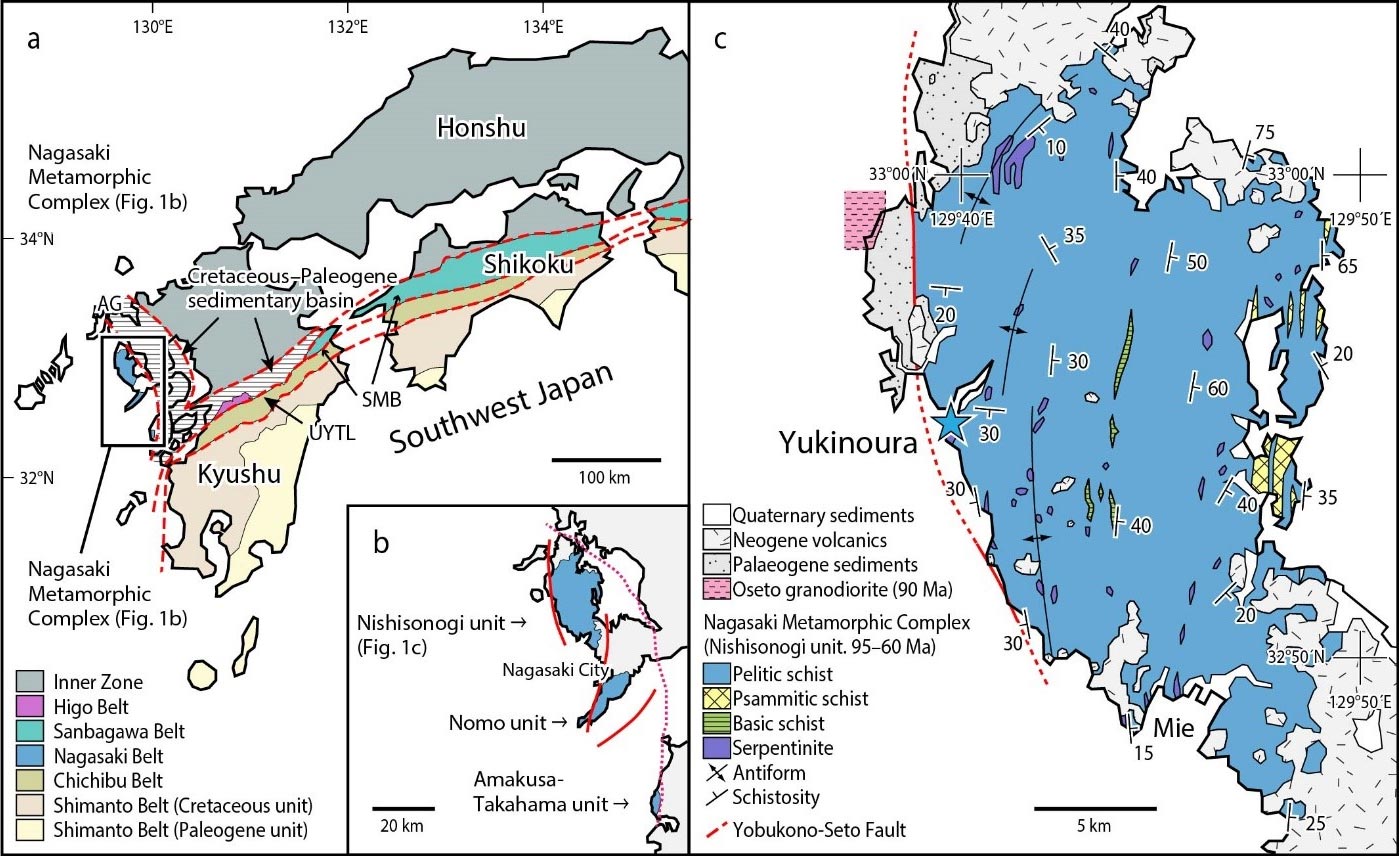
    Geological Map of Yukinoura District
    a: Geological zone in western Japan. The blue-green part is the Sanbagawa belt that crosses mainland Japan. The Nishisonogi metamorphic rock was thought to belong to the same geological formation as the Sanbagawa belt.
    b: Enlarged map of Saikai city.
    c: An enlarged view of the Yukinoura district of Saikai City. The star indicates where microdiamonds were found.
    Credit: Professor Tadao Nishiyama

    The area where the microdiamonds were discovered is an approximately 100-million-year-old Cretaceous metamorphic rock formation. On the west coast of Saikai City in Nagasaki Prefecture, blocks of pelitic and basic schist are scattered amongst serpentinite that was created from mantle material. Such rocks are called a serpentinite mélange and indicate that they have risen from deep in the subduction zone. Researchers found microdiamonds here, in the serpentinite mélange. Their formation conditions have been estimated to be a temperature of about 450 °C and a pressure of about 2.8 GPa, which makes them the coldest diamonds ever formed. It has been thought that the Nishisonogi metamorphic rock was formed under a pressure of about 1 GPa, but it is now clear that they were ultrahigh-pressure metamorphic rocks that rose after subducting to 120 km–a very unexpected discovery.

    “The discovery of microdiamonds from Japan’s first metamorphic rocks will rewrite Japan’s geological history,” said Professor Tadao Nishiyama, the leader of this study. “Until now, the Nagasaki metamorphic rocks were said to belong to a low-temperature, high-pressure-type metamorphic rock belt, the “Sanbagawa Belt,” which crosses the Japanese mainland. It has become clear, however, that they are independently-formed ultrahigh-pressure metamorphic rocks. I expect that there will be many discussions about what kind of plate movement created this formation.”

    This research was posted online in Scientific Reports on July 15, 2020.

    Reference: “Microdiamond in a low-grade metapelite from a Cretaceous subduction complex, western Kyushu, Japan” by Tadao Nishiyama, Hiroaki Ohfuji, Kousuke Fukuba, Masami Terauchi, Ukyo Nishi, Kazuki Harada, Kouhei Unoki, Yousuke Moribe, Akira Yoshiasa, Satoko Ishimaru, Yasushi Mori, Miki Shigeno and Shoji Arai, 15 July 2020. Scientific Reports.
    DOI:10.1038/s41598-020-68599-7

    Never miss a breakthrough: Join the SciTechDaily newsletter.
    Follow us on Google and Google News.

    Geology Geophysics Tectonic Plates
    Share. Facebook Twitter Pinterest LinkedIn Email Reddit

    Related Articles

    Strange Precariously Balanced Rocks Provide Earthquake Forecasting Clues

    Deep Underground “Rock-Melting” Forces Explain Quakes on San Andreas Fault

    Deep-Earth Structures Discovered That May Signal Enormous Hidden Metal Lodes

    Researchers Dig Into Case of Geologic Amnesia – In Search of a Billion Years Missing From the Geologic Record

    Pūhāhonu Revealed: The Largest and Hottest Shield Volcano on Earth

    A Tale of Two Kinds of Volcanoes – One Partially Responsible for a Civilization’s Demise

    Great 2011 Japan Tsunami Magnified by Shifts in Deep Geologic Structure

    Yale Researchers Find a Soft Spot in the Nazca Plate

    Unusual Indian Ocean Earthquakes May Signal Tectonic Breakup

    2 Comments

    1. Hugh miller on September 4, 2020 7:14 pm

      Q. What kind of plate movement made this formation the author asked? Instead of the normal slow plate movement over millions of years maybe it was very rapid caused by an immense sized asteroid or Large comet strike?

      Reply
    2. John M Fischer on September 9, 2020 6:35 pm

      While deep burial is the usual choice, lateral compression leading to metamorphism should be considered. It could indicate a larger event.

      Reply
    Leave A Reply Cancel Reply

    • Facebook
    • Twitter
    • Pinterest
    • YouTube

    Don't Miss a Discovery

    Subscribe for the Latest in Science & Tech!

    Trending News

    Largest-Ever Study Finds Medicinal Cannabis Ineffective for Anxiety, Depression, PTSD

    250-Million-Year-Old Egg Solves One of Evolution’s Biggest Mysteries

    Living With Roommates Might Be Changing Your Gut Microbiome Without You Knowing

    Century-Old Cleaning Chemical Linked to 500% Increased Risk of Parkinson’s Disease

    What if Your Memories Never Happened? Physicists Take a New Look at the Boltzmann Brain Paradox

    One of the Universe’s Largest Stars May Be Getting Ready To Explode

    Scientists Discover Enzyme That Could Supercharge Ozempic-Like Weight Loss Drugs

    Popular Sweetener Linked to DNA Damage – “It’s Something You Should Not Be Eating”

    Follow SciTechDaily
    • Facebook
    • Twitter
    • YouTube
    • Pinterest
    • Newsletter
    • RSS
    SciTech News
    • Biology News
    • Chemistry News
    • Earth News
    • Health News
    • Physics News
    • Science News
    • Space News
    • Technology News
    Recent Posts
    • Scientists Say This Overlooked Organ Could Hold the Key to Longer Life
    • Want Less Stress? Landmark Study Points to a Simple Habit
    • Scientists Reveal Eating Fruits and Vegetables May Increase Your Risk of Lung Cancer
    • AI Reveals Explosive Growth of Floating Algae Across the World’s Oceans
    • 5.5 Million Bees Discovered Living Beneath a New York Cemetery
    Copyright © 1998 - 2026 SciTechDaily. All Rights Reserved.
    • Science News
    • About
    • Contact
    • Editorial Board
    • Privacy Policy
    • Terms of Use

    Type above and press Enter to search. Press Esc to cancel.