
G106.3+2.7 may be the first confirmed PeVatron, emitting 100+ TeV gamma rays linked to cosmic-ray collisions with a nearby molecular cloud.
The Tibet ASgamma experiment, a China-Japan joint research project, has discovered gamma rays beyond 100 TeV (tera electron volts) from G106.3+2.7, a supernova remnant (SNR) 2600 lightyears from Earth.
These gamma rays are of the highest energy ever observed from SNRs, and are probably produced in collisions between cosmic rays (protons) accelerated in G106.3+2.7 and a nearby molecular cloud.
“SNR G106.3+2.7 is thus the first candidate object with sufficient evidence in the Milky Way that can accelerate cosmic rays (protons) up to 1 PeV (peta electron volts),” said HUANG Jing, one of the leading researchers of the study from the Institute of High Energy Physics (IHEP) of the Chinese Academy of Sciences. “It will open an important window in the search for the ‘PeVatron’,” she said.
The study was published online in Nature Astronomy.
Cosmic rays are protons and other atomic nuclei arriving from space. They have been detected in the 109-1020 eV energy range. Astrophysical sources that can accelerate cosmic rays up to PeV energies are called ‘PeVatrons’, which can reach 100 times more energetic than the highest energy achieved in any man-made accelerator on Earth.
PeVatrons are believed to exist in our galaxy, but none have been detected yet, making it a long-standing mystery in the universe. Since cosmic rays can be deflected by the galactic magnetic field due to their electric charge, their arrival directions observed on Earth do not point back to their place of origin. Therefore, it is impossible to find a ‘PeVatron’ by using the direction of cosmic rays.
Tracing PeV Energies with Gamma Rays
Fortunately, cosmic rays, after accelerated at their sources, can collide with nearby molecular clouds and produce gamma rays. Gamma rays, with no electric charge, can travel straight from their sources to Earth, making it possible to trace their sources.
There are three criteria for the identification of a ‘PeVatron’, that is, gamma-ray emission beyond 100 TeV, coherence of the gamma-ray emission region and the location of a molecular cloud nearby, as well as exclusion of ‘leptonic origin’, namely source of high energy electrons of pulsars.
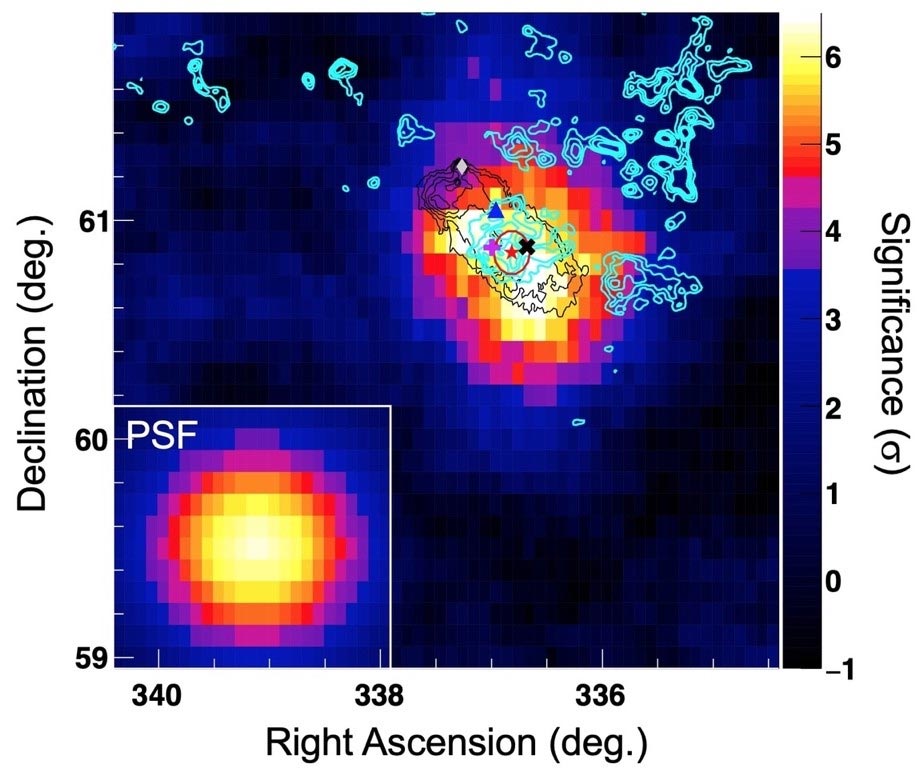
No astrophysical source ever detected meets the above three criteria so far. SNR G106.3+2.7 has been detected by the VERITAS Imaging Air Cherenkov Telescope at TeV energies and the Fermi Gamma-ray Space Telescope at GeV energies. However, neither of the two experiments is sensitive enough to 100 TeV gamma rays. Recently the HAWC experiment observed gamma-rays in the 40-100 TeV energy range from this SNR, but its gamma-ray emission region overlaps with PSR J2229+6114, the pulsar born in the supernova explosion of SNR G106.3+2.7 (Figure 1).
The Tibet ASgamma experiment team, using about two years’ data taken, observed ultrahigh-energy gamma rays up to and beyond 100 TeV from the supernova remnant (SNR) G106.3+2.7, and found that the gamma-ray emission region is far away from the pulsar at the northeast corner of G106.3+2.7 and in good agreement with the location of a nearby molecular cloud.
These observational facts suggest that cosmic-ray nuclei may be accelerated up to PeV energy in this SNR and then collide with the molecular cloud, thus producing gamma ray photons via the production and subsequent decay of neutral pions.
The important work shows that SNR G106.3+2.7 is a highly potential ‘PeVatron’ in our galaxy, which is a big step in the attempt to reveal the mysterious origin of cosmic rays.
The Tibet ASgamma Experiment
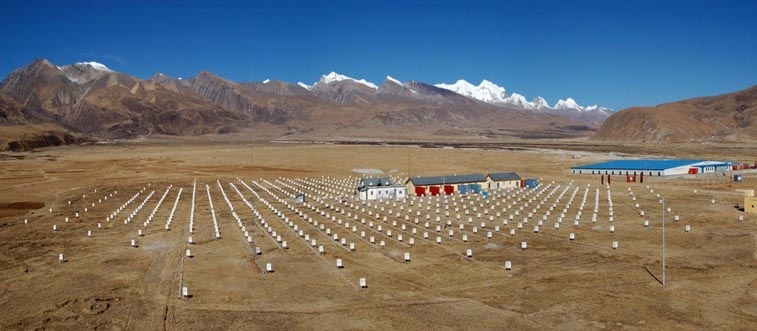
Located at an altitude of 4,300 m (14,000 ft) above sea level in the town of Yangbajing in Tibet, the Tibet ASgamma experiment has been operated jointly by China and Japan since 1990 (Figure 2). It involves 28 international institutions, including IHEP and ICRR, University of Tokyo, Japan.
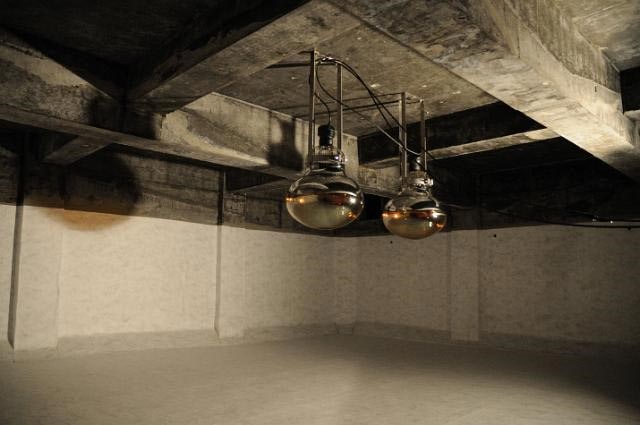
Since 2014, the team has added water-Cherenkov-type muon detectors under the existing cosmic-ray array (Figure 3). This enabled them to suppress 99.92% of the cosmic-ray background noise and thus improve sensitivity significantly.
Reference: “Potential PeVatron supernova remnant G106.3+2.7 seen in the highest-energy gamma rays” by The Tibet AS? Collaboration, 1 March 2021, Nature Astronomy.
DOI: 10.1038/s41550-020-01294-9
Never miss a breakthrough: Join the SciTechDaily newsletter.
Follow us on Google and Google News.