
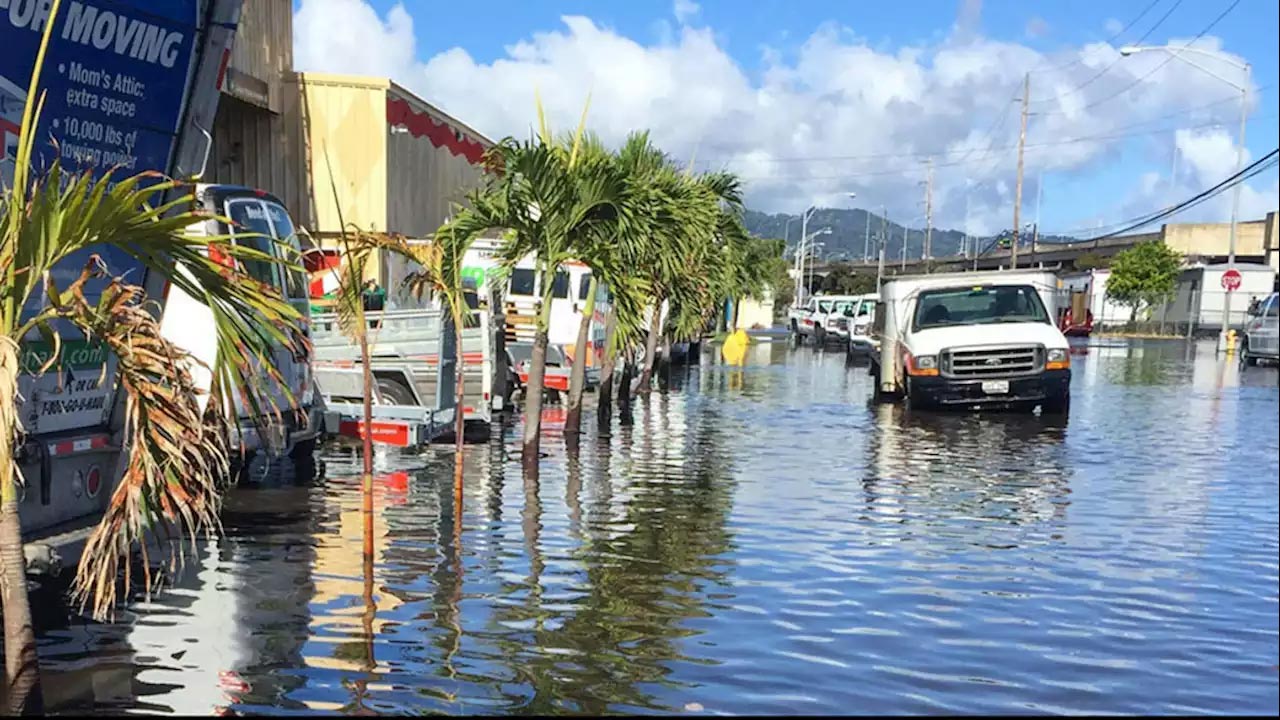
In the mid-2030s, every U.S. coast will experience rapidly increasing high-tide floods, when a lunar cycle will amplify rising sea levels caused by climate change.
High-tide floods – also called nuisance floods or sunny day floods – are already a familiar problem in many cities on the U.S. Atlantic and Gulf coasts. The National Oceanic and Atmospheric Administration (NOAA) reported a total of more than 600 such floods in 2019. Starting in the mid-2030s, however, the alignment of rising sea levels with a lunar cycle will cause coastal cities all around the U.S. to begin a decade of dramatic increases in flood numbers, according to the first study that takes into account all known oceanic and astronomical causes for floods.
Led by the members of the NASA Sea Level Change Science Team from the University of Hawaii, the new study shows that high tides will exceed known flooding thresholds around the country more often. What’s more, the floods will sometimes occur in clusters lasting a month or longer, depending on the positions of the Moon, Earth, and the Sun. When the Moon and Earth line up in specific ways with each other and the Sun, the resulting gravitational pull and the ocean’s corresponding response may leave city dwellers coping with floods every day or two.
Climate Change and the Moon’s Role in Rising Waters
“Low-lying areas near sea level are increasingly at risk and suffering due to the increased flooding, and it will only get worse,” said NASA Administrator Bill Nelson. “The combination of the Moon’s gravitational pull, rising sea levels, and climate change will continue to exacerbate coastal flooding on our coastlines and across the world. NASA’s Sea Level Change Team is providing crucial information so that we can plan, protect, and prevent damage to the environment and people’s livelihoods affected by flooding.”
“It’s the accumulated effect over time that will have an impact,” said Phil Thompson, an assistant professor at the University of Hawaii and the lead author of the new study, published this month in Nature Climate Change. Thompson pointed out that because high-tide floods involve a small amount of water compared to hurricane storm surges, there’s a tendency to view them as a less significant problem overall. “But if it floods 10 or 15 times a month, a business can’t keep operating with its parking lot under water. People lose their jobs because they can’t get to work. Seeping cesspools become a public health issue.”
The Moon’s 18.6-Year Wobble
Why will cities on such widely separated coastlines begin to experience these higher rates of flooding at almost the same time? The main reason is a regular wobble in the Moon’s orbit that takes 18.6 years to complete. There’s nothing new or dangerous about the wobble; it was first reported in 1728. What’s new is how one of the wobble’s effects on the Moon’s gravitational pull – the main cause of Earth’s tides – will combine with rising sea levels resulting from the planet’s warming.
In half of the Moon’s 18.6-year cycle, Earth’s regular daily tides are suppressed: High tides are lower than normal, and low tides are higher than normal. In the other half of the cycle, tides are amplified: High tides get higher, and low tides get lower. Global sea level rise pushes high tides in only one direction – higher. So half of the 18.6-year lunar cycle counteracts the effect of sea level rise on high tides, and the other half increases the effect.
The Moon is in the tide-amplifying part of its cycle now. However, along most U.S. coastlines, sea levels have not risen so much that even with this lunar assist, high tides regularly top flooding thresholds. It will be a different story the next time the cycle comes around to amplify tides again, in the mid-2030s. Global sea level rise will have been at work for another decade. The higher seas, amplified by the lunar cycle, will cause a leap in flood numbers on almost all U.S. mainland coastlines, Hawaii, and Guam. Only far northern coastlines, including Alaska’s, will be spared for another decade or longer because these land areas are rising due to long-term geological processes.
Tipping Points
The researchers uncovered these tipping points in flood numbers by studying 89 tide gauge locations in every coastal U.S. state and territory but Alaska. They created a new statistical framework that mapped NOAA’s widely used sea level rise scenarios and flooding thresholds, the number of times those thresholds have been exceeded annually, astronomical cycles, and statistical representations of other processes, such as El Niño events, that are known to affect tides. They projected results to 2080.
Ben Hamlington of NASA’s Jet Propulsion Laboratory in Southern California is a co-author of the paper and also the leader of NASA’s Sea Level Change Team. He notes that the findings of the new study are a vital resource for coastal urban planners, who may be focused on preparing for extreme events rather than more high-tide floods.
“From a planning perspective, it’s important to know when we’ll see an increase,” Hamlington said. “Understanding that all your events are clustered in a particular month, or you might have more severe flooding in the second half of a year than the first – that’s useful information.” A high-tide flood tool developed by Thompson already exists on the NASA team’s sea level portal, a resource for decision-makers and the general public. The flood tool will be updated in the near future with the findings from this study.
Never miss a breakthrough: Join the SciTechDaily newsletter.
Follow us on Google and Google News.
11 Comments
Uzaylı Venüs’e ait olan gezegenlere, onun başkalaşım geçirterek değerli hale getirdiği maddelere dokunmadan, onları çalmadan da, Nasa uzayda araştırma yapabilirdi ama yapmıyor. Çalmak hoşlarına gidiyor, bu günahtan vazgeçemiyorlar. Allah da ben de uzaylı Venüs olarak bu hırsızlıkları affetmeyiz. Çaldıklarını bedelini ödesin, sorumlular. Başlarına gelecek belaları onlar çağırıyor, böyle yapmakla!
At current rates of sea level rise due to warming, which humans may contribute 50% to, we can expect that sea level will be about an inch higher in a decade. What kind of person builds so close to the ocean that an inch rise will create problems?
A reasonable person would consider the maximum likely storm surge with high tides, and then add a bit more elevation just to be ‘safe.’ Even small waves lapping at one’s feet at the beach are over an inch high!
“What kind of person builds so close to the ocean that an inch rise will create problems?”
Clyde, the answer is a person who does not have to bear the full cost of flood insurance, i.e., a person who has a policy under the National Flood Insurance Program.
NFIP loses money every year, and politicians have been promising for as long as I can remember to reform it to charge actuarially sound rates. But rates can be set correctly only in a private market where companies are free to charge as much as they have to to earn a profit. The do-gooders decided in the 1960s that this was not “fair,” so here we are.
When your agent quotes you a flood premium of $120,000 a year for your $300,000 house, the market is trying to tell you something: “It’s too risky to build here.”
I think that your points are well taken. While the intent was good, to protect people from catastrophic losses, government subsidies have encouraged the rich to build on cliffs overlooking the Pacific Ocean, and on flat spots on mountainsides in California, which are invariably metastable landslides. It seems that there are a disproportionate number of rich people who benefit from a program that everyone contributes to. There is a saying that “The road to Hell is paved with good intentions.” I support your position that those living in high-risk areas should pay the going rate for insurance.
Having said that, I still would not live in a high-risk zone with or without government insurance. There are some things such as family heirlooms and works of art that are priceless and irreplaceable.
Agreed. We live about 7 miles from a major river, so I’ve seen (and smelled – ugh) the aftermath of floods many times. I wouldn’t live in a flood plain even if the insurance were free. Our house is up on the side of a hill, so if the water ever gets this far I will start building an ark.
Having said that, I do understand the allure of the ocean. I believe John Stossel had a program one time where he thanked taxpayers for rebuilding his beach house three times.
Global average sea level is currently rising at about 6mm a year and accelerating. So we can expect a rise of more than 60mm over the next decade.
The amount you are quoting is more than 3X what recent research indicates:
“All told, sea levels have risen on average 1.6 millimeters (0.063 inches) per year between 1900 and 2018.”
https://scitechdaily.com/nasa-research-reveals-the-true-causes-of-sea-level-rise-since-1900/
The apparent recent acceleration seems to be a result of depending on satellite measurements rather than tide gauges. The difference is that currently tide gauges give about 2mm/yr, whereas satellites give about 3mm/yr. Therefore, it may be a matter of comparing apples and apricots.
However, even if it is 60mm/decade, that is still less than 2.4″! So, let me rephrase what I said: “What kind of person builds so close to the ocean that a two inch rise will create problems?”
I have been watching the Global Warming pseudoscience since about 1976. Since then none of the dire sea level rise predictions have come true. Manhattan was to be under water like 30 years ago.. they were SURE of it! Al Gore with no business or significant background in science was wrong. All of them have been wrong. I did not take statistics but my degree is in Chemistry and the Global Warming turned Climate Change fear is statistically insignificant. All irresponsible lies in this new millennium.
“… my degree is in Chemistry …”
Therefore, unlike most climatologists, you are familiar with significant figures and propagation of uncertainty.
Quick!! Flee to the mountains!!!
Perhaps it is time to start storing more and more fresh water atop continents, out in deserts behind very tall dams. This should increase rainfall, and snowfall on continents, and else where, which will help clean the air. Then we need to create carbonate rocks out of Calcium, Magnesium, and CO2. Put the CO2 Back into the concrete where it came from ( cooked limestone ), which is being done in Ocean border states, but not in the middle of the US. It should be.