
Close Menu
    Facebook X (Twitter) Instagram
    SciTechDaily
    • Biology
    • Chemistry
    • Earth
    • Health
    • Physics
    • Science
    • Space
    • Technology
    Facebook X (Twitter) Pinterest YouTube RSS
    SciTechDaily
    Home»Biology»Dynamic Model of SARS-CoV-2 Spike Protein Reveals Potential New COVID Vaccine Targets
    Biology

    Dynamic Model of SARS-CoV-2 Spike Protein Reveals Potential New COVID Vaccine Targets

    By PLOSApril 11, 20211 Comment3 Mins Read
    Facebook Twitter Pinterest Telegram LinkedIn WhatsApp Email Reddit
    Share
    Facebook Twitter LinkedIn Pinterest Telegram Email Reddit
    Dynamic Model of SARS-CoV-2 Spike Protein
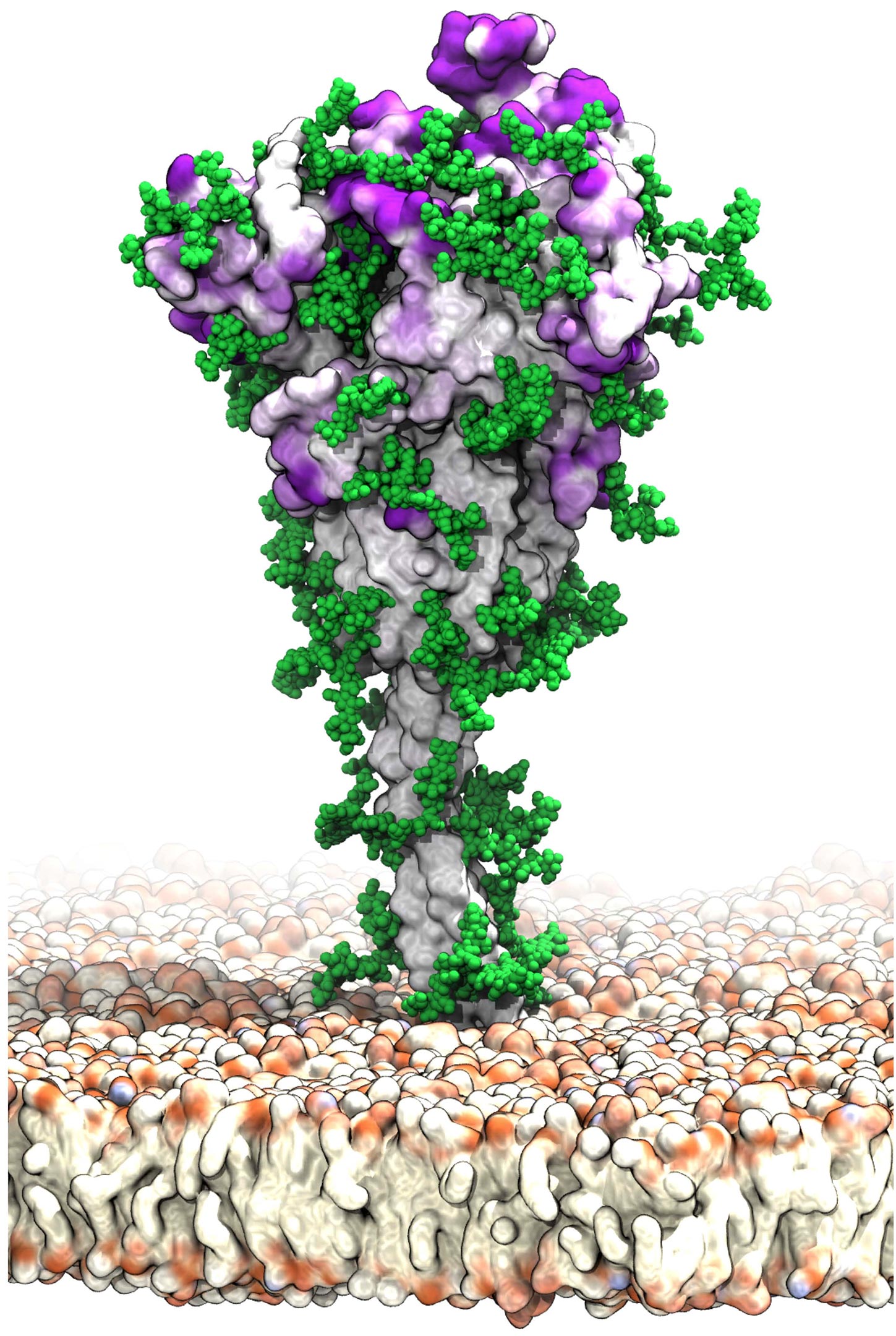
    In this visualization of antibody target sites, the SARS-CoV-2 spike protein is tethered to the viral membrane with a slender stalk. Patches of intense purple color at the surface of spike indicate potential target sites for antibodies that are not protected by the glycans — chains of sugar molecules — shown in green. These binding sites and their accessibility were identified with molecular dynamics simulations that capture the complete structure of the spike protein and its motions in a realistic environment. Credit: Mateusz Sikora, Sören von Bülow, Florian E. C. Blanc, Michael Gecht, Roberto Covino and Gerhard Hummer

    New model captures glycan molecules whose motions shield much of the spike from immune defenses.

    A new, detailed model of the surface of the SARS-CoV-2 spike protein reveals previously unknown vulnerabilities that could inform development of vaccines. Mateusz Sikora of the Max Planck Institute of Biophysics in Frankfurt, Germany, and colleagues present these findings in the open-access journal PLOS Computational Biology.

    SARS-CoV-2 is the virus responsible for the COVID-19 pandemic. A key feature of SARS-CoV-2 is its spike protein, which extends from its surface and enables it to target and infect human cells. Extensive research has resulted in detailed static models of the spike protein, but these models do not capture the flexibility of the spike protein itself nor the movements of protective glycans — chains of sugar molecules — that coat it.

    To support vaccine development, Sikora and colleagues aimed to identify novel potential target sites on the surface of the spike protein. To do so, they developed molecular dynamics simulations that capture the complete structure of the spike protein and its motions in a realistic environment.

    Glycans as a Dynamic Viral Shield

    These simulations show that glycans on the spike protein act as a dynamic shield that helps the virus evade the human immune system. Similar to car windshield wipers, the glycans cover nearly the entire spike surface by flopping back and forth, even though their coverage is minimal at any given instant.

    By combining the dynamic spike protein simulations with bioinformatic analysis, the researchers identified spots on the surface of the spike proteins that are least protected by the glycan shields. Some of the detected sites have been identified in previous research, but some are novel. The vulnerability of many of these novel sites was confirmed by other research groups in subsequent lab experiments.

    “We are in a phase of the pandemic driven by the emergence of new variants of SARS-CoV-2, with mutations concentrated in particular in the spike protein,” Sikora says. “Our approach can support the design of vaccines and therapeutic antibodies, especially when established methods struggle.”

    The method developed for this study could also be applied to identify potential vulnerabilities of other viral proteins.

    Reference: “Computational epitope map of SARS-CoV-2 spike protein” by Mateusz Sikora, Sören von Bülow, Florian E. C. Blanc, Michael Gecht, Roberto Covino and Gerhard Hummer, 1 April 2021, PLOS Computational Biology.
    DOI: 10.1371/journal.pcbi.1008790

    Never miss a breakthrough: Join the SciTechDaily newsletter.
    Follow us on Google and Google News.

    Cell Biology COVID-19 Infectious Diseases PLOS Vaccine
    Share. Facebook Twitter Pinterest LinkedIn Email Reddit

    Related Articles

    New Insights Into Why COVID-19 Infects Some Animals, but Not Others

    SARS-CoV-2 Infection Revealed in “Mini-Lungs” Shows How COVID-19 Damages the Lungs

    SARS-CoV-2 Antibodies Provide Lasting COVID-19 Immunity

    Researchers Reveal Possible New COVID-19 Coronavirus Entry Points

    Antiviral Treatment for COVID-19 Could Come Much Sooner Thanks to Malaria Breakthrough

    Research Shows Exposure to Common Cold Coronaviruses Can Teach the Immune System to Recognize SARS-CoV-2

    Common Molecular Feature of Antibodies That Neutralize SARS-CoV-2 Discovered, Boosting COVID-19 Vaccine Prospects

    Varying Virus-Specific Antibodies in Recently Recovered COVID-19 Patients

    Infection Researchers Identify How Coronaviruses From Animals Need to Change to Spread to Humans

    1 Comment

    1. Liz on July 7, 2024 10:55 am

      No doubt but that this research will be used by others to create new and deadlier pathogens; why does humanity tolerate the behaviors of psychopathic billionaires? Because, humans by design are mostly mentally disturbed?

      Reply
    Leave A Reply Cancel Reply

    • Facebook
    • Twitter
    • Pinterest
    • YouTube

    Don't Miss a Discovery

    Subscribe for the Latest in Science & Tech!

    Trending News

    Your Blood Pressure Reading Could Be Wrong Because of One Simple Mistake

    Astronomers Stunned by Ancient Galaxy With No Spin

    Physicists May Be on the Verge of Discovering “New Physics” at CERN

    Scientists Solve 320-Million-Year Mystery of Reptile Skin Armor

    Scientists Say This Daily Walking Habit May Be the Secret to Keeping Weight Off After Dieting

    New Therapy Rewires the Brain To Restore Joy in Depression Patients

    Giant Squid Detected off Western Australia in Stunning Deep-Sea Discovery

    Popular Sugar-Free Sweetener Linked to Liver Disease, Study Warns

    Follow SciTechDaily
    • Facebook
    • Twitter
    • YouTube
    • Pinterest
    • Newsletter
    • RSS
    SciTech News
    • Biology News
    • Chemistry News
    • Earth News
    • Health News
    • Physics News
    • Science News
    • Space News
    • Technology News
    Recent Posts
    • Scientists Say a 40-Year-Old Childhood Obesity Warning May Be Completely Wrong
    • Marijuana Use May Raise Lung Cancer Risk, Researchers Warn
    • This Common Type of Food May Be Raising Your Risk of Heart Disease
    • Fur Seals’ Hearts Suddenly Spike Hours After Returning to Land
    • Scientists Say Cognitive Decline Isn’t Inevitable — Your Brain Can Improve at Any Age
    Copyright © 1998 - 2026 SciTechDaily. All Rights Reserved.
    • Science News
    • About
    • Contact
    • Editorial Board
    • Privacy Policy
    • Terms of Use

    Type above and press Enter to search. Press Esc to cancel.