
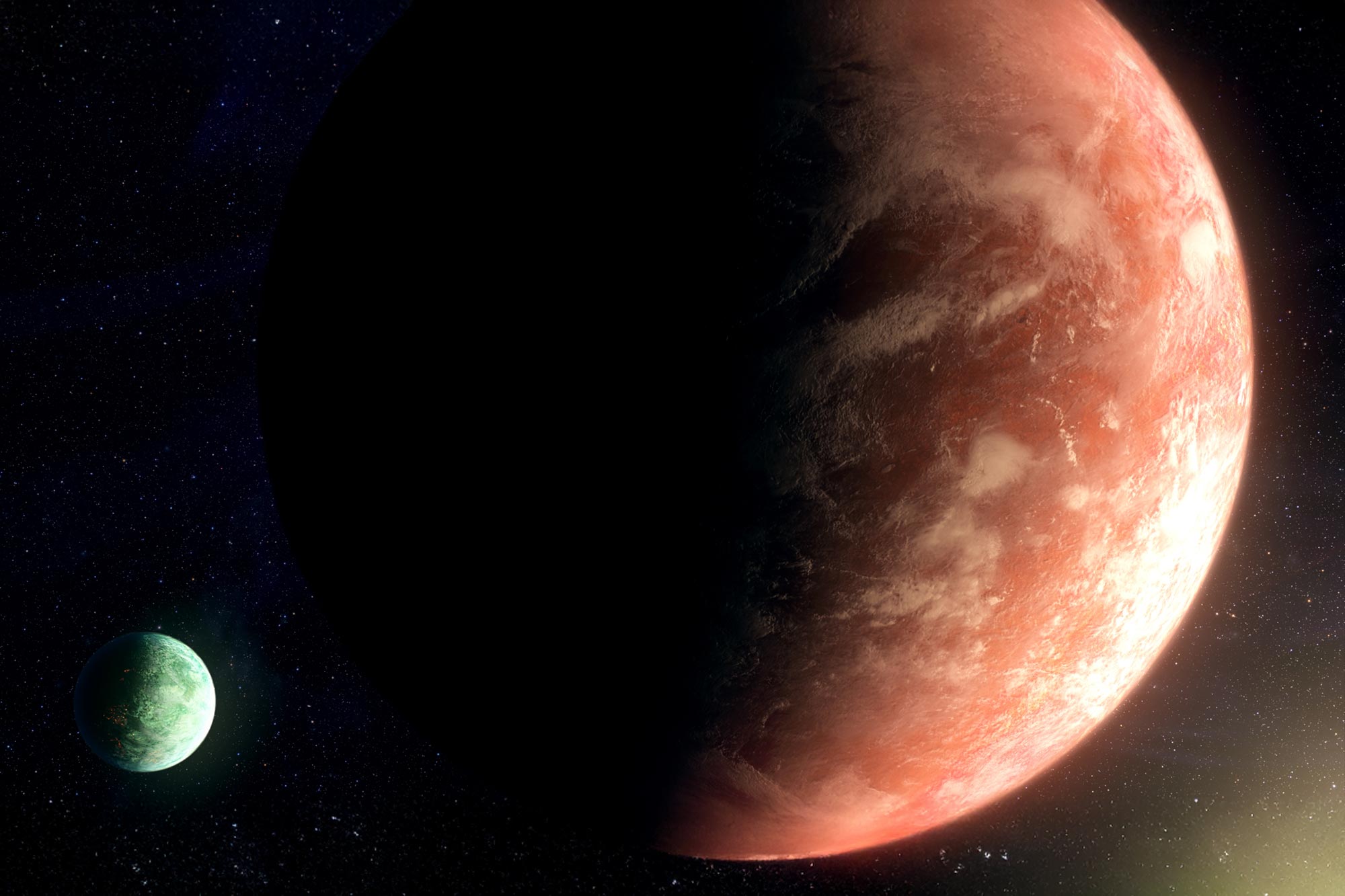
Rocky planets may have gotten their start far earlier than anyone expected, almost as soon as the first stars gave the universe the ingredients to build them.
New computer simulations suggest that planetesimals, the solid precursors of planets like Earth, could have formed only about 100 million years after the Big Bang. At that point, the Universe was less than 1 percent of its current age, and the first generations of stars were only beginning to transform the chemical makeup of the cosmos.
The finding pushes the possible beginnings of rocky planet formation billions of years earlier than traditionally expected, opening the possibility that potentially habitable environments may also have emerged far sooner than scientists once assumed.
The Big Bang produced a cosmos made overwhelmingly of hydrogen and helium, with only tiny amounts of a few other light elements. Carbon, oxygen, iron, silicon, and other ingredients needed to make rocky planets had to be manufactured later inside stars.
Some of the earliest stars, known as Population III or Pop III stars, are thought to have been extremely massive. When certain Pop III stars reached the ends of their lives, they exploded and scattered newly forged elements into surrounding space, changing otherwise pristine clouds of gas into material from which more chemically complex stars and planets could eventually form.
Supernovae Seeded the Early Universe
One particularly extreme explosion may have accelerated that process dramatically.
Pair-instability supernovae are predicted to occur in some exceptionally massive stars. Rather than leaving behind a conventional stellar remnant, such an explosion can completely disrupt the star and release an enormous quantity of newly created elements.
Models indicate that some Pop III pair-instability supernovae could eject more than 100 times the Sun’s mass in heavy elements. Those elements can mix with nearby gas and raise its metallicity, the astronomical term for the abundance of elements heavier than hydrogen and helium, to levels high enough for solid grains and eventually planetary material to form.
Simulating Planet Formation 100 Million Years After the Big Bang
Researchers led by scientists including Daniel Whalen of the University of Portsmouth modeled what could happen next.
“Our new paper, in which my PhD student Chris Jessop ran the first part of the simulation chain, shows that the precursors of terrestrial planets can form around low-mass, long-lived stars in the debris of the first cosmic explosions 100 million years after the Big Bang.
“To put this into perspective, the Universe is about 13.8 billion years old, so this is remarkably early in cosmic history,” Whalen said.
The simulations followed enriched gas as it collapsed under gravity and gave birth to a comparatively small star surrounded by a rotating protoplanetary disc. This is broadly the same type of structure from which planets formed around the young Sun.
But this system would have existed at cosmic dawn.
Enough Material to Build Rocky Worlds
In the researchers’ model, the emerging star was roughly 70 percent as massive as the Sun. Around it, dust and other solid material accumulated in the disc and began producing planetesimals.
These objects are an important intermediate step in planet formation. Dust grains first collide and stick together, eventually producing progressively larger bodies. Once planetesimals form, continued collisions and gravitational interactions can build planetary embryos and, potentially, full-size planets.
The simulations produced several Earth masses of planetesimals roughly 0.5 to 1 astronomical unit from the star. One astronomical unit, or AU, is the average distance between Earth and the Sun, about 93 million miles (150 million kilometers).
Whalen said, “In our computer simulations of the early Universe, we found one such disc around a young star about 70 percent as massive as the Sun. Within that disc, enough solid material accumulated to create several Earth-masses’ worth of planetary building blocks at roughly the same distance from the star as Earth is from the Sun.”
Planetesimals are only the starting material from which rocky planets can grow, and many things can interrupt that process. Still, producing several Earth masses of them so early in cosmic history shows that a lack of planetary raw materials may not have delayed rocky planet formation for nearly as long as once assumed.
Water Appears in an Ancient Planet-Forming Disc
Another notable feature of the simulated disc was its water content.
Earlier work by Whalen and colleagues found that water could form in dense clouds enriched by primordial supernovae only 100 million to 200 million years after the Big Bang. Some of those clouds reached water concentrations only a few times below those associated with the Solar System.
How Early Planets Could Have Received Water
The new simulations carry that scenario forward into the planet formation stage.
“Most surprisingly, the disc also contained substantial amounts of water, only a few times less than what was available when our own Solar System formed. This means that any planets forming there could potentially have received water in a similar way to Earth, which is thought to have gained much of its water from material left over during the planet-building process,” Whalen said.
The planetesimals modeled by the researchers formed inside the system’s water snowline, the region where temperatures are generally too high for abundant water ice to survive. As a result, those particular planetesimals would initially have been relatively dry.
That does not necessarily rule out watery planets. The researchers suggest that developing planets could later receive water from material originating farther from the star, somewhat like scenarios proposed for the delivery of water to the early Earth.
Ancient Planetary Systems Could Survive Today
The implications become especially intriguing because the star in the simulation is a low-mass star, not one of the short-lived giants that produced the original elements.
Low-mass stars can survive for extremely long periods. The researchers note that a star with roughly 40 percent of the Sun’s mass formed during this early era could still be shining today. That raises the possibility that remnants of the Universe’s earliest era of planet formation might, in principle, still exist in the Milky Way and perhaps be identified through future searches of very old, metal-poor stars.
The calculations even suggest that favorable circumstances could have allowed similar water-rich protoplanetary discs to appear as early as roughly 50 million to 100 million years after the Big Bang.
Rocky Worlds May Have Emerged Billions of Years Before Earth
Such a possibility dramatically changes the cosmic timeline available for planetary evolution. Earth formed about 4.5 billion years ago, more than 9 billion years after the Big Bang. A rocky world born during cosmic dawn would therefore have preceded Earth by many billions of years.
Whether such planets actually formed, survived, or ever developed habitable conditions remains unknown. The study is based on numerical simulations rather than the observation of an ancient planetary system, and the early Universe was a very different and often violent environment.
The work instead demonstrates something more fundamental: the physical ingredients and processes needed to begin assembling rocky planets may have appeared astonishingly soon after the first stars began manufacturing heavy elements.
“Our findings suggest that the conditions for planet formation may have existed much earlier than previously thought. If that’s the case, it raises an intriguing question: could potentially habitable worlds have appeared far earlier in the Universe’s history as well?” Whalen said.
Reference: “Planet Formation at Cosmic Dawn: Planetesimals in H$_2$O-Rich Disks Around Low-Mass Stars” by Eduard I. Vorobyov, Daniel J. Whalen, Muhammad A. Latif, Alexander M. Skliarevskii, Christopher Jessop, Ryoki Matsukoba, Takashi Hosokawa and Devesh Nandal, 30 July 2026, arXiv.
DOI: 2501.08375
Never miss a breakthrough: Join the SciTechDaily newsletter.
Follow us on Google and Google News.