
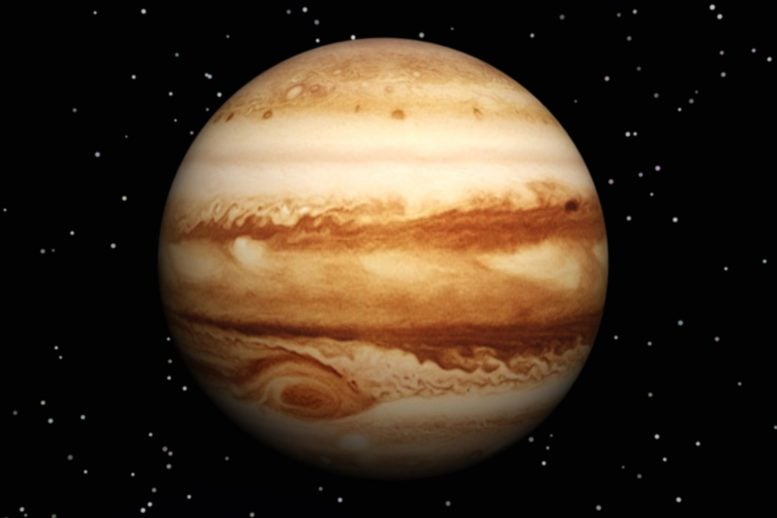
Scientists now have a better understanding of gas giant exoplanets and what is going on in their cores. By studying computer simulations, scientists believe that Jupiter’s rocky core has been liquefying and mixing with the rest of the planet’s innards, representing a mixture of elements without defined borders and layers.
Jupiter might be having a change of heart. Literally.
New simulations suggest that Jupiter’s rocky core has been liquefying and mixing with the rest of the planet’s innards. With this new data, astronomers hope to better explain a recent puzzling discovery of a strange planet outside of our solar system.
“It’s a really important piece of the puzzle of trying to figure out what’s going on inside giant planets,” said Jonathan Fortney, a planetary scientist at the University of California Santa Cruz who was not affiliated with the research.
Conventional planetary formation theory has modeled Jupiter as a set of neat layers with a gassy outer envelope surrounding a rocky core consisting of heavier elements. But increasing evidence has indicated that the insides of gas giants like Jupiter are a messy mixture of elements without strictly defined borders.
This new research on a melting Jovian core bolsters a mixing model of gas giant planets and would provide another avenue for heavier elements to flow throughout the planet.
“People have been working on the assumption that these planets are layered because it’s easier to work on this assumption,” said Hugh Wilson, a planetary scientist at the University of California Berkeley and a coauthor of the new research appearing in the journal Physical Review Letters.
Although scientists had previously toyed with the idea of melting cores in large planets, nobody sat down and did the necessary calculations, said Wilson.
Scientists have to rely on calculations of Jupiter’s core environment because the conditions there are far too extreme to recreate on Earth. Wilson and his UC-Berkeley colleague Burkhard Militzer used a computer program to simulate temperatures exceeding 7,000 degrees Celsius and pressures reaching 40 million times the air pressure found on Earth at sea level.
Those conditions are thought to be underestimates of the actual conditions inside Jupiter’s core. Nonetheless, the authors found that magnesium oxide — an important compound likely found in Jupiter’s core — would liquefy and begin drifting into Jupiter’s fluid upper envelope under these relatively tame conditions.
Researchers believe that similarly-sized gas giant exoplanets — planets found outside of our solar system — probably have similar internal structures to Jupiter. Consequently, scientists were baffled earlier this year when they found a planet with approximately the same volume as Jupiter yet four to five times more mass.
Called CoRoT-20b, the new planet was announced in February, and its discoverers searched for a suitable explanation for its unusual density. Using conventional models, the astronomers calculated that the core would have to make up over half of the planet. For comparison, Jupiter’s core only represents about between 3-15 percent of the planet’s total mass.
With a core that large, CoRoT-20b presented a huge problem for traditional assumptions surrounding planet formation.
“It’s much easier to explain the composition of this planet under a model where you have a mixed interior,” said Wilson.
Even the team that discovered the planet noted that a mixing model could allow for a more palatable planet density. Wilson’s simulations not only add credence to the mixing model of giant planets but also suggest that this specific exoplanet’s core is probably melting just like Jupiter’s.
This melting may help explain why the exoplanet’s heavy elements are likely stirred up and distributed throughout its volume, said Wilson.
Santa Cruz’s Fortney agrees that most of the exoplanet’s heavy elements likely reside in the outer envelope. Nonetheless, he expects other factors played a larger role in how the planet’s interior became mixed: “It’s more of a planet formation issue.”
Several other events, such as two gas giants colliding together, might explain the ultra-high density of this new planet, Wilson admits. Certain processes may also limit the effectiveness of the melting and mixing process.
Liquefied parts of a gas giant’s core may have trouble reaching the outer envelope due to double diffusive convection — a process commonly found in Earth’s oceans. When salty water accumulates at the bottom of the ocean, its density keeps it from mixing thoroughly with the upper layers. In a similar fashion, the heavy elements in Jupiter’s core may have trouble gaining enough energy to move upward and outward.
Scientists don’t know how much this hindrance will affect potential mixing inside Jupiter, and many other questions remain to be answered about the melting process.
“The next question is, ‘How efficient is this process?'” said Fortney.
Researchers will have more tools to answer this question once NASA’s Juno probe reaches Jupiter in 2016. With the spacecraft’s instruments carefully analyzing Jupiter’s composition, Wilson believes that there will be signatures of mixing and core erosion.
Reference: “Rocky Core Solubility in Jupiter and Giant Exoplanets” by Hugh F. Wilson and Burkhard Militzer, 14 March 2012, Physical Review Letters.
DOI: 10.1103/PhysRevLett.108.111101
Never miss a breakthrough: Join the SciTechDaily newsletter.
Follow us on Google and Google News.