
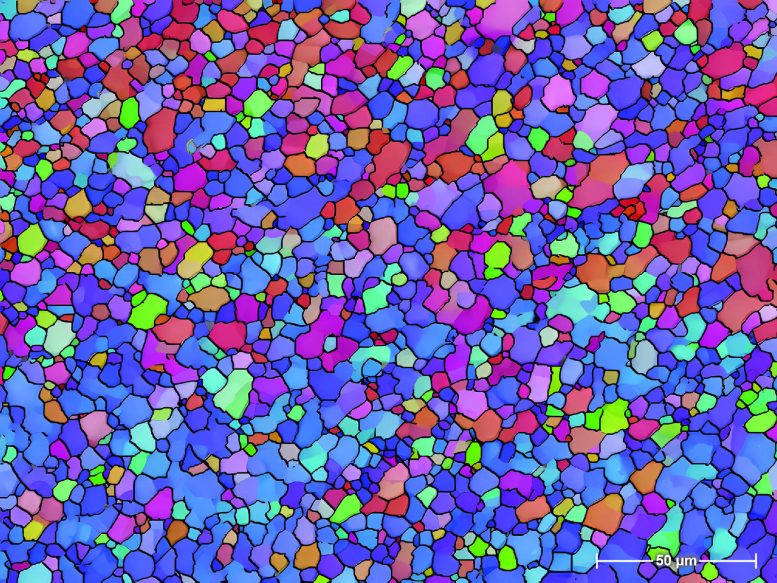
The new manufacturing process results in the creation of high-strength aluminum vehicle components that are both cost-effective and more eco-friendly.
The automotive industry, specifically for electric vehicles, is pioneering an innovative process for collecting and transforming scrap aluminum into new vehicle parts. The DOE’s Pacific Northwest National Laboratory, in partnership with top mobility technology firm Magna, has just revealed a new manufacturing method that reduces embodied energy by over 50% and cuts carbon dioxide emissions by more than 90% by eliminating the need to extract and process the same amount of raw aluminum ore. In addition, the use of lightweight aluminum can also enhance the driving range of EVs.
This patented and award-winning Shear Assisted Processing and Extrusion (ShAPE™) process collects scrap bits and leftover aluminum trimmings from automotive manufacturing and transforms it directly into suitable material for new vehicle parts. It is now being scaled to make lightweight aluminum parts for EVs.
The most recent advancement, described in detail in a new report and in a Manufacturing Letters research article, eliminates the need to add newly mined aluminum to the material before using it for new parts. By reducing the cost of recycling aluminum, manufacturers may be able to reduce the overall cost of aluminum components, better enabling them to replace steel.
Automakers’ aluminum scrap transforms into new vehicle parts with the PNNL-patented ShAPE manufacturing process. Heat and friction soften the aluminum and transform it from rough metal into a smooth, strong uniform product without a melting step. Credit: Animation by Sara Levine | Pacific Northwest National Laboratory
“We showed that aluminum parts formed with the ShAPE process meet automotive industry standards for strength and energy absorption,” said Scott Whalen, a PNNL materials scientist and lead researcher. “The key is that ShAPE process breaks up metal impurities in the scrap without requiring an energy-intensive heat treatment step. This alone saves considerable time and introduces new efficiencies.”
The new report and research publications mark the culmination of a four-year partnership with Magna, the largest manufacturer of auto parts in North America. Magna received funding for the collaborative research from DOE’s Vehicle Technologies Office, Lightweight Materials Consortium (LightMAT) Program.
“Sustainability is at the forefront of everything we do at Magna,” said Massimo DiCiano, Manager Materials Science at Magna. “From our manufacturing processes to the materials we use, and the ShAPE process is a great proof point of how we’re looking to evolve and create new sustainable solutions for our customers.”
Aluminum Advantages
Besides steel, aluminum is the most used material in the auto industry. The advantageous properties of aluminum make it an attractive automotive component. Lighter and strong, aluminum is a key material in the strategy to make lightweight vehicles for improved efficiency, being it extending the range of an EV or reducing the battery capacity size. While the automotive industry currently does recycle most of its aluminum, it routinely adds newly mined primary aluminum to it before reusing it, to dilute impurities.
Metals manufacturers also rely on a century-old process of pre-heating bricks, or “billets” as they are known in the industry, to temperatures over 1,000°F (550°C) for many hours. The pre-heating step dissolves clusters of impurities such as silicon, magnesium, or iron in the raw metal and distributes them uniformly in the billet through a process known as homogenization.
By contrast, the ShAPE process accomplishes the same homogenization step in less than a second and then transforms the solid aluminum into a finished product in a matter of minutes with no pre-heating step required.
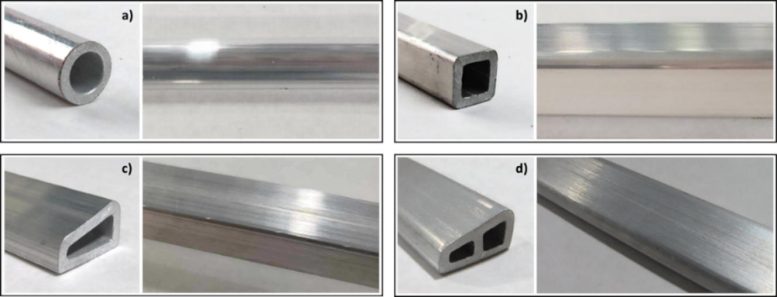
“With our partners at Magna, we have reached a critical milestone in the evolution of the ShAPE process,” said Whalen. “We have shown its versatility by creating square, trapezoidal, and multi-cell parts that all meet quality benchmarks for strength and ductility.”
For these experiments, the research team worked with an aluminum alloy known as 6063, or architectural aluminum. This alloy is used for variety of automotive components, such as engine cradles, bumper assemblies, frame rails, and exterior trim. The PNNL research team examined the extruded shapes using scanning electron microscopy and electron backscatter diffraction, which creates an image of the placement and microstructure of each metal particle within the finished product. The results showed that the ShAPE products are uniformly strong and lack manufacturing defects that could cause parts failure. In particular, the products had no signs of the large clusters of metal—impurities that can cause material deterioration and that have hampered efforts to use secondary recycled aluminum to make new products.
Now the research team is examining even higher-strength aluminum alloys typically used in battery enclosures for electric vehicles.
“This innovation is only the first step toward creating a circular economy for recycled aluminum in manufacturing,” said Whalen. “We are now working on including post-consumer waste streams, which could create a whole new market for secondary aluminum scrap.”
Reference: “Porthole die extrusion of aluminum 6063 industrial scrap by shear assisted processing and extrusion” by Scott Whalen, Brandon Scott Taysom, Nicole Overman, Md. Reza-E-Rabby, Yao Qiao, Thomas Richter, Timothy Skszek and Massimo DiCiano, 28 March 2023, Manufacturing Letters.
DOI: 10.1016/j.mfglet.2023.01.005
In addition to Whalen, the PNNL research team included Nicole Overman, Brandon Scott Taysom, Md. Reza-E-Rabby, Mark Bowden and Timothy Skszek. In addition to DiCiano, Magna contributors included Vanni Garbin, Michael Miranda, Thomas Richter, Cangji Shi and Jay Mellis. This work was supported by DOE’s Vehicle Technologies Office, LightMAT Program.
The patented ShAPE technology is available for licensing for other applications.
Never miss a breakthrough: Join the SciTechDaily newsletter.
Follow us on Google and Google News.