
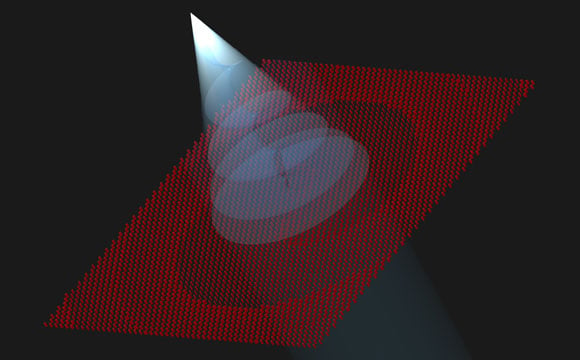
Engineers from the Jet Propulsion Laboratory and the California Institute of Technology have developed innovative flat, optical lenses that are capable of manipulating light in ways that are difficult or impossible to achieve with conventional optical devices.
The new lenses are not made of glass. Instead, silicon nanopillars are precisely arranged into a honeycomb pattern to create a “metasurface” that can control the paths and properties of passing light waves.
Applications of these devices include advanced microscopes, displays, sensors, and cameras that can be mass-produced using the same techniques used to manufacture computer microchips.
“These flat lenses will help us to make more compact and robust imaging assemblies,” said Mahmood Bagheri, a microdevices engineer at JPL and co-author of a new Nature Nanotechnology study describing the devices.
“Currently, optical systems are made one component at a time, and the components are often manually assembled,” said Andrei Faraon, an assistant professor of applied physics and materials science at Caltech, and the study’s principal investigator. “But this new technology is very similar to the one used to print semiconductor chips onto silicon wafers, so you could conceivably manufacture millions of systems such as microscopes or cameras at a time.”
Seen under a scanning electron microscope, the new metasurfaces that the researchers created resemble a cut forest where only the stumps remain. Each silicon stump, or pillar, has an elliptical cross section, and by carefully varying the diameters of each pillar and rotating them around their axes, the scientists were able to simultaneously manipulate the phase and polarization of passing light.
Phase has to do with the separation between peaks of light waves; light waves in phase with each other combine to produce a single, more powerful wave. Manipulating its phase influences the degree to which a light ray bends, which in turn influences whether an image is in or out of focus. Polarization refers to the way some light waves vibrate only in a particular direction, whereas waves in natural sunlight vibrate in all directions. Manipulating the polarization of light is essential for the operation of advanced microscopes, cameras and displays; the control of polarization also enables simple gadgets such as 3-D glasses and polarized sunglasses.
“If you think of a modern microscope, it has multiple components that have to be carefully assembled inside,” Faraon says. “But with our platform, we can actually make each of these optical components and stack them atop one another very easily using an automated process. Each component is just a millionth of a meter thick, or less than a hundredth of the thickness of a human hair. ”
Additionally, the new, flat lenses can be used to modify the shape of light beams at will. Semiconductor lasers typically emit into elliptical beams that are really hard to work with, and the new metasurface optical components could replace expensive optical systems used to circularize the beams. The small size of these devices would also allow for more compact systems.
The team is currently working with industrial partners to create metasurfaces for use in commercial devices such as miniature cameras and spectrometers, but a limited number have already been produced for use in optical experiments by collaborating scientists in other disciplines.
The current work was supported by the Caltech/JPL President’s and Director’s Fund and the Defense Advanced Research Projects Agency (DARPA). Yu Horie was supported by the Department of Energy’s Energy Frontier Research Center program and a Japan Student Services Organization fellowship. The device nanofabrication was performed in the Kavli Nanoscience Institute at Caltech. JPL is a division of Caltech.
Reference: “Dielectric metasurfaces for complete control of phase and polarization with subwavelength spatial resolution and high transmission” by Amir Arbabi, Yu Horie, Mahmood Bagheri and Andrei Faraon, 31 August 2015, Nature Nanotechnology.
DOI: 10.1038/nnano.2015.186
Never miss a breakthrough: Join the SciTechDaily newsletter.
Follow us on Google and Google News.
2 Comments
thank you
What if I wanted to change lenses?