
Close Menu
    Facebook X (Twitter) Instagram
    SciTechDaily
    • Biology
    • Chemistry
    • Earth
    • Health
    • Physics
    • Science
    • Space
    • Technology
    Facebook X (Twitter) Pinterest YouTube RSS
    SciTechDaily
    Home»Technology»Entanglement Enhanced Sensing Paves the Way for Advanced Quantum Sensors
    Technology

    Entanglement Enhanced Sensing Paves the Way for Advanced Quantum Sensors

    By University of InnsbruckAugust 30, 2023No Comments3 Mins Read
    Facebook Twitter Pinterest Telegram LinkedIn WhatsApp Email Reddit
    Share
    Facebook Twitter LinkedIn Pinterest Telegram Email Reddit
    Squeezed Quantum State
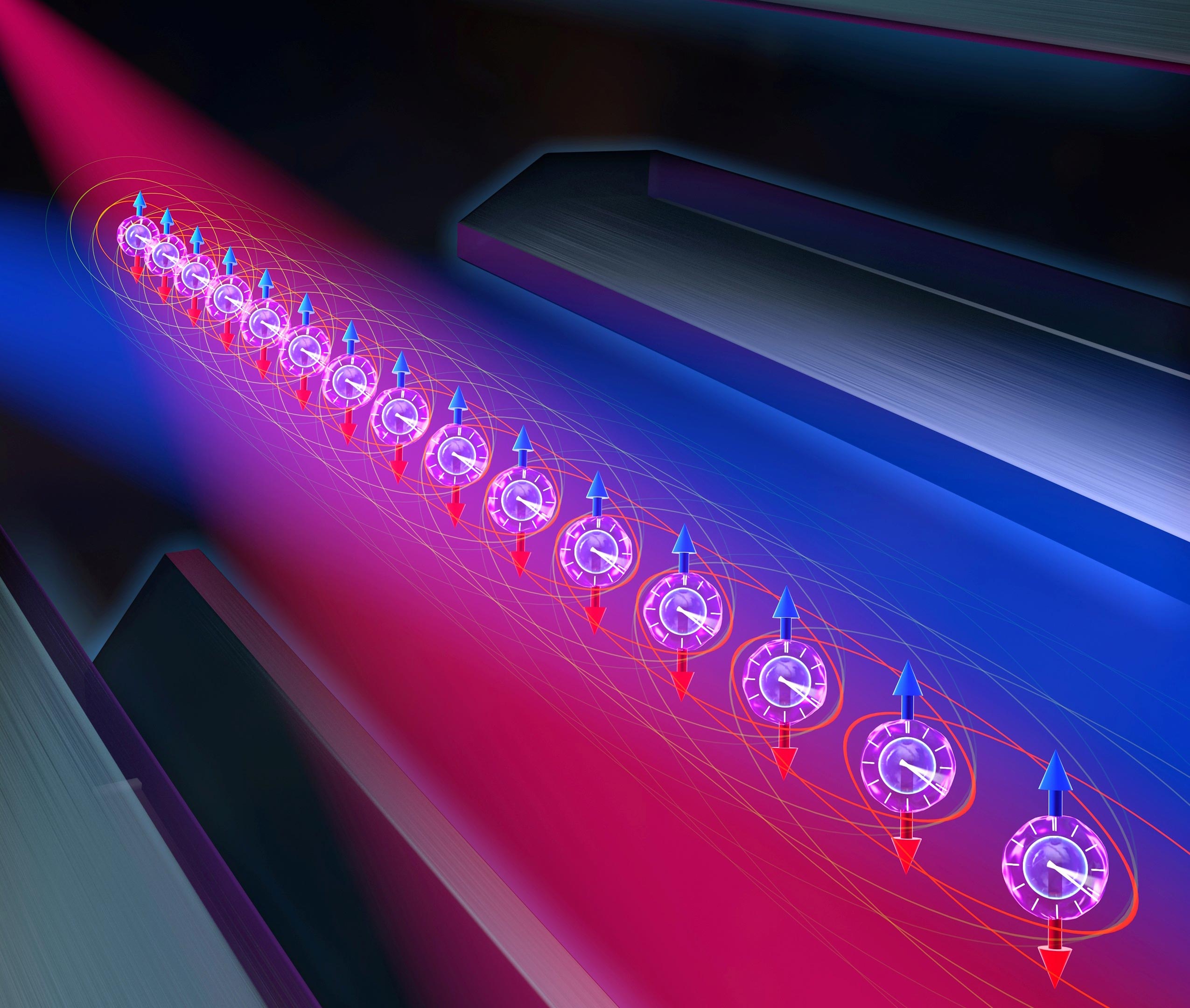
    Innsbruck physicists entangled all particles in the chain with each other and produced a so-called squeezed quantum state. Credit: Steven Burrows and the Rey Group/JILA

    A New Research Study Explores Finite-Range Interactions for Creating Quantum Entanglement

    Metrological institutions around the world administer our time, using atomic clocks based on the natural oscillations of atoms. These clocks, pivotal for applications like satellite navigation or data transfer, have recently been improved by using ever-higher oscillation frequencies in optical atomic clocks.

    Now, scientists at the University of Innsbruck and the Institute of Quantum Optics and Quantum Information (IQOQI) of the Austrian Academy of Sciences led by Christian Roos show how a particular way of creating entanglement can be used to further improve the accuracy of measurements integral to an optical atomic clock’s function.

    Reduction of Measurement Errors

    Observations of quantum systems are always subject to a certain statistical uncertainty. “This is due to the nature of the quantum world,” explains Johannes Franke from Christian Roos’ team. “Entanglement can help us reduce these errors.”

    With the support of theorist Ana Maria Rey from JILA in Boulder, USA, the Innsbruck physicists tested the measurement accuracy on an entangled ensemble of particles in the laboratory. The researchers used lasers to tune the interaction of ions lined up in a vacuum chamber and entangled them.

    “The interaction between neighboring particles decreases with the distance between the particles. Therefore, we used spin-exchange interactions to allow the system to behave more collectively,” explains Raphael Kaubrügger from the Department of Theoretical Physics at the University of Innsbruck.

    Thus, all particles in the chain were entangled with each other and produced a so-called squeezed quantum state. Using this, the physicists were able to show that measurement errors can be roughly halved by entangling 51 ions in relation to individual particles. Previously, entanglement-enhanced sensing mainly relied on infinite interactions, limiting its applicability to only certain quantum platforms.

    Even More Accurate Clocks

    With their experiments, the Innsbruck quantum physicists demonstrated that quantum entanglement makes sensors even more sensitive. “We used an optical transition in our experiments that is also employed in atomic clocks,” says Christian Roos. This technology could improve areas where atomic clocks are currently used, such as satellite-based navigation or data transfer. Moreover, these advanced clocks could open new possibilities in pursuits like the search for dark matter or the determination of time variations of fundamental constants.

    Christian Roos and his team now want to test the new method in two-dimensional ion ensembles. The current results were published in the journal Nature. In the same issue, researchers published very similar results using neutral atoms. The research in Innsbruck was financially supported by the Austrian Science Fund FWF and the Federation of Austrian Industries Tyrol, among others.

    Reference: “Quantum-enhanced sensing on optical transitions through finite-range interactions” by Johannes Franke, Sean R. Muleady, Raphael Kaubruegger, Florian Kranzl, Rainer Blatt, Ana Maria Rey, Manoj K. Joshi and Christian F. Roos, 30 August 2023, Nature.
    DOI: 10.1038/s41586-023-06472-z

    Never miss a breakthrough: Join the SciTechDaily newsletter.
    Follow us on Google and Google News.

    Quantum Information Science Quantum Optics Sensor University of Innsbruck
    Share. Facebook Twitter Pinterest LinkedIn Email Reddit

    Related Articles

    Harvard Just Collapsed a Quantum Computer Onto a Chip

    Tiny Diamonds, Big Spark: A Laser-Free Leap in Quantum Spin Detection

    Quantum Computers Just Got Smarter With Dual-Code Error Correction

    Quantum Sensing Revolution: Networked Atoms for Ultimate Precision

    Harnessing the Void: MIT Controls Quantum Randomness For the First Time

    Fundamental Breakthrough: Error-Free Quantum Computing Gets Real

    Iridescent Butterfly Wing Properties to Lead to Better Thermal Imaging Cameras

    Physicists Work on Nano Loudspeakers to Make Better MRIs, Quantum Computers

    Smart Pills Will Track Patients from the Inside Out

    Leave A Reply Cancel Reply

    • Facebook
    • Twitter
    • Pinterest
    • YouTube

    Don't Miss a Discovery

    Subscribe for the Latest in Science & Tech!

    Trending News

    Breakthrough Bowel Cancer Trial Leaves Patients Cancer-Free for Nearly 3 Years

    Natural Compound Shows Powerful Potential Against Rheumatoid Arthritis

    100,000-Year-Old Neanderthal Fossils in Poland Reveal Unexpected Genetic Connections

    Simple “Gut Reset” May Prevent Weight Gain After Ozempic or Wegovy

    2.8 Days to Disaster: Scientists Warn Low Earth Orbit Could Suddenly Collapse

    Common Food Compound Shows Surprising Power Against Superbugs

    5 Simple Ways To Remember More and Forget Less

    The Atomic Gap That Could Cost the Semiconductor Industry Billions

    Follow SciTechDaily
    • Facebook
    • Twitter
    • YouTube
    • Pinterest
    • Newsletter
    • RSS
    SciTech News
    • Biology News
    • Chemistry News
    • Earth News
    • Health News
    • Physics News
    • Science News
    • Space News
    • Technology News
    Recent Posts
    • Scientists Print Artificial Neurons That Can Talk to the Brain
    • Bowel and Ovarian Cancers Are Dramatically Rising in Young Adults and Scientists Aren’t Sure Why
    • Alzheimer’s May Begin Decades Earlier Than You Think, New Mayo Clinic Study Finds
    • The Hidden Risk of Taking Breaks From Weight-Loss Drugs Like Ozempic
    • Total Solar Eclipse Made Cities Go Eerily Quiet Beneath the Surface
    Copyright © 1998 - 2026 SciTechDaily. All Rights Reserved.
    • Science News
    • About
    • Contact
    • Editorial Board
    • Privacy Policy
    • Terms of Use

    Type above and press Enter to search. Press Esc to cancel.