
Close Menu
    Facebook X (Twitter) Instagram
    SciTechDaily
    • Biology
    • Chemistry
    • Earth
    • Health
    • Physics
    • Science
    • Space
    • Technology
    Facebook X (Twitter) Pinterest YouTube RSS
    SciTechDaily
    Home»Space»ESO’s Very Large Telescope Views the Dragon’s Head Nebula
    Space

    ESO’s Very Large Telescope Views the Dragon’s Head Nebula

    By European Southern ObservatoryNovember 27, 20131 Comment3 Mins Read
    Facebook Twitter Pinterest Telegram LinkedIn WhatsApp Email Reddit
    Share
    Facebook Twitter LinkedIn Pinterest Telegram Email Reddit
    ESO Views the Dragons Head Nebula
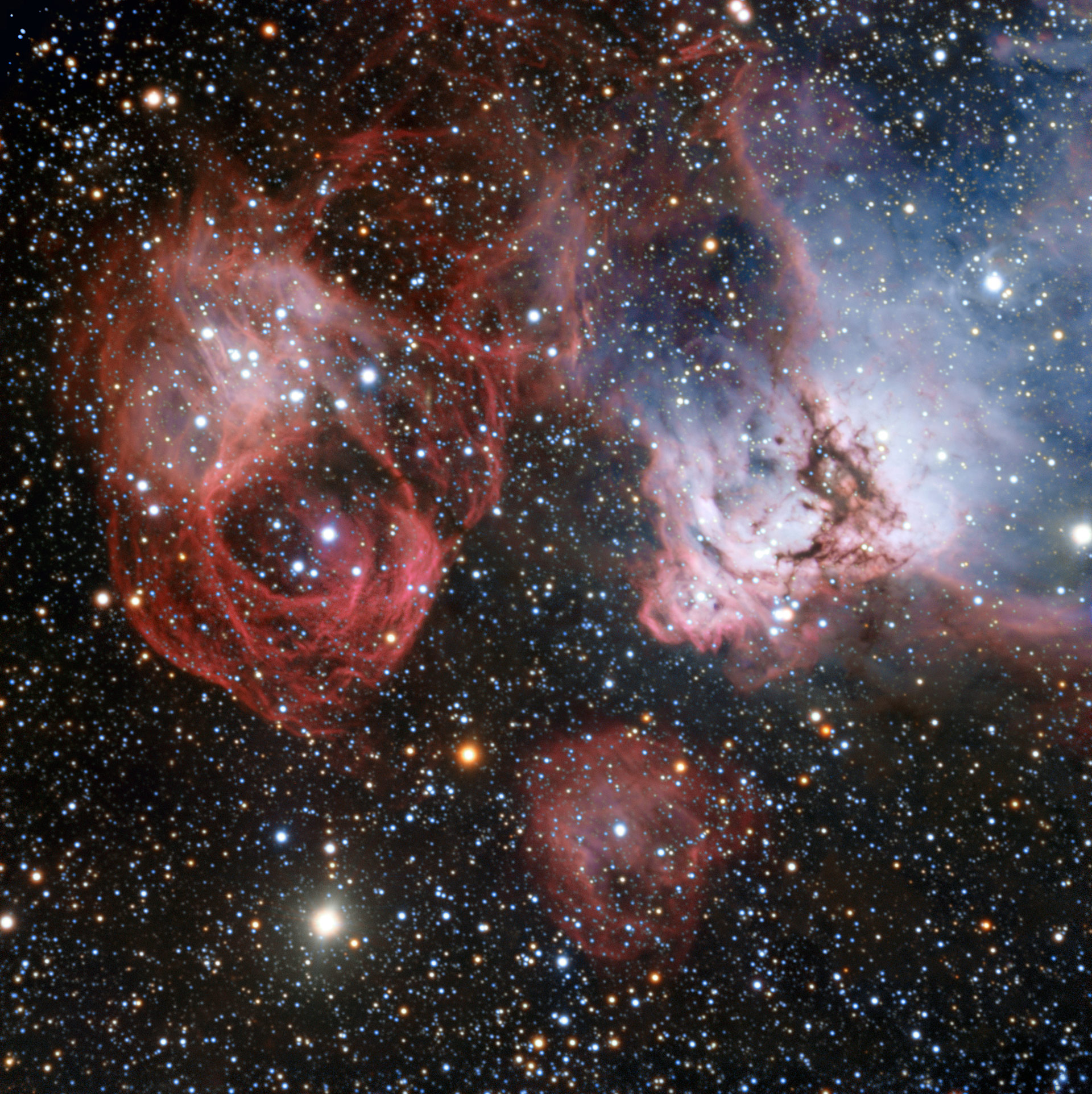
    The Large Magellanic Cloud is one of the closest galaxies to our own. Astronomers have now used the power of the ESO’s Very Large Telescope to explore NGC 2035, one of its lesser known regions, in great detail. This new image shows clouds of gas and dust where hot new stars are being born and are sculpting their surroundings into odd shapes. But the image also shows the effects of stellar death — filaments created by a supernova explosion (left). Credit: ESO

    A new ESO image explores the Large Magellanic Cloud and an area nicknamed the Dragon’s Head Nebula.

    The Large Magellanic Cloud is one of the closest galaxies to our own. Astronomers have now used the power of ESO’s Very Large Telescope to explore one of its lesser known regions. This new image shows clouds of gas and dust where hot new stars are being born and sculpting their surroundings into odd shapes. But the image also shows the effects of stellar death — filaments created by a supernova explosion.

    Located only about 160,000 light-years from us in the constellation of Dorado (The Swordfish), the Large Magellanic Cloud is one of our closest galactic neighbors. It is actively forming new stars in regions that are so bright that some can even be seen from Earth with the naked eye, such as the Tarantula Nebula. This new image, taken by ESO’s Very Large Telescope at the Paranal Observatory in Chile, explores an area called NGC 2035 (right), sometimes nicknamed the Dragon’s Head Nebula.

    NGC 2035 is an HII region, or emission nebula, consisting of clouds of gas that glow due to the energetic radiation given off by young stars. This radiation strips electrons from atoms within the gas, which eventually recombine with other atoms and release light. Mixed in with the gas are dark clumps of dust that absorb rather than emit light, creating weaving lanes and dark shapes across the nebula.

    The filamentary shapes to the left in the image are not the results of starbirth, but rather stellar death. It was created by one of the most violent events that can happen in the Universe — a supernova explosion [1]. These explosions are so bright that they often briefly outshine their entire host galaxy, before fading from view over several weeks or months.

    From looking at this image, it may be difficult to grasp the sheer size of these clouds — they are several hundred light-years across. And they are not in our galaxy, but far beyond. The Large Magellanic Cloud is enormous, but when compared to our own galaxy it is very modest in extent, spanning just 14,000 light-years — about ten times smaller than the Milky Way.

    This image was acquired using the FOcal Reducer and low dispersion Spectrograph instrument attached to ESO’s Very Large Telescope, which is located at the Paranal Observatory in Chile, as part of the ESO Cosmic Gems program [2].

    Notes

    [1] The remnant left over by the supernova explosion that can be seen in this image is called SNR 0536-67.6.

    [2] The ESO Cosmic Gems program is an initiative to produce images of interesting, intriguing or visually attractive objects using ESO telescopes, for the purposes of education and public outreach. The program makes use of telescope time that cannot be used for science observations. All data collected may also be suitable for scientific purposes, and are made available to astronomers through ESO’s science archive.


    Never miss a breakthrough: Join the SciTechDaily newsletter.
    Follow us on Google and Google News.

    Astronomy European Southern Observatory Large Magellanic Cloud
    Share. Facebook Twitter Pinterest LinkedIn Email Reddit

    Related Articles

    ESO Captures Dazzling Image of Newly-Forming Stars in the LMC

    New Deep View of the Large and Small Magellanic Clouds

    ESO’s VLT Views Two Glowing Clouds of Gas

    Popular VISTA Image of the Orion Nebula

    Quasar 3C 279 Shown in Unprecedented Sharpness

    Scientists Detect Dark Galaxies for the First Time

    Gas Cloud Headed Towards Milky Way’s Supermassive Black Hole

    No Evidence of Dark Matter Around the Sun

    Astronomers Combine Hundreds of Images of Carina Nebula to Reveal Thousands of Stars in Stellar Nursery

    1 Comment

    1. Patricia J. Chesley on March 15, 2017 6:57 pm

      My grandson is 10 years old and has a persuasive writing assignment to sell an object from space. He was allowed to choose from planets, stars, comets, moons, satellites, nebulas, dwarf planets and asteroids. After doing research, he chose the Dragon’s Head Nebula as his subject matter, because of it’s beauty and expansiveness.

      Reply
    Leave A Reply Cancel Reply

    • Facebook
    • Twitter
    • Pinterest
    • YouTube

    Don't Miss a Discovery

    Subscribe for the Latest in Science & Tech!

    Trending News

    Scientists Uncover Potential Brain Risks of Popular Fish Oil Supplements

    Scientists Discover a Surprising Way To Make Bread Healthier and More Nutritious

    After 60 Years, Scientists Uncover Unexpected Brain Effects of Popular Diabetes Drug Metformin

    New Research Uncovers Hidden Side Effects of Popular Weight-Loss Drugs

    Scientists Rethink Extreme Warming After Surprising Ocean Discovery

    Landmark Study Links Never Marrying to Significantly Higher Cancer Risk

    Researchers Discover Unknown Beetle Species Just Steps From Their Lab

    Largest-Ever Study Finds Medicinal Cannabis Ineffective for Anxiety, Depression, PTSD

    Follow SciTechDaily
    • Facebook
    • Twitter
    • YouTube
    • Pinterest
    • Newsletter
    • RSS
    SciTech News
    • Biology News
    • Chemistry News
    • Earth News
    • Health News
    • Physics News
    • Science News
    • Space News
    • Technology News
    Recent Posts
    • Scientists Finally Crack Decades-Old Mystery of “Breathing” Lasers
    • “Like Liquid Metal”: Scientists Create Strange Shape-Shifting Material
    • Early Warning Signals of Esophageal Cancer May Be Hiding in Plain Sight
    • Researchers Have Discovered a THC-Free Cannabis Compound That May Replace Opioids
    • Common Blood Pressure Drug Shows Surprising Power Against Deadly Antibiotic-Resistant Superbug
    Copyright © 1998 - 2026 SciTechDaily. All Rights Reserved.
    • Science News
    • About
    • Contact
    • Editorial Board
    • Privacy Policy
    • Terms of Use

    Type above and press Enter to search. Press Esc to cancel.