
Consuming Amino LP7, a specific combination of essential amino acids, could inhibit the development of dementia, shows a study from Japan.
Protein intake is known to be vital for maintaining brain function in older individuals. Now, using a mouse model of Alzheimer’s disease, researchers have shown that the intake of a specific set of amino acids can inhibit the death of brain cells, protect the connections between them, and reduce inflammation, preserving brain function. Their research suggests that this amino acid combination called Amino LP7 can hinder the development of dementia, including Alzheimer’s disease.
Dementia—a condition involving the extreme loss of cognitive function—is caused by a variety of disorders, including Alzheimer’s disease. According to World Health Organization estimates, approximately 10 million individuals worldwide develop dementia every year, indicating the high psychological and social impact of this condition. Dementia mainly affects older people, and so far, simple and effective strategies for preventing this condition have remained elusive.
The Promise of Amino LP7
In a recent study published in Science Advances, Japanese researchers showed that a low-protein diet can accelerate brain degeneration in mouse models of Alzheimer’s disease. More importantly, they found that Amino LP7—a supplement containing seven specific amino acids—can slow down brain degeneration and dementia development in these animals. Their work expands on previous studies, which have demonstrated the effectiveness of Amino LP7 in improving cognitive function.
Dr. Makoto Higuchi from the National Institutes for Quantum Sciences and Technology, one of the lead scientists on the study, explains, “In older individuals, low protein diets are linked to poor maintenance of brain function. Amino acids are the building blocks of proteins. So, we wanted to understand whether supplementation with essential amino acids can protect the brains of older people from dementia, and if yes, what mechanisms would contribute to this protective effect.”
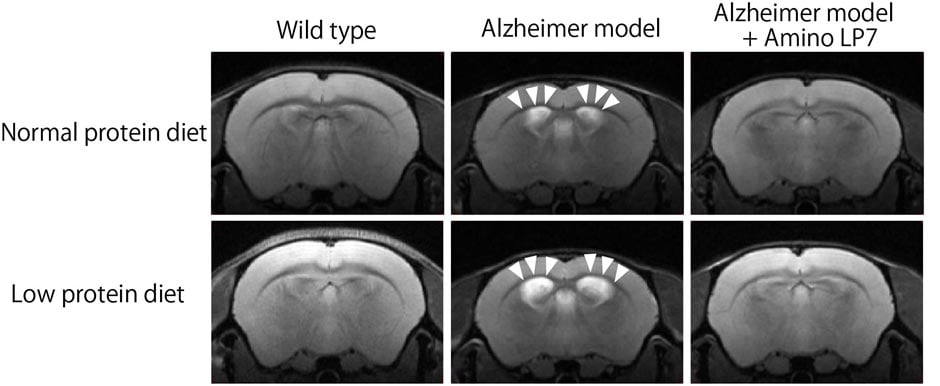
First, the researchers studied how a low protein diet affects the brain in mouse models of Alzheimer’s disease, which generally demonstrate neurodegeneration and abnormal protein aggregates called “Tau” aggregates in the brain. They found that mice consuming a low-protein diet not only showed accelerated brain degeneration but also had signs of poor neuronal connectivity. Interestingly, these effects were reversed after supplementation with Amino LP7, indicating that the combination of seven specific amino acids could inhibit brain damage.
Going Beyond Tau: A New Approach
Next, the research team examined how Amino LP7 affects different signs of brain degeneration in the Alzheimer’s model. Untreated mice showed high levels of progressive brain degeneration, but Amino LP7 treatment suppressed neuronal death and thereby reduced brain degeneration, even though the Tau aggregates remained. According to Dr. Akihiko Kitamura, who also led this study, “Tau plaques in the brain are characteristic of Alzheimer’s and most treatments target them. However, we have shown that it is possible to overcome this Tau deposition and prevent brain atrophy via supplementation with Amino LP7.”
Next, to understand how Amino LP7 protects the brain, the researchers comprehensively analyzed the gene-level changes induced by Amino LP7. Their findings were quite encouraging. They observed that Amino LP7 reduces brain inflammation and also prevents kynurenine, an inflammation inducer, from entering the brain, thereby preventing inflammatory immune cells from attacking neurons. They also found that Amino LP7 reduces neuronal death and improves neuronal connectivity, improving brain function.
“These results suggest that essential amino acids can help maintain balance in the brain and prevent brain deterioration. Our study is the first to report that specific amino acids can hinder the development of dementia,” said Dr. Hideaki Sato and Dr. Yuhei Takado, both of whom majorly contributed to the study. “Although our study was performed in mice, it brings hope that amino acid intake could also modify the development of dementia in humans, including Alzheimer’s disease,” they add.
A New Direction in Dementia Prevention
The study by this research group throws open several avenues for a better understanding of how dementias occur and how they can be prevented. Given that Amino LP7 improves brain function in older people without cognitive impairment, their findings suggest that it could also be effective in people with cognitive dysfunction.
Indeed, this patent-pending supplement could one day help millions worldwide live an improved, dementia-free life.
Reference: “Neurodegenerative processes accelerated by protein malnutrition and decelerated by essential amino acids in a tauopathy mouse model” by Hideaki Sato, Yuhei Takado, Sakiko Toyoda, Masako Tsukamoto-Yasui, Keiichiro Minatohara, Hiroyuki Takuwa, Takuya Urushihata, Manami Takahashi, Masafumi Shimojo, Maiko Ono, Jun Maeda, Asumi Orihara, Naruhiko Sahara, Ichio Aoki, Sachise Karakawa, Muneki Isokawa, Noriko Kawasaki, Mika Kawasaki, Satoko Ueno, Mayuka Kanda, Mai Nishimura, Katsuya Suzuki, Akira Mitsui, Kenji Nagao, Akihiko Kitamura and Makoto Higuchi, 22 October 2021, Science Advances.
DOI: 10.1126/sciadv.abd5046
The present work was supported by Ajinomoto Co., Inc., Grants-in-Aid for Brain Mapping by Integrated Neurotechnologies for Disease Studies (Brain/MINDS; 18dm0207018 and 19dm0207072), JST grant number JPMJMS2024 and AMED grant number 20356533 to M.H., and grant for Young Scientists (20 K15910 to K.M.)
About National Institutes for Quantum Science and Technology, Japan
The National Institutes for Quantum Science and Technology (QST) was established in April 2016 to promote quantum science and technology in a comprehensive and integrated manner. The new organization was formed from the merger of the National Institute of Radiological Sciences (NIRS) with certain operations that were previously undertaken by the Japan Atomic Energy Agency (JAEA).
QST’s mission is to raise the level of quantum and radiological sciences and technologies through its commitment to research and development into quantum science and technology, the effect of radiation on humans, radiation emergency medicine, and the medical use of radiation.
To ensure that research and development delivers significant academic, social and economic impacts, and to maximize benefits from global innovation, QST is striving to establish world-leading research and development platforms, explore new fields, and serve as a center for radiation protection and radiation emergency medicine.
About Dr. Makoto Higuchi from National Institutes for Quantum Science and Technology, Japan
Dr. Makoto Higuchi is a renowned neuroscientist and heads the Department of Functional Brain Imaging at the National Institutes for Quantum Sciences and Technology, Japan. In 1997, he was awarded a Ph.D. in Medicine from Tohoku University Graduate School of Medicine, and he completed his postdoctoral training in the University of Pennsylvania School of Medicine. His primary research interest lies in translational molecular imaging aimed at elucidating the pathophysiology of neuropsychiatric disorders such as schizophrenia, depression, and Alzheimer’s disease. He is credited for the development of agents for imaging pathological tau protein deposits in neurodegenerative diseases.
Never miss a breakthrough: Join the SciTechDaily newsletter.
Follow us on Google and Google News.
24 Comments
Ok.ok
this articles details the contents of LP7:
https://www.science.org/doi/10.1126/sciadv.abd5046
Thanks! Unbelievably lame to not include it in the article. I guess this is paid advertisement instead of a science article.
I take it back. 3 letter abbreviations?
And how does one obtain this amino acid?
Which seven amino acids is it?
Great news for mice! Essential amino acids? Eat Balanced diet. Avoid junk. This has all the earmarks of the 19th century quack dealing his wacky nostrums from the back of a horse drawn wagon. Hydroxychloroquine anyone? with a lysol chaser.
What strikes me is the dosage. The mice were given LP7 at a dose of 1g/kg x 2/day. If that is the required beneficial amount, a 50kg adult would have to consume 100g/day. Based on most comercially available EAA supplements (powder form) that would be 14 servings, with ~250ml water each for a total of 3.5l per day. That would be a gargantuan task for a young healthy adult and close to impossible for a senior. I would like to see if the results are repeatable at 1/4 of that amount before even considering this as an avenue of treatment.
😂
Impossible for a senior?
Do you think it’s hard for old people to drink water?
Why is the amino acid purchasing info not revealed?
😂
Impossible for a senior?
Do you think it’s hard for old people to drink water?
How can I buy amino LP7.
@JG Crawford when converting mouse doses to humans, you don’t convert by straight mass proportions. It would be less for humans. I don’t remember the formula, but it is much less than proportional.
I have a protein drink in front of me now. It says 30g is its serving size. I suspect that is probably in the ballpark.
However, I think this is far from demonstrated effective in humans. The Alzheimer’s mouse model has proven very poor in the past. They have cured mouse Alzheimer’s over and over, but when they apply these treatments to humans, they have come up dry. It is, of course, still worthy of reporting. And we can hope.
If you really want to prevent Alzheimer’s your best bet is 20+ minutes of cardio 5+ days a week or a similar amount of sauna where your heart beats at a similarly high rate.
Add in good nutrition especially including omega 3 and supplements to lower inflammation, and regular social activity, and you have a reasonable chance of avoiding it.
If you want a bit more assurance, exercise every day rather than 5 days a week.
Then there are lots of speculative things that might help. Fully addressing any sleep apnea, and insuring regular full night’s sleep is reasonable. HEPA Air filtration in the home may be beneficial (but not that ion stuff). There has been some evidence that nano-particles of ferrous metals in the air may be implicated. In any case, cleaner air should be harmless, and is pretty cheap.
Then there is very speculative and usually expensive or unpleasant tries: Cleaning toxins out of the blood with plasmaphereses (this appears to have had great benefits in aging mice but is not a cheap procedure), Hyperbaric oxygen treatment (expensive, but appears to have benefits this time in actual humans…but those benefits may or may not include brain health), the fasting mimicking diet where a few times a year you go on a roughly 1/3 the usual calories but less than 10% of that as protein for a few days…usually 4 or 5 days. This is supposed to drop down IGF-1, clear some senescent cells and allow the body and cells to clear out wastes and do other housecleaning. It can also stimulate neuron growth. But this state is a temporary thing, you want the diet to go back to normal after a few days, hopefully retaining that somewhat repaired state. And obviously not everyone is in good enough health to do fasting/near fasting. And my last one is a low Advanced Glycation End Product (AGEs) diet. These AGEs are dangerous crosslinks that are implicated in many aging diseases, including Alzheimer’s. It is a bit challenging to minimize these. They are made when food is cooked at high temperature, when things are blended at high speeds, and by fermentation. And a few foods just have it high naturally. Pine nuts is one. AGEs are impossible to avoid, so it is a matter of the degree to which you want to go to minimize them. It is easy to avoid the worst offenders: Fried meats, grilled meats, broiled meats and processed meats, butter, margarine, mayonnaise, hard cheeses, creme cheese roasted nuts, roasted/toasted oils, nut butters using roasted nuts, peanut oil, cottonseed oil, and believe it or not, olive oil, and canola. If you want to make minimal changes hold the: bacon, butter, margarine, mayonnaise, hot dogs, toasted sesame oil, Parmesan cheese, white American cheese, deep-fried chicken, and pine nuts. And USE avocado and sunflower oils. Use the crock pot, the pressure cooker, and steamer more. And eat soups, stews, and chili more.
Some supplements and drugs can also reduce the formation of AGEs within the body. Most of these are antioxidants, but metformin and aspirin also reduce AGEs.
Nothing new here. Eat a balanced diet, exercisr and get sleep and clean water, and a positive point of view. Here they are just discussing laboratory inventiveness of throwing a few aminos together and creating a theory that serves them.
It’s a scam probably.!!!🤔
2 weeks to late just lost my husband
And the award for the biggest idiot here goes to John Karkalis! There are a few other notables, including Rose Jane and Libby. If you’re not in the health field it’s probably best to keep your uneducated comments to yourself…
Thanks for nothing Maureen!
Yeah, like which aminos specifically? I don’t know about dementia, but I’m a 70 year old male who started strength training just 6 years ago. I take powders containing Leucine,Isoleucine, Value and Lysine to help me gain and preserve muscle. They have worked amazingly for me at least. I’m the strongest and most muscular I’ve ever been in my life. I feel great too.
First, I do hope the effects workout in humans. Big fan of such methods if we can find them. No dangerous molecules or invasive procedures certainly sounds good. Looking forward to more data.
Next, for those looking for the aminos follow the link to the study and then get the supplemental PDF and it has a table that will show you the specifics of what percentage each constituted in what they call LP7.
Taking the suggested aminos should not harm you especially considering they are essential; unless you have a condition preventing it such as for phenylalanine, and beware of what you purchase and what else it may contain; such as caffeine
or other molecules which may not work out good for “you” or cause you to not be able to properly adjust dosage; read labels and ingredients. I’m not a doctor nor recommending you do or do not take any substance of any form including these aminos. I can tell you that AZ has not been kind to my family and is my driver for interest.
Keep everything in moderation and don’t over do it. You should be able to find safe dosing data for each through reputable health sites should you choose to take them. It’s difficult to get certain amounts of specific nutrients without a little supplementation for me and imagine others; use a little caution to be sure you get what you are trying to get and not something else or mostly something else.
You can take the table from the PDF and order the specifics from GNC or The Vitamin Store or pick your own place. You can find most of those in isolation or a good subset together I saw from some quick searches. Then you’ll need to mix and match either powders or pills to get the percentages right and adjust the total amount for your diet and target body weight. But always keep in mind if there are other substances in what you buy, say something you should not over do like vitamins or otherwise, then you’ll limit your ability to safely adjust your intake to get the percentages correct.
Remember that even ingesting too much water can he deadly, so always be thinking!
This makes no sense considering we are humans not mice and there is a high prevalence of neurodegenerative diseases among people that eat high exorbitant amounts of protein.
😂
That’s just not how thinking is supposed to work.
Keep trying!
Where do I buy this product…what brands carry this product, please let me know. Thsnk you.
Look into Fulvic acid minerals.