
Close Menu
    Facebook X (Twitter) Instagram
    SciTechDaily
    • Biology
    • Chemistry
    • Earth
    • Health
    • Physics
    • Science
    • Space
    • Technology
    Facebook X (Twitter) Pinterest YouTube RSS
    SciTechDaily
    Home»Health»Evaporation Critical to Coronavirus Transmission As Weather Changes: Effects of Humidity, Temperature, and Wind on COVID-19
    Health

    Evaporation Critical to Coronavirus Transmission As Weather Changes: Effects of Humidity, Temperature, and Wind on COVID-19

    By American Institute of PhysicsSeptember 22, 20203 Comments3 Mins Read
    Facebook Twitter Pinterest Telegram LinkedIn WhatsApp Email Reddit
    Share
    Facebook Twitter LinkedIn Pinterest Telegram Email Reddit
    Weather Impact on Virus Transmission
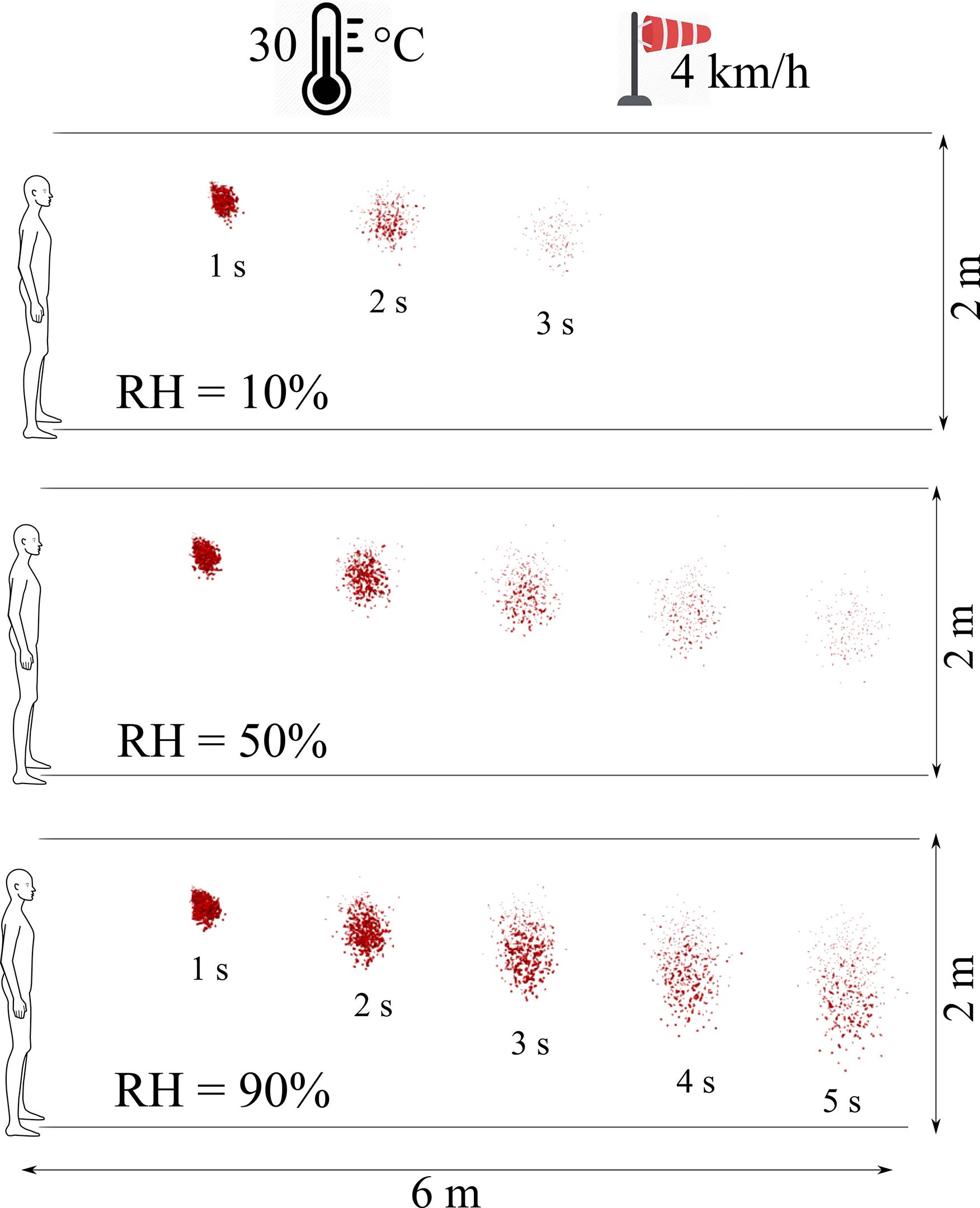
    Weather impact on virus transmission. Effect of relative humidity (RH=10%, 50%, and 90%) on coronavirus respiratory droplet cloud at temperature 30 C (86 F) and wind speed of 4 kph (2.5 mph). Wind direction is from left to right. Credit: Talib Dbouk and Dimitris Drikakis

    Impact of evaporation on virus survival, concentration, transmission.

    As COVID-19 cases continue to rise worldwide, it is increasingly urgent to understand how climate impacts the continued spread of the coronavirus, particularly as winter virus infections are more common and countries in the northern hemisphere will soon see cooler temperatures.

    In a paper in the journal Physics of Fluids, by AIP Publishing, researchers studied the effects of relative humidity, environmental temperature, and wind speed on the respiratory cloud and virus viability. They found that a critical factor for the transmission of the infectious particles, which are immersed in respiratory clouds of saliva droplets, is evaporation.

    “Suppose we have a better understanding of the evaporation and its relation to climate effects. In that case, we can more accurately predict the virus concentration and better determine its viability or the potential for virus survival,” said Dimitris Drikakis, one of the authors.

    Despite the importance of airborne droplet transmission, research regarding heat and mass transfer around and within respiratory droplets containing the virus has been scarce.

    To address the challenge, the researchers developed theoretical correlations for the unsteady evaporation of coronavirus-contaminated saliva droplets. They implemented the theory in an advanced computational fluid dynamics platform and studied the effects of weather conditions on airborne virus transmission.

    “We found high temperature and low relative humidity lead to high evaporation rates of saliva-contaminated droplets, thus significantly reducing the virus viability,” said co-author Talib Dbouk.

    Additionally, the researchers observed the travel distance and concentration of the droplet cloud continued to be significant, even at high temperatures if the relative humidity is high. The wind speed is another crucial factor that might alter all the rules for the social distancing guidelines.

    These findings help explain why the pandemic increased during July in different crowded cities around the world, such as Delhi, which experienced both high temperatures and high relative humidity. It also provides a crucial alert for the possibility of a second wave of the pandemic in the coming autumn and winter seasons, where low temperatures and high wind speeds will increase airborne virus survival and transmission.

    This study adds to the growing body of research that reinforces the importance of social distancing and the use of face masks to prevent full virus spread. The results reveal the importance of weather conditions in the virus’s viability, which can help guide the design of measures in both indoor and outdoor environments, to reduce airborne virus transmission in private and public spaces.

    Reference: “Weather impact on airborne coronavirus survival” by Talib Dbouk and Dimitris Drikakis, 22 September 2020, Physics of Fluids.
    DOI: 10.1063/5.0024272

    Never miss a breakthrough: Join the SciTechDaily newsletter.
    Follow us on Google and Google News.

    American Institute of Physics Biophysics COVID-19 Fluid Dynamics Infectious Diseases
    Share. Facebook Twitter Pinterest LinkedIn Email Reddit

    Related Articles

    Cloth COVID Masks Filter Less Than 10% of Particles – Inferior for Protection Against Airborne Viral Spread

    Researchers Find Leakage of Airborne Droplets Escaping From COVID Masks – Even When Just Breathing

    Deactivating COVID-19 Virus Cough Droplets With UV-C Lamps

    See How Strategic Air Purifier Placement Reduces COVID Virus Spread Within Music Classrooms

    Simply Talking While Infected Can Spread COVID-19 – Even While Wearing Masks

    Contagion Transmission Model: Estimating Risk of Airborne COVID-19 With Mask Usage, Social Distancing

    Aerosol Microdroplets Not Very Effective at Spreading the COVID-19 Virus

    The Latest Science on How to Keep COVID-19 Out of School Classrooms

    Scientists Compare How COVID-19 Cough Clouds Travel With and Without Face Masks

    3 Comments

    1. Loudest Soul on September 22, 2020 10:12 am

      It’s a really tough situation for all of us, thanks for sharing some of the facts that people are not know.

      Reply
    2. Nagaraj on September 22, 2020 3:07 pm

      This seems to be at variance with a SARS coronavirus paper –
      https://www.hindawi.com/journals/av/2011/734690/
      Where they indicate that higher humidity helped to contain the spread of SARS in Hong Kong and other high humidity countries.

      Reply
    3. Gordon Schofield on September 22, 2020 3:54 pm

      This seems to be in contradiction with the article from the American Institute of Physics which stated that Water Droplets carrying the virus would remain longer in the air and travel further the higher the humidity, irrespective of temperature.

      Reply
    Leave A Reply Cancel Reply

    • Facebook
    • Twitter
    • Pinterest
    • YouTube

    Don't Miss a Discovery

    Subscribe for the Latest in Science & Tech!

    Trending News

    Scientists Uncover Potential Brain Risks of Popular Fish Oil Supplements

    Scientists Discover a Surprising Way To Make Bread Healthier and More Nutritious

    After 60 Years, Scientists Uncover Unexpected Brain Effects of Popular Diabetes Drug Metformin

    New Research Uncovers Hidden Side Effects of Popular Weight-Loss Drugs

    Scientists Rethink Extreme Warming After Surprising Ocean Discovery

    Landmark Study Links Never Marrying to Significantly Higher Cancer Risk

    Researchers Discover Unknown Beetle Species Just Steps From Their Lab

    Largest-Ever Study Finds Medicinal Cannabis Ineffective for Anxiety, Depression, PTSD

    Follow SciTechDaily
    • Facebook
    • Twitter
    • YouTube
    • Pinterest
    • Newsletter
    • RSS
    SciTech News
    • Biology News
    • Chemistry News
    • Earth News
    • Health News
    • Physics News
    • Science News
    • Space News
    • Technology News
    Recent Posts
    • Scientists Solve Mystery of Where the Colorado River Vanished Millions of Years Ago
    • Not Just Alzheimer’s: Scientists Uncover Clues to a Second, Overlooked Disorder
    • Scientists Uncover Dangerous Connection Between Serotonin and Heart Valve Disease
    • Scientists Discover a “Protector” Protein That Could Help Reverse Hair Loss
    • Powerful Lasers Reveal How Matter Becomes Plasma in Trillionths of a Second
    Copyright © 1998 - 2026 SciTechDaily. All Rights Reserved.
    • Science News
    • About
    • Contact
    • Editorial Board
    • Privacy Policy
    • Terms of Use

    Type above and press Enter to search. Press Esc to cancel.