
Close Menu
    Facebook X (Twitter) Instagram
    SciTechDaily
    • Biology
    • Chemistry
    • Earth
    • Health
    • Physics
    • Science
    • Space
    • Technology
    Facebook X (Twitter) Pinterest YouTube RSS
    SciTechDaily
    Home»Physics»COVID-19 Transmission: Tracking Flight Trajectory of Evaporating Cough Droplets
    Physics

    COVID-19 Transmission: Tracking Flight Trajectory of Evaporating Cough Droplets

    By American Institute of PhysicsNovember 3, 2020No Comments3 Mins Read
    Facebook Twitter Pinterest Telegram LinkedIn WhatsApp Email Reddit
    Share
    Facebook Twitter LinkedIn Pinterest Telegram Email Reddit
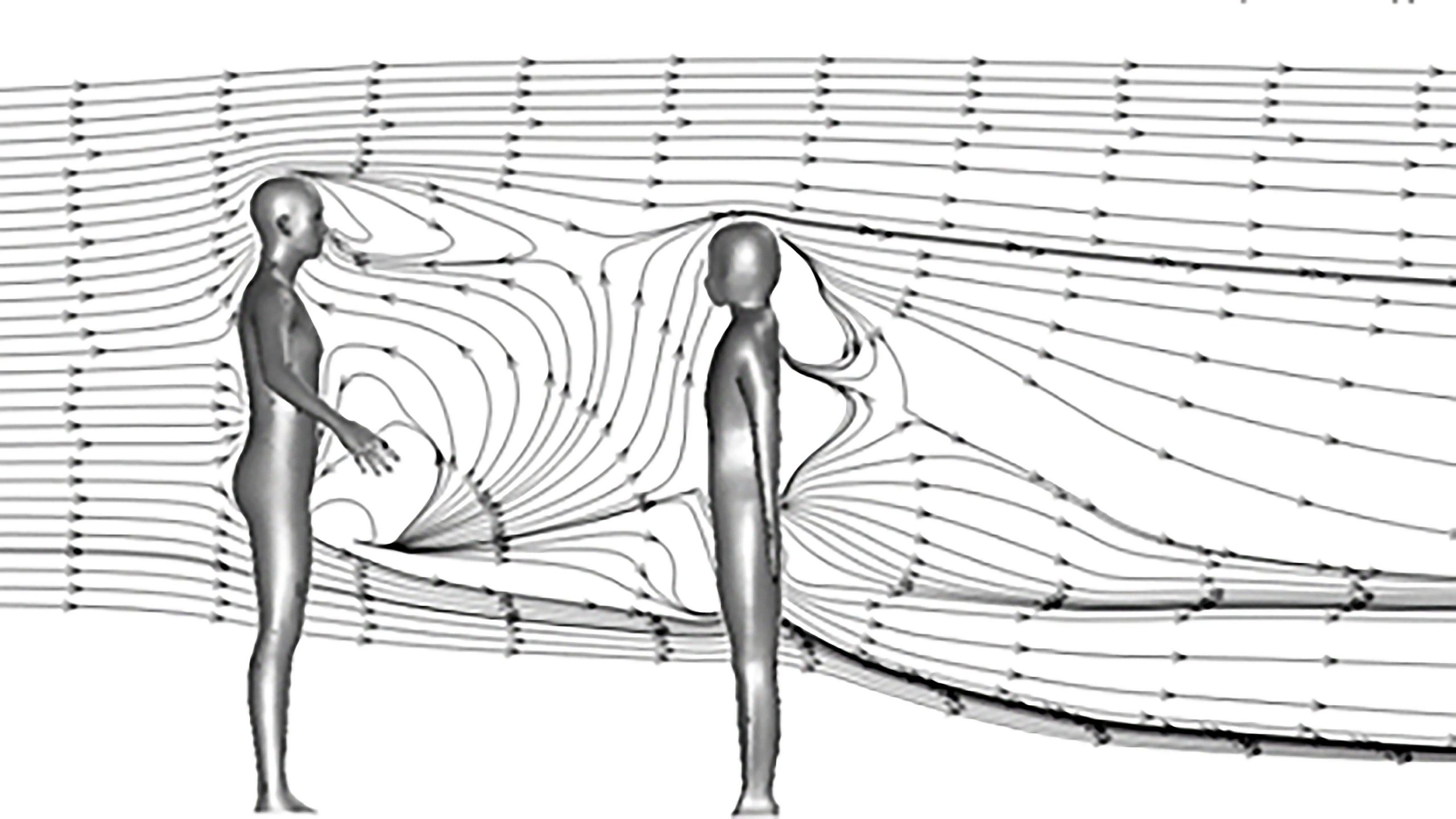
    Recirculating Flows Coughing
    Recirculating flows, namely wakes, are observed both in the front of the cougher (left) and at the back of the listener (right). A droplet may be entrained and trapped in the wake, significantly altering its trajectory and fate. Credit: A*STAR Institute of High Performance Computing

    Dispersion of large, medium, small airborne cough droplets in various outdoor conditions.

    The ongoing COVID-19 pandemic has led many researchers to study airborne droplet transmission in different conditions and environments. The latest studies are starting to incorporate important aspects of fluid physics to deepen our understanding of viral transmission.

    In a new paper in Physics of Fluids, by AIP Publishing, researchers from A*STAR’s Institute of High Performance Computing conducted a numerical study on droplet dispersion using high-fidelity airflow simulation. The scientists found a single 100-micrometer cough droplet under wind speed of 2 meters per second (4.5 mph) can travel up to 6.6 meters (22 feet) and even further under dry air conditions due to droplet evaporation.

    “In addition to wearing a mask, we found social distancing to be generally effective, as droplet deposition is shown to be reduced on a person who is at least 1 meter from the cough,” said author Fong Yew Leong.

    The researchers used computational tools to solve complex mathematical formulations representing airflow and the airborne cough droplets around human bodies at various wind speeds and when impacted by other environmental factors. They also assessed the deposition profile on a person at a certain proximity.
    Droplet Dispersion
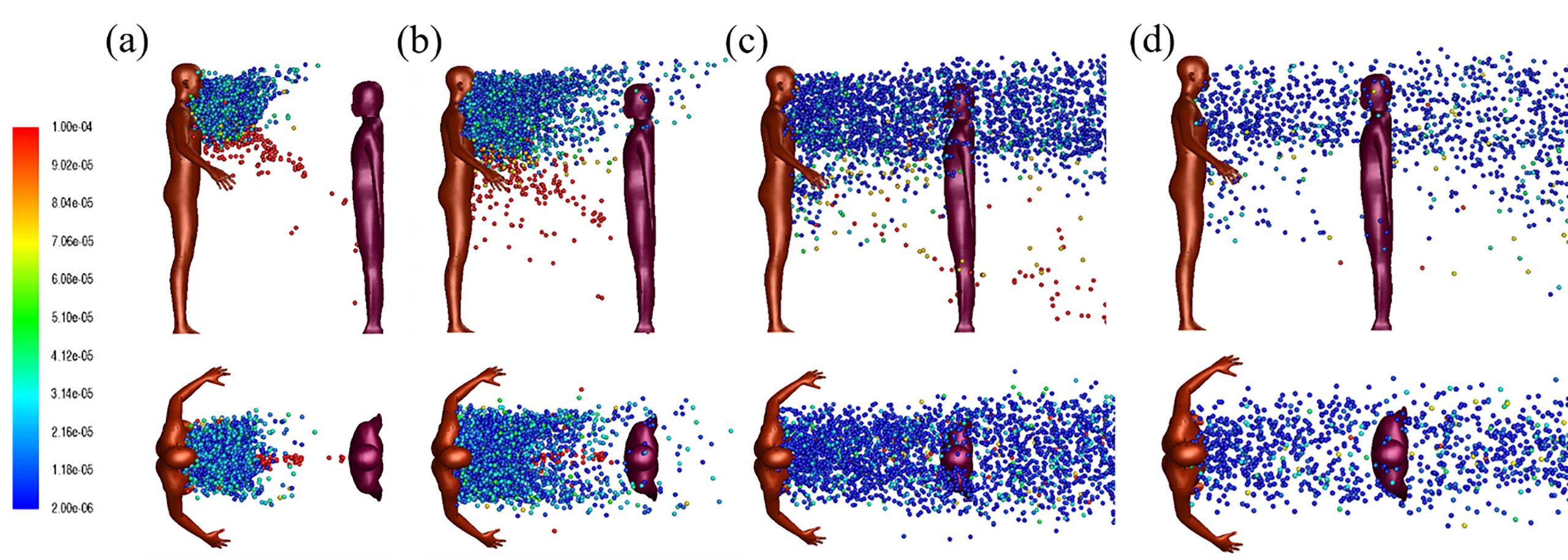
    Droplet dispersion (side, top-down views) from a single cough for two people spaced 1 m apart at (a) t = 0.52s, (b) t = 1s, (c) t = 3s and (d) t = 5s. Credit: A*STAR Institute of High Performance Computing

    A typical cough emits thousands of droplets across a wide size range. The scientists found large droplets settled on the ground quickly due to gravity but could be projected 1 meter by the cough jet even without wind. Medium-sized droplets could evaporate into smaller droplets, which are lighter and more easily borne by the wind, and these traveled further.

    The researchers offer a more detailed picture of droplet dispersion as they incorporated the biological considerations of the virus, such as the nonvolatile content in droplet evaporation, into the modeling of the airborne dispersion of droplets.

    “An evaporating droplet retains the nonvolatile viral content, so the viral loading is effectively increased,” said author Hongying Li. “This means that evaporated droplets that become aerosols are more susceptible to be inhaled deep into the lung, which causes infection lower down the respiratory tract, than larger unevaporated droplets.”

    These findings are also greatly dependent on the environmental conditions, such as wind speed, humidity levels, and ambient air temperature, and based on assumptions made from existing scientific literature on the viability of the COVID-19 virus.

    While this research focused on outdoor airborne transmission in a tropical context, the scientists plan to apply their findings to assess risk in indoor and outdoor settings where crowds gather, such as conference halls or amphitheaters. The research could also be applied to designing environments that optimize comfort and safety, such as hospital rooms that account for indoor airflow and airborne pathogen transmission.

    Reference: “Dispersion of evaporating cough droplets in tropical outdoor environment” by Hongying Li, Fong Yew Leong, George Xu, Zhengwei Ge, Chang Wei Kang and Keng Hui Lim, 3 November 2020, Physics of Fluids.
    DOI: 10.1063/5.0026360

    Never miss a breakthrough: Join the SciTechDaily newsletter.
    Follow us on Google and Google News.

    A*STAR Research American Institute of Physics COVID-19 Fluid Dynamics Infectious Diseases Popular Public Health
    Share. Facebook Twitter Pinterest LinkedIn Email Reddit

    Related Articles

    Cloth COVID Masks Filter Less Than 10% of Particles – Inferior for Protection Against Airborne Viral Spread

    Physics Shows Why You Should Wash Your Hands for 20 Seconds

    Safe Social Distancing Alert: Long Streams of Virus-Laden Droplets Can Trail Behind Infected Individuals

    Scientists Compare How COVID-19 Cough Clouds Travel With and Without Face Masks

    COVID-19 Warning: Flushing Public Restroom Toilets Can Spew Clouds of Particles Carrying Viruses

    Droplet Spread From Humans Doesn’t Always Follow Airflow – Important Implications for Spread of COVID-19

    How Face Mask Construction & Materials Matter for Containing Coughing & Sneezing Droplets

    Seeing Is Believing: Comparing Facemask Effectiveness in Mitigating Transmission of COVID-19

    Yikes! Flushing Toilets Create Long-Lasting Clouds of Virus-Containing Particles

    Leave A Reply Cancel Reply

    • Facebook
    • Twitter
    • Pinterest
    • YouTube

    Don't Miss a Discovery

    Subscribe for the Latest in Science & Tech!

    Trending News

    The Universe Is Expanding Too Fast and Scientists Can’t Explain Why

    “Like Liquid Metal”: Scientists Create Strange Shape-Shifting Material

    Early Warning Signals of Esophageal Cancer May Be Hiding in Plain Sight

    Common Blood Pressure Drug Shows Surprising Power Against Deadly Antibiotic-Resistant Superbug

    Scientists Uncover Dangerous Connection Between Serotonin and Heart Valve Disease

    Scientists Discover a “Protector” Protein That Could Help Reverse Hair Loss

    Bone-Strengthening Discovery Could Reverse Osteoporosis

    Scientists Uncover Hidden Trigger Behind Stem Cell Aging

    Follow SciTechDaily
    • Facebook
    • Twitter
    • YouTube
    • Pinterest
    • Newsletter
    • RSS
    SciTech News
    • Biology News
    • Chemistry News
    • Earth News
    • Health News
    • Physics News
    • Science News
    • Space News
    • Technology News
    Recent Posts
    • Scientists Overcome Major Quantum Bottleneck, Potentially Transforming Teleportation and Computing
    • Quantum Physics’ Strangest Problem May Hold the Key to Time Itself
    • Scientists Create “Liquid Gears” That Spin Without Touching
    • The Simple Habit That Could Help Prevent Cancer
    • Forgotten Medicinal Plant Shows Promise in Fighting Dangerous Superbugs
    Copyright © 1998 - 2026 SciTechDaily. All Rights Reserved.
    • Science News
    • About
    • Contact
    • Editorial Board
    • Privacy Policy
    • Terms of Use

    Type above and press Enter to search. Press Esc to cancel.