
In a newly published study, researchers from the Natural History Museum provide the first evidence that any organic material, either inside a meteorite or already on Earth, can survive the impact of a meteorite striking the planet at high speed.
New research shows that organic molecules, on which life is based, can survive the impact from a meteorite.
Reporting in the journal Nature Geoscience, mineralogist Dr Kieran Howard and his team have discovered intact organic molecules inside debris from a meteorite impact. Dr Howard was a researcher at the Museum when he performed the analyses.
This is the first evidence that any organic material, either inside a meteorite or already on Earth, can survive the impact of a meteorite striking the planet at high speed.
The discovery lends weight to the idea of panspermia – the suggestion that life on our planet was seeded by material falling from space.
The debris studied by the team was thrown up by a meteorite impact in Western Tasmania, Australia, leaving a 1.2km diameter crater known as Darwin Crater.
The meteorite crash-landed on Earth approximately 800,000 years ago at a speed of up to 18kms per second, and with a possible temperature on impact of more than 1,700°C.
It was thought that any organic material would be vaporized by the extreme temperature and pressure of a collision. But the researchers found organic matter within the impact debris from local swamps and rainforests present when the meteorite struck.
Extra-terrestrial life
‘We were surprised by our discovery,’ said Dr Howard. ‘We have long assumed any organic molecules, such as amino acids would not survive a meteorite impact. The evidence we have now supports an old hypothesis that impacts might have delivered the building blocks of life to the early Earth.’
It has been experimentally proven that some bacteria can survive the heat and speed of entering our atmosphere, but whether anything could survive an actual impact was uncertain.
Tiny time capsules
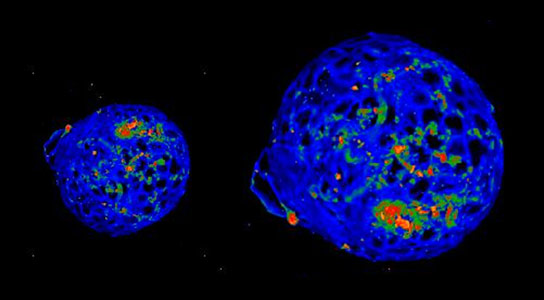
The evidence for the new research comes from ‘impact glasses’, smooth spheres that form when the energy of a meteorite impact melts the rock it strikes and sends it hurtling through the air. These droplets are flung huge distances, solidifying as they travel.
The impact glasses used in the study were strewn up to 20km from the impact site at Darwin Crater.
Inside the glasses the team found tiny inclusions of organic material, sometimes less than 0.001mm in diameter. They were able to analyze this material and confidently link it to plants that existed in the nearby swamps and rainforests of the time.
Life on Mars?
Organic material usually degrades over time, but inside the impact glasses it was perfectly preserved for nearly one million years.
Impact glasses act as tiny time capsules, preserving a record of the local environment at the time of the meteorite strike. This adds new dimensions to the search for evidence of life on Mars.
Since material ejected from Earth could reach Mars in as little as 30,000 years, organic material originating in Earth impact glasses could be found on the surface of the red planet.
Mars’ own impact glasses could also have preserved material from a time when we know the planet was much wetter and warmer, and may have been able to support life.
Reference: “Biomass preservation in impact melt ejecta” by Kieren Torres Howard, Melanie J. Bailey, Deborah Berhanu, Phil A. Bland, Gordon Cressey, Lauren E. Howard, Chris Jeynes, Richard Matthewman, Zita Martins, Mark A. Sephton, Vlad Stolojan and Sasha Verchovsky, 10 November 2013, Nature Geoscience.
DOI: 10.1038/ngeo1996
Never miss a breakthrough: Join the SciTechDaily newsletter.
Follow us on Google and Google News.