
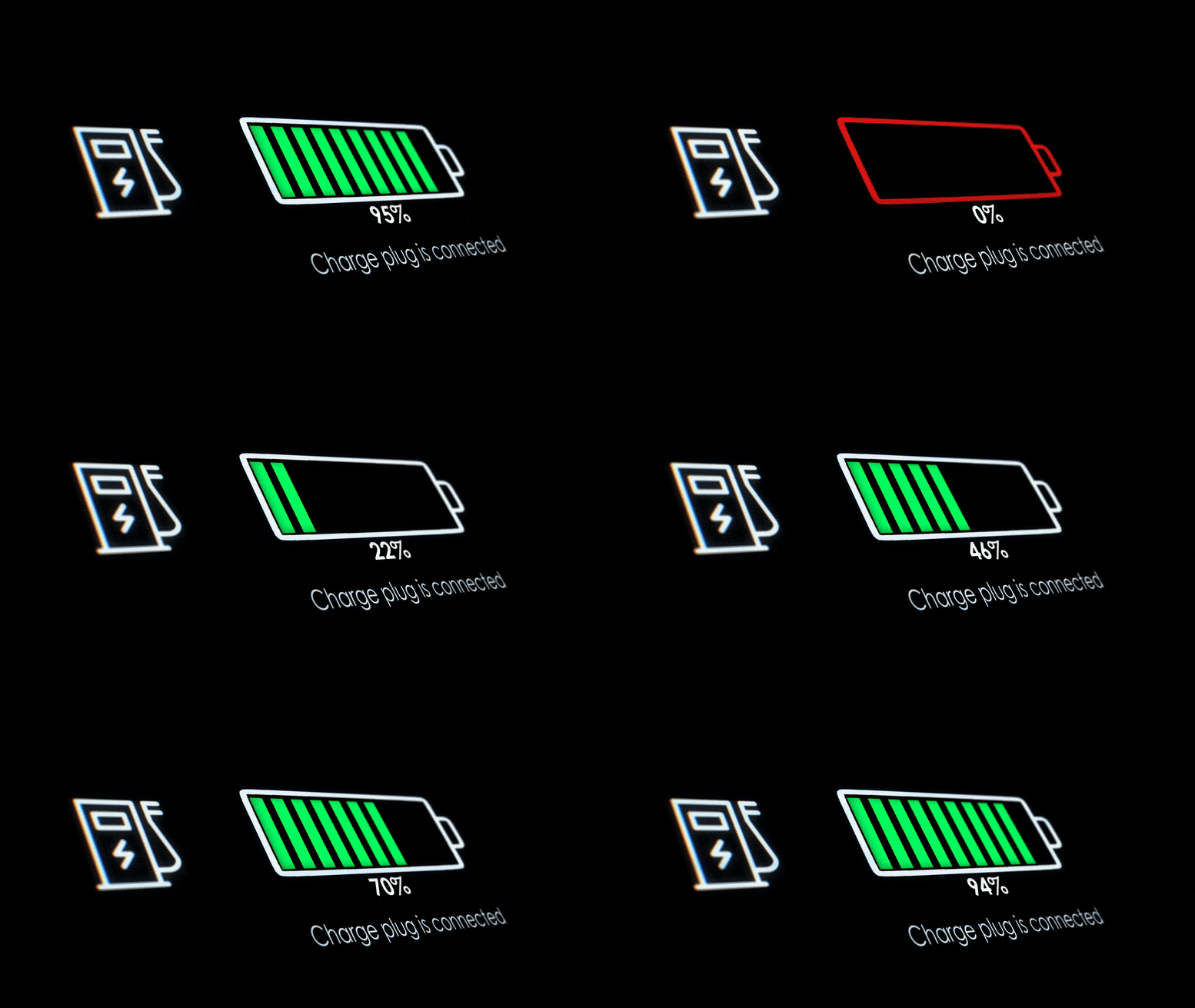
High-accuracy electric vehicle battery monitoring with diamond quantum sensors for driving range extension toward carbon neutrality.
The popularity of electric vehicles (EVs) as an environmentally friendly alternative to conventional vehicles with gasoline-powered internal combustion engines has been on the rise. This has led to major research efforts directed toward developing high-efficiency EV batteries. However, a significant inefficiency in EVs results from inaccurate estimations of the battery charge. The current output of the battery is measured to assess the charge state of an EV battery. This is used to calculate an estimate of the remaining driving range of the vehicles.
Typically, the battery currents in EVs can reach hundreds of amperes. However, commercial sensors that can detect such currents cannot measure small changes in the current at milliampere levels. This leads to an uncertainty of around 10% in the battery charge estimation. What this means is that the driving range of EVs could be extended by 10%. This, in turn, would reduce inefficient battery usage.
Fortunately, a team of scientists has now come up with a solution. In their study, they reported a diamond quantum sensor-based detection technique that can estimate the battery charge within 1% accuracy while measuring high currents typical of EVs. The team of researchers from Japan was led by Professor Mutsuko Hatano from the Tokyo Institute of Technology (Tokyo Tech) and published their study today (September 6) in Scientific Reports.
Diamond Quantum Sensors for Precise Current Measurement
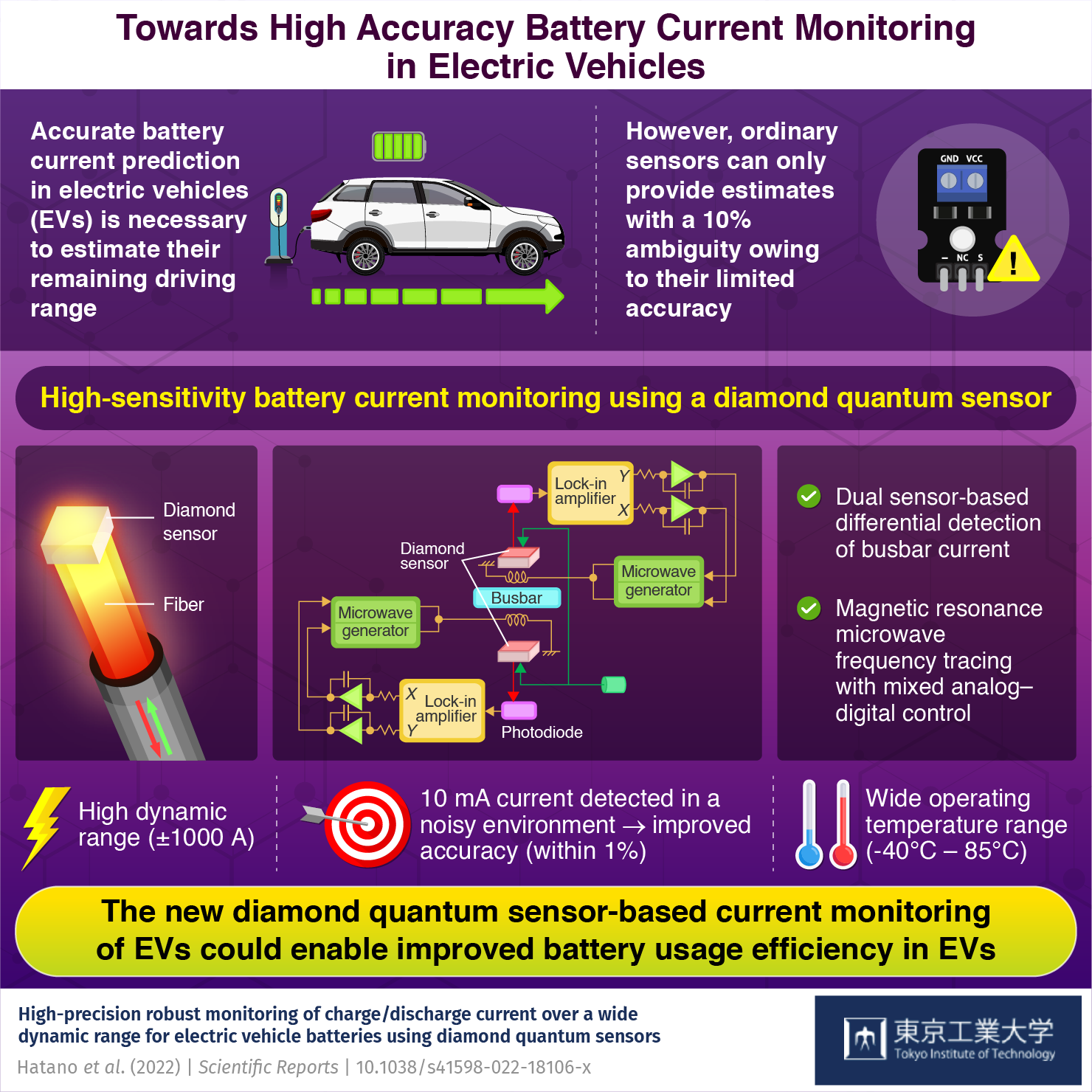
“We developed diamond sensors that are sensitive to milliampere currents and compact enough to be implemented in automobiles. Furthermore, we measured currents in a wide range as well as detected milliampere-level currents in a noisy environment,” explains Prof. Hatano.
In their work, the researchers developed a prototype sensor using two diamond quantum sensors that were placed on either side of the busbar (electrical junction for incoming and outgoing currents) in the car. They then used a technique called “differential detection” to eliminate the common noise detected by both the sensors and retain only the actual signal. This, in turn, enabled them to detect a small current of 10 mA amid background environmental noise.
Wide Dynamic Range and Temperature Resilience
Next, the team of scientists used a mixed analog-digital control of the frequencies generated by two microwave generators to trace the magnetic resonance frequencies of the quantum sensor over a bandwidth of 1 gigahertz. This allowed for a large dynamic range (ratio of largest to smallest current detected) of ±1000 A. Moreover, a wide operating temperature range of − 40 to + 85 °C was confirmed to cover general vehicular applications.
Finally, the team tested this prototype for Worldwide Harmonized Light Vehicles Test Cycle (WLTC) driving, a standard test for energy consumption in EVs. The sensor accurately traced the charge/discharge current from -50 A to 130 A and demonstrated the battery charge estimation accuracy within 1%.
What are the implications of these findings? Prof. Hatano remarks, “Increasing battery usage efficiency by 10% would reduce battery weight by 10%, which will reduce 3.5% running energy and 5% production energy of 20 million new EVs in 2030 WW. This, in turn, corresponds to a 0.2% reduction in CO2 emissions in 2030 WW transportation field.”
We certainly hope this breakthrough takes us one step closer to a carbon-neutral society!
Reference: “High-precision robust monitoring of charge/discharge current over a wide dynamic range for electric vehicle batteries using diamond quantum sensors” by Yuji Hatano, Jaewon Shin, Junya Tanigawa, Yuta Shigenobu, Akimichi Nakazono, Takeharu Sekiguchi, Shinobu Onoda, Takeshi Ohshima, Keigo Arai, Takayuki Iwasaki and Mutsuko Hatano6 September 2022, Scientific Reports.
DOI: 10.1038/s41598-022-18106-x
Funding: The Ministry of Education, Culture, Sports, Science and Technology
Never miss a breakthrough: Join the SciTechDaily newsletter.
Follow us on Google and Google News.
1 Comment
“This leads to an uncertainty of around 10% in the battery charge estimation. What this means is that the driving range of EVs could be extended by 10%.”
Someone doesn’t understand the concept of uncertainty. It also means that the battery may be completely discharged sooner than expected, leaving one stranded on the road.