
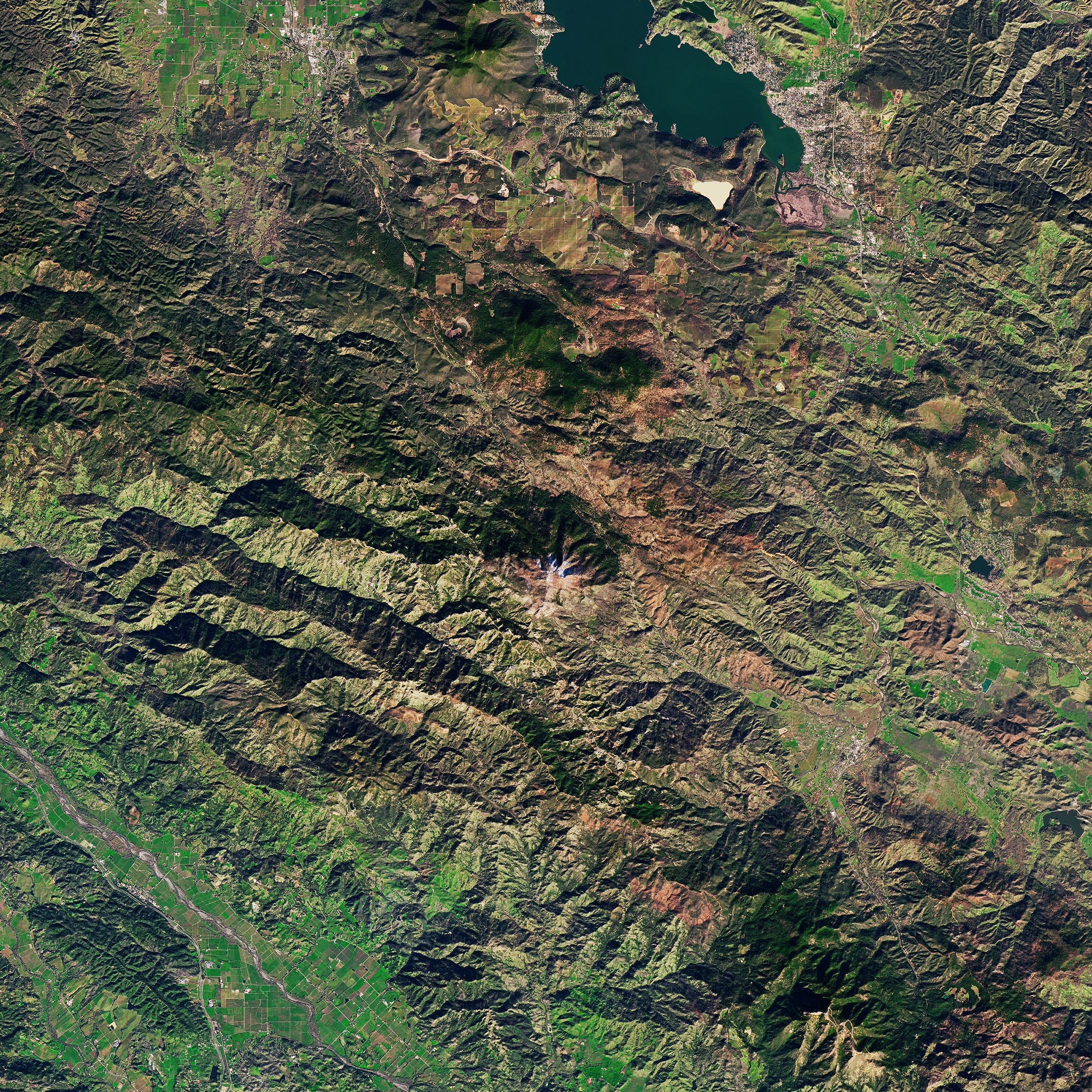
Hot springs and fumaroles dot this misnamed geothermal field that hosts the world’s largest complex of power plants capturing subterranean heat.
A large blob of silica-rich magma forced its way through Earth’s crust beneath the Coast Range of northern California about 1.3 million years ago. Today that shallow rock body is still piping hot, and the 45-square-mile (120-square-km) area above it is known as The Geysers. It is the world’s largest energy-producing geothermal field.
Although the nearby Clear Lake volcanic field was still erupting as recently as a few thousand years ago, this geothermal field never actually had any geysers. The Geysers is a misnomer that originated with 19th-century settlers to the area who misunderstood the hot springs and fumaroles bubbling and steaming away in the canyon of Big Sulphur Creek. From the mid-19th to the mid-20th century, a popular resort hotel operated in the area. Indigenous people of the region have visited the springs since prehistoric times.
Geothermal Energy Production at The Geysers
Located around 8 miles (13 kilometers) northeast of Geyserville, the site is now home to 18 power plants that use steam to drive turbines to generate electricity. The white roofs of several of the power plants are visible in this natural-color satellite image, which was acquired by the Operational Land Imager (OLI) on Landsat 8 on January 10, 2022.
The steam-driven turbines in this area can generate 725 megawatts of electricity, which is enough to power a city the size of San Francisco. The Geysers’ power plants typically supply the power needs of Sonoma, Lake, and Mendocino counties, as well as a portion of Marin and Napa counties. As of 2018, turbines in the Geysers area produced 50% of California’s geothermal power.
Geothermal energy is produced by extracting heat from within the Earth, either via natural steam or very hot water. It is a reliable and renewable source of energy. It has the advantage of being available whether or not the Sun is shining or the wind is blowing.
Three elements are needed to produce geothermal energy: magma close to the surface, fractured or permeable rock, and fluids that can circulate through the heated rock. At The Geysers, the body of rock that intruded over a million years ago lies just 0.6 miles (1 kilometer) below the surface. Deeper parts, below 1.5 miles (2.5 kilometers), can reach temperatures of 750 °F (400 °C).
While most geothermal power plants tap into water reservoirs, according to the U.S. Geological Survey, the Geysers system is one of only two vapor-dominated systems in the world. This means the formation produces steam directly, which can be tapped more efficiently to generate electricity.
Evolution of Energy Production and Sustainability Efforts
A small steam-engine generator was first used to produce electricity here in the 1920s, and the first modern geothermal well was drilled in 1955. Over the next several decades, further drilling and development by various operators brought The Geysers to its peak production in 1987. At that time, there were 21 power plants with a total capacity of more than 2,000 megawatts. After that, power production began to decline as the steam reservoir began to tap out.
In the mid-1990s, plant operators turned to a practice called enhanced geothermal systems (EGS) to sustain energy production and extend the life of the field. Water is injected at high pressure to reopen the natural fractures in the rock and allow hot water or steam to flow into the wells. Today, two pipelines deliver treated wastewater to recharge the reservoir from Lake County and the city of Santa Rosa.
NASA Earth Observatory image by Joshua Stevens, using Landsat data from the U.S. Geological Survey.
Never miss a breakthrough: Join the SciTechDaily newsletter.
Follow us on Google and Google News.