
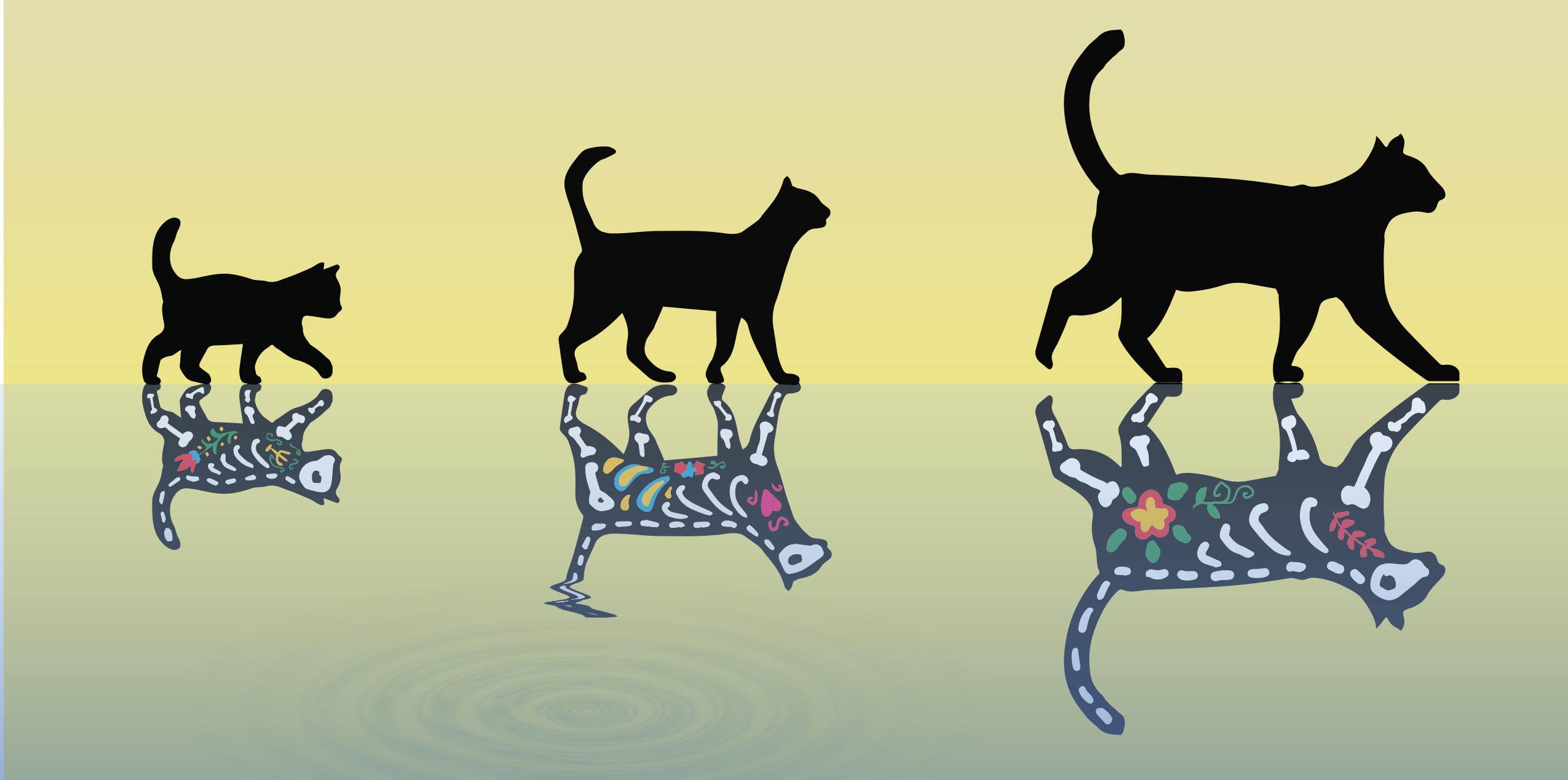
Researchers at ETH Zurich have created the heaviest Schrödinger cat to date by putting a crystal in a superposition of two oscillation states. Their results could lead to more robust quantum bits and help to explain why quantum superpositions are not observed in everyday life.
- Researchers at ETH Zurich have created the heaviest Schrödinger cat to date.
- For this, they combined an oscillating crystal with a superconducting circuit.
- They hope to better understand the reason behind the disappearance of quantum effects in the macroscopic world.
Even if you are not a quantum physicist, you will most likely have heard of Schrödinger’s famous cat. Erwin Schrödinger came up with the feline that can be alive and dead at the same time in a thought experiment in 1935. The obvious contradiction – after all, in everyday life we only ever see cats that are either alive or dead – has prompted scientists to try to realize analogous situations in the laboratory. So far, they have managed to do so using, for instance, atoms or molecules in quantum mechanical superposition states of being in two places at the same time.
At ETH, a team of researchers led by Yiwen Chu, professor at the Laboratory for Solid State Physics, has now created a substantially heavier Schrödinger cat by putting a small crystal into a superposition of two oscillation states. Their results, which have been published this week in the scientific journal Science, could lead to more robust quantum bits and shed light on the mystery of why quantum superpositions are not observed in the macroscopic world.
Cat in a Box
In Schrödinger’s original thought experiment, a cat is locked up inside a metal box together with a radioactive substance, a Geiger counter and a flask of poison. In a certain time-frame – an hour, say – an atom in the substance may or may not decay through a quantum mechanical process with a certain probability, and the decay products might cause the Geiger counter to go off and trigger a mechanism that smashes the flask containing the poison, which would eventually kill the cat. Since an outside observer cannot know whether an atom has actually decayed, he or she also doesn’t know whether the cat is alive or dead – according to quantum mechanics, which governs the decay of the atom, it should be in an alive/dead superposition state. (Schrödinger’s idea is commemorated by a life-size cat figure outside his former home at Huttenstrasse 9 in Zurich).
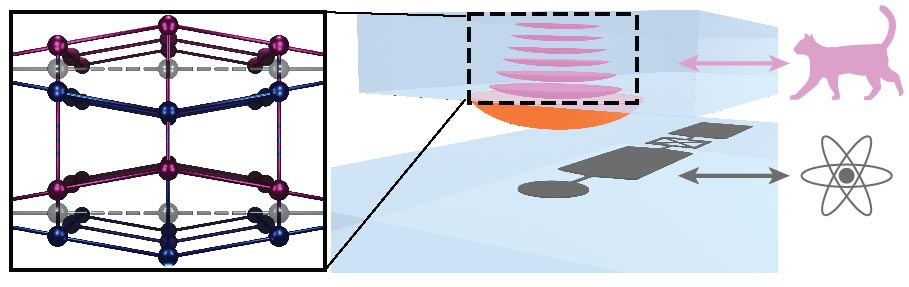
“Of course, in the lab we can’t realize such an experiment with an actual cat weighing several kilograms,” says Chu. Instead, she and her co-workers managed to create a so-called cat state using an oscillating crystal, which represents the cat, with a superconducting circuit representing the original atom. That circuit is essentially a quantum bit or qubit that can take on the logical states “0” or “1” or a superposition of both states, “0+1”. The link between the qubit and the crystal “cat” is not a Geiger counter and poison, but rather a layer of piezoelectric material that creates an electric field when the crystal changes shape while oscillating. That electric field can be coupled to the electric field of the qubit, and hence the superposition state of the qubit can be transferred to the crystal.
Simultaneous Oscillations in Opposite Directions
As a result, the crystal can now oscillate in two directions at the same time – up/down and down/up, for instance. Those two directions represent the “alive” or “dead” states of the cat. “By putting the two oscillation states of the crystal in a superposition, we have effectively created a Schrödinger cat weighing 16 micrograms,” explains Chu. That is roughly the mass of a fine grain of sand and nowhere near that of a cat, but still several billion times heavier than an atom or molecule, making it the fattest quantum cat to date.
In order for the oscillation states to be true cat states, it is important that they be macroscopically distinguishable. This means that the separation of the “up” and “down” states should be larger than any thermal or quantum fluctuations of the positions of the atoms inside the crystal. Chu and her colleagues checked this by measuring the spatial separation of the two states using the superconducting qubit. Even though the measured separation was only a billionth of a billionth of a meter – smaller than an atom, in fact – it was large enough to clearly distinguish the states.
Measuring Small Disturbances With Cat States
In the future, Chu would like to push the mass limits of her crystal cats even further. “This is interesting because it will allow us to better understand the reason behind the disappearance of quantum effects in the macroscopic world of real cats,” she says. Beyond this rather academic interest, there are also potential applications in quantum technologies. For instance, quantum information stored in qubits could be made more robust by using cat states made up of a huge number of atoms in a crystal rather than relying on single atoms or ions, as is currently done. Also, the extreme sensitivity of massive objects in superposition states to external noise could be exploited for precise measurements of tiny disturbances such as gravitational waves or for detecting dark matter.
Reference: “Schrödinger cat states of a 16-microgram mechanical oscillator” by Marius Bild, Matteo Fadel, Yu Yang, Uwe von Lüpke, Phillip Martin, Alessandro Bruno and Yiwen Chu, 20 April 2023, Science.
DOI: 10.1126/science.adf7553
Never miss a breakthrough: Join the SciTechDaily newsletter.
Follow us on Google and Google News.
2 Comments
The interaction and balance of topological vortices cover all long-distance and short-range contributions to spatiotemporal motion, and are the foundation of the evolution of spatiotemporal material motion. Topological vortices are not only the superposition of both dextrorotatiom and levorotation, but also the superposition of both certainty and uncertainty. The interaction of topological vortices is the evolution of material motion from uncertainty to certainty. The opening of the Schrödinger cat’s box is also an from uncertain to certain of evolution. Without certainty, there would be no topological vortices. Without uncertainty, there would be no motion and evolution of topological vortices. Topological vortex is a natural gravitational field. Quantum gravity and it’s uncertainty can been reasonably explained in this way.
I’m gonna pull a distant future Mike 🥽 T.V. 📺 ((From Charlie And The Chocolate 🍫 Factory 🏭 possibility…, and ask “What about 👥️ people?!!” “What if a persons entire atomic makeup could be phase shifted / attenuated into a Superpostion State??!!” 🤔 “Would they alternate between dimensionally existing and ceasing to exist within this known dimension of reality.., simultaneously?!!” “Could this ve the actual actualization of the age old adage of us humans saying [being in two places at once]?”