
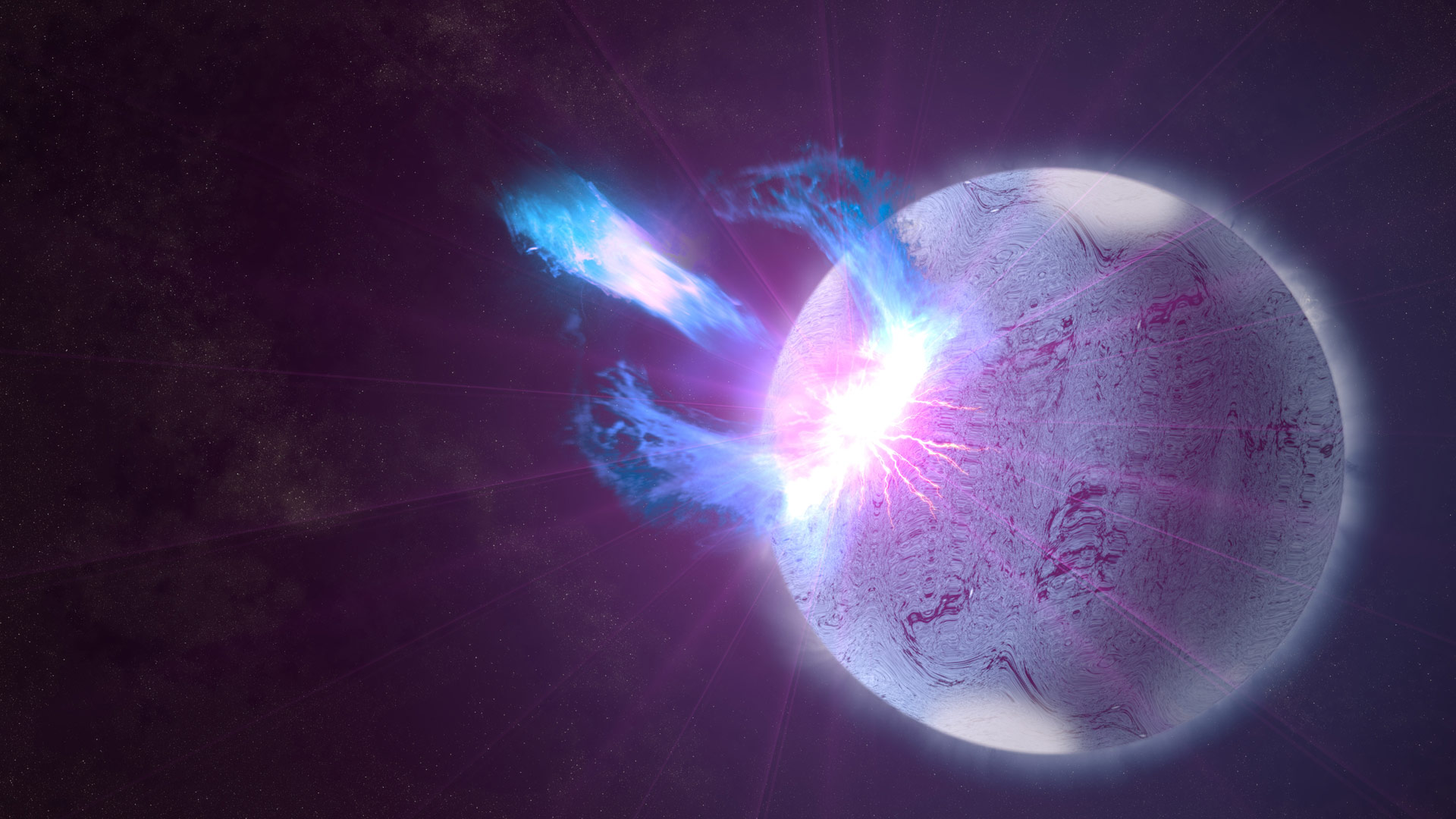
Using data from NASA’s Fermi Gamma-ray Space Telescope, astronomers have discovered underlying signals related to the rapid-fire “storm” of high-energy blasts detected in 2009 from a highly magnetized neutron star.
Such signals were first identified during the fadeout of rare giant flares produced by magnetars. Over the past 40 years, giant flares have been observed just three times – in 1979, 1998, and 2004 – and signals related to starquakes, which set the neutron stars ringing like a bell, were identified only in the two most recent events.
“Fermi’s Gamma-ray Burst Monitor (GBM) has captured the same evidence from smaller and much more frequent eruptions called bursts, opening up the potential for a wealth of new data to help us understand how neutron stars are put together,” said Anna Watts, an astrophysicist at the University of Amsterdam in the Netherlands and co-author of a new study about the burst storm. “It turns out that Fermi’s GBM is the perfect tool for this work.”
In the midst of SGR J1550-5418’s 2009 burst storm, Swift’s X-Ray Telescope captured an expanding halo produced by the magnetar’s brightest bursts. The rings formed as X-rays from the brightest bursts scattered off of intervening dust clouds. Clouds closer to Earth produced larger rings. Credit: NASA/Swift/Jules Halpern, Columbia University
Neutron stars are the densest, most magnetic, and fastest-spinning objects in the universe that scientists can observe directly. Each one is the crushed core of a massive star that ran out of fuel, collapsed under its own weight, and exploded as a supernova. A neutron star packs the equivalent mass of half a million Earths into a sphere about 12 miles across, roughly the length of Manhattan Island in New York City.
While typical neutron stars possess magnetic fields trillions of times stronger than Earth’s, the eruptive activity observed from magnetars requires fields 1,000 times stronger still. To date, astronomers have confirmed only 23 magnetars.
Because a neutron star’s solid crust is locked to its intense magnetic field, a disruption of one immediately affects the other. A fracture in the crust will lead to a reshuffling of the magnetic field, or a sudden reorganization of the magnetic field may instead crack the surface. Either way, the changes trigger a sudden release of stored energy via powerful bursts that vibrate the crust, a motion that becomes imprinted on the burst’s gamma-ray and X-ray signals.
It takes an incredible amount of energy to convulse a neutron star. The closest comparison on Earth is the 9.5-magnitude Chilean earthquake of 1960, which ranks as the most powerful ever recorded on the standard scale used by seismologists. On that scale, said Watts, a starquake associated with a magnetar giant flare would reach magnitude 23.
The 2009 burst storm came from SGR J1550−5418, an object discovered by NASA’s Einstein Observatory, which operated from 1978 to 1981. Located about 15,000 light-years away in the constellation Norma, the magnetar was quiet until October 2008, when it entered a period of eruptive activity that ended in April 2009. At times, the object produced hundreds of bursts in as little as 20 minutes, and the most intense explosions emitted more total energy than the sun does in 20 years. High-energy instruments on many spacecraft, including NASA’s Swift and Rossi X-ray Timing Explorer, detected hundreds of gamma-ray and X-ray blasts.
Speaking at the Fifth Fermi International Symposium in Nagoya, Japan, on October 21, Watts said the new study examined 263 individual bursts detected by Fermi’s GBM and confirms vibrations in the frequency ranges previously seen in giant flares. “We think these are likely twisting oscillations of the star where the crust and the core, bound by the super-strong magnetic field, are vibrating together,” she explained. “We also found, in a single burst, an oscillation at a frequency never seen before and which we still do not understand.”
A key element of the research is a new analysis technique developed by University of Amsterdam researcher Daniela Huppenkothen. Normally scientists search for oscillations in high-energy data by looking for variations aligned to a particular frequency. Such methods are best suited for finding a strong signal with little competition rather than a faint signal immersed in a bright and rapidly changing environment, such as a burst.
Huppenkothen likens the problem to detecting ripples from a stone tossed into a quiet pond. “Now imagine you’re in the middle of the North Atlantic during a storm, searching for those ripples amidst huge waves in a churning sea,” she explained. “Our old methods really weren’t appropriate for this, but I have in effect developed a way of accounting for the rough sea so we can find ripples even in stormy conditions.”
While there are many efforts to describe the interiors of neutron stars, scientists lack enough observational detail to choose between differing models. Neutron stars reach densities far beyond the reach of laboratories and their interiors may exceed the density of an atomic nucleus by as much as 10 times. Knowing more about how bursts shake up these stars will give theorists an important new window into understanding their internal structure.
“Right now,” added Watts, “we are waiting for more bursts – and if we’re lucky, a giant flare – to take advantage of GBM’s excellent capabilities.”
References:
“Quasi-Periodic Oscillations and Broadband Variability in Short Magnetar Bursts” by Daniela Huppenkothen, Anna L. Watts, Phil Uttley, Alexander J. van der Horst, Michiel van der Klis, Chryssa Kouveliotou, Ersin Gogus, Jonathan Granot, Simon Vaughan and Mark H. Finger, 4 April 2013, The Astrophysical Journal.
DOI: 10.1088/0004-637X/787/2/128
arXiv: 1212.1011
“Quasi-periodic Oscillations in Short Recurring Bursts of the Soft Gamma Repeater J1550–5418” by Daniela Huppenkothen, Caroline D’Angelo, Anna L. Watts, Lucy Heil, Michiel van der Klis, Alexander J. van der Horst, Chryssa Kouveliotou, Matthew G. Baring, Ersin Gogus, Jonathan Granot, Yuki Kaneko, Lin Lin, Andreas von Kienlin and George Younes, 12 May 2014, The Astrophysical Journal.
DOI: 10.1088/0004-637X/768/1/87
arXiv: 1404.2756
Never miss a breakthrough: Join the SciTechDaily newsletter.
Follow us on Google and Google News.