

Gathering the latest advancements in optical fiber telecommunications technology towards practical petabit-class backbone networks.
- The first 1 Petabit per second switching demonstration using spatial division multiplexing
- Prototype optical network testbed using multicore optical fibers and large-scale spatial optical switching
- Progress to the practical realization of ultra-high capacity petabit per second backbone networks
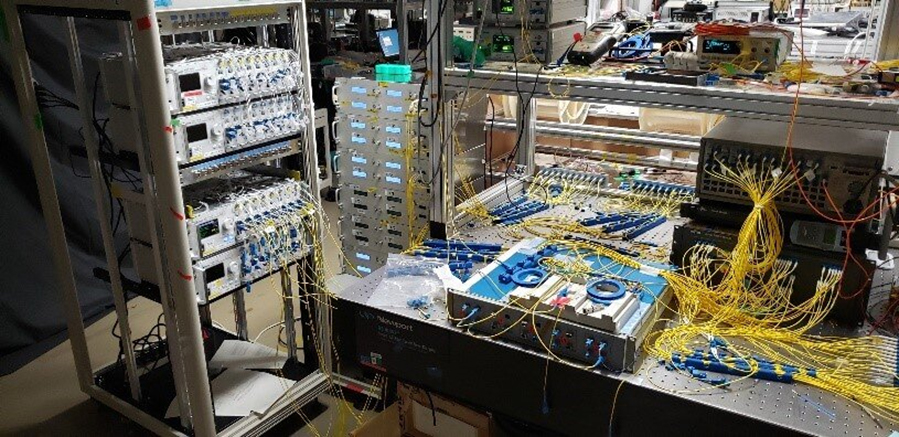
The Network System Research Institute at the National Institute of Information and Communications Technology (NICT, President: Hideyuki Tokuda, Ph.D.) has developed and demonstrated the first large-scale optical switching testbed capable of handling 1 Petabit per second optical signals. 1 Petabit per second is equivalent to the capacity to send 8K video to 10 million people simultaneously.
This demonstration made use of state-of-the-art large-scale and low-loss optical switches based on MEMS technology, three types of next-generation spatial-division multiplexing fibers, and included the routing of signals with capacities from 10 Terabit per second to 1 Petabit per second. This corresponds to more than 100 times the capacity of currently available networks.
This is a major step forward toward the early implementation of the petabit-class backbone optical networks capable of supporting the increasing requirements of internet services such as broadband video streaming, 5G mobile networks, or Internet of Things. As such, the results of this demonstration were acknowledged by the scientific community with a post-deadline presentation at the 45th European Conference on Optical Communication (ECOC 2019).
Background
NICT has collaborated extensively with academia and industry to develop new types of optical fiber technologies and provide petabit-class communications for short and long reach backbone networks as well as datacenter networks. These included achievements such as the record petabit-class transmission in a single fiber (September 2015, September 2018), and the longest link using spatial division multiplexing amplifiers (March 2019).
However, petabit-class transmission requires petabit-class switching technologies to manage and reliably direct large amounts of data through complex networks. Up to now, such technologies have been beyond reach because the existing approaches are limited by the complexity and/or performance.
Achievements
NICT has successfully implemented a network demonstration using state-of-the-art large-scale spatial optical switching, aiming at petabit-class next-generation optical networks using spatial-division multiplexing. The experimental network testbed supported data rates from 10 Terabit per second up to 1 Petabit per second over 3 types of next-generation multicore fibers and included practical requirements of real networks, such as protection switching. The total capacity of the network was 1 Petabit per second, corresponding to simultaneous 8K-TV broadcasting for 10 million people. The system was demonstrated in 4 fundamental scenarios that constitute the building blocks of the next-generation optical fiber networks.
1. Optical switching of 1 Petabit per second of data
2. Redundant configuration to support network failures or fiber breaks
3. Branching of 1 Petabit per second signals into different types of optical fibers with various capacities
4. Management of lower-capacity signals (10 Terabit per second) within the 1 Petabit per second network
The outcomes of this demonstration were awarded with a post-deadline presentation at the 45th European Conference on Optical Communication (ECOC 2019), held in Dublin, Ireland on September 26. This is one of the largest international conferences in the field of optical fiber communications.
Future Prospects
NICT will continue to pursue the advancement of ultra-high capacity telecommunications networks in collaboration with the industry, academia, and government.
Never miss a breakthrough: Join the SciTechDaily newsletter.
Follow us on Google and Google News.