

The newly installed Sequoia IBM Bluegene/Q system at Lawrence Livermore National Laboratories set a new record in computational science by successfully becoming the first supercomputer to use more than one million computing cores to solve a complex problem.
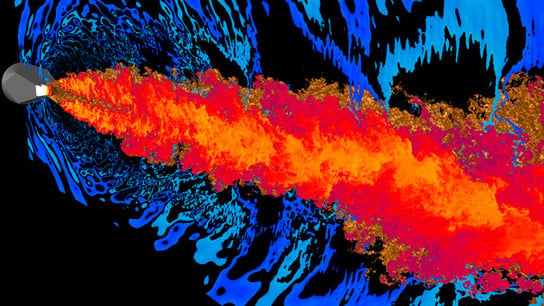
Stanford Engineering’s Center for Turbulence Research (CTR) has set a new record in computational science by successfully using a supercomputer with more than one million computing cores to solve a complex fluid dynamics problem—the prediction of noise generated by a supersonic jet engine.
Joseph Nichols, a research associate in the center, worked on the newly installed Sequoia IBM Bluegene/Q system at Lawrence Livermore National Laboratories (LLNL) funded by the Advanced Simulation and Computing (ASC) Program of the National Nuclear Security Administration (NNSA). Sequoia once topped the list of the world’s most powerful supercomputers, boasting 1,572,864 compute cores (processors) and 1.6 petabytes of memory connected by a high-speed five-dimensional torus interconnect.
Because of Sequoia’s impressive numbers of cores, Nichols was able to show for the first time that million-core fluid dynamics simulations are possible—and also to contribute to research aimed at designing quieter aircraft engines.
The physics of noise
The exhausts of high-performance aircraft at takeoff and landing are among the most powerful human-made sources of noise. For ground crews, even for those wearing the most advanced hearing protection available, this creates an acoustically hazardous environment. To the communities surrounding airports, such noise is a major annoyance and a drag on property values.
Understandably, engineers are keen to design new and better aircraft engines that are quieter than their predecessors. New nozzle shapes, for instance, can reduce jet noise at its source, resulting in quieter aircraft.
Predictive simulations—advanced computer models—aid in such designs. These complex simulations allow scientists to peer inside and measure processes occurring within the harsh exhaust environment that is otherwise inaccessible to experimental equipment. The data gleaned from these simulations are driving computation-based scientific discovery as researchers uncover the physics of noise.
More cores, more challenges
“Computational fluid dynamics (CFD) simulations, like the one Nichols solved, are incredibly complex. Only recently, with the advent of massive supercomputers boasting hundreds of thousands of computing cores, have engineers been able to model jet engines and the noise they produce with accuracy and speed,” said Parviz Moin, the Franklin M. and Caroline P. Johnson Professor in the School of Engineering and Director of CTR.
CFD simulations test all aspects of a supercomputer. The waves propagating throughout the simulation require a carefully orchestrated balance between computation, memory, and communication. Supercomputers like Sequoia divvy up the complex math into smaller parts so they can be computed simultaneously. The more cores you have, the faster and more complex the calculations can be.
And yet, despite the additional computing horsepower, the difficulty of the calculations only becomes more challenging with more cores. At the one-million-core level, previously innocuous parts of the computer code can suddenly become bottlenecks.
Ironing out the wrinkles
Over the past few weeks, Stanford researchers and LLNL computing staff have been working closely to iron out these last few wrinkles. This week, they were glued to their terminals during the first “full-system scaling” to see whether initial runs would achieve stable run-time performance. They watched eagerly as the first CFD simulation passed through initialization then thrilled as the code performance continued to scale up to and beyond the all-important one-million-core threshold, and as the time-to-solution declined dramatically.
“These runs represent at least an order-of-magnitude increase in computational power over the largest simulations performed at the Center for Turbulence Research previously,” said Nichols “The implications for predictive science are mind-boggling.”
A homecoming
The current simulations were a homecoming of sorts for Nichols. He was inspired to pursue a career in supercomputing as a high-school student when he attended a two-week summer program at Lawrence Livermore computing facility in 1994 sponsored by the Department of Energy. Back then he worked on the Cray Y-MP, one of the fastest supercomputers of its time.
“Sequoia is approximately 10 million times more powerful than that machine,” Nichols noted.
The Stanford ties go deeper still. The computer code used in this study is named CharLES and was developed by former Stanford senior research associate, Frank Ham. This code utilizes unstructured meshes to simulate turbulent flow in the presence of complicated geometry.
In addition to jet noise simulations, Stanford researchers in the Predictive Science Academic Alliance Program (PSAAP), sponsored by the Department of Energy, are using the CharLES code to investigate advanced-concept scramjet propulsion systems used in hypersonic flight (with video)—flight at many times the speed of sound—and to simulate the turbulent flow over an entire airplane wing.
Never miss a breakthrough: Join the SciTechDaily newsletter.
Follow us on Google and Google News.
2 Comments
Mr. Supercomputer, what is the meaning of Life, the Universe, and Everything?
I love these stories. Way over my head but with enough information that I am able to understand enough to blow my mind. Sometimes blood shoots out my nose like when I read this, “This code utilizes unstructured meshes to simulate turbulent flow in the presence of complicated geometry.”
I can’t even imagine. These people are my role models. Like artists, they paint the world as they see it and understand it. Math really is a beautiful thing.