
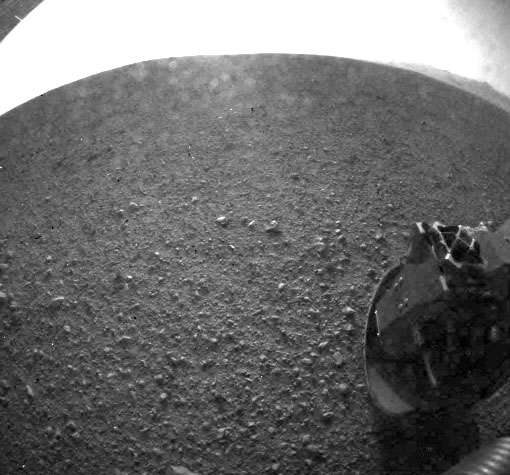
The above image is one of the first images taken by NASA’s Curiosity rover after its successful landing on Mars.
NASA’s most advanced Mars rover Curiosity has landed on the Red Planet. The one-ton rover, hanging by ropes from a rocket backpack, touched down on Mars on Sunday, August 5, 2012, to end a 36-week flight and begin a two-year investigation.
The Mars Science Laboratory (MSL) spacecraft that carried Curiosity succeeded in every step of the most complex landing ever attempted on Mars, including the final severing of the bridle cords and flyaway maneuver of the rocket backpack.
“Today, the wheels of Curiosity have begun to blaze the trail for human footprints on Mars. Curiosity, the most sophisticated rover ever built, is now on the surface of the Red Planet, where it will seek to answer age-old questions about whether life ever existed on Mars — or if the planet can sustain life in the future,” said NASA Administrator Charles Bolden. “This is an amazing achievement, made possible by a team of scientists and engineers from around the world and led by the extraordinary men and women of NASA and our Jet Propulsion Laboratory. President Obama has laid out a bold vision for sending humans to Mars in the mid-2030’s, and today’s landing marks a significant step toward achieving this goal.”
The Curiosity Mars Descent Imager (MARDI) captured the rover’s descent to the surface of the Red Planet. The instrument shot 4 fps video from heatshield separation to the ground.
Curiosity landed at 10:32 p.m. August 5, PDT, (1:32 a.m. EDT August 6) near the foot of a mountain three miles tall and 96 miles in diameter inside Gale Crater. During a nearly two-year prime mission, the rover will investigate whether the region ever offered conditions favorable for microbial life.
“The Seven Minutes of Terror has turned into the Seven Minutes of Triumph,” said NASA Associate Administrator for Science John Grunsfeld. “My immense joy in the success of this mission is matched only by overwhelming pride I feel for the women and men of the mission’s team.”
Curiosity returned its first view of Mars, a wide-angle scene of rocky ground near the front of the rover. More images are anticipated in the next several days as the mission blends observations of the landing site with activities to configure the rover for work and check the performance of its instruments and mechanisms.
“Our Curiosity is talking to us from the surface of Mars,” said MSL Project Manager Peter Theisinger of NASA’s Jet Propulsion Laboratory in Pasadena, California. “The landing takes us past the most hazardous moments for this project, and begins a new and exciting mission to pursue its scientific objectives.”
Confirmation of Curiosity’s successful landing came in communications relayed by NASA’s Mars Odyssey orbiter and received by the Canberra, Australia, antenna station of NASA’s Deep Space Network.
NASA’s most advanced Mars rover Curiosity has landed on the Red Planet. The one-ton rover, hanging by ropes from a rocket backpack, touched down onto Mars Sunday to end a 36-week flight and begin a two-year investigation. The Mars Science Laboratory (MSL) spacecraft that carried Curiosity succeeded in every step of the most complex landing ever attempted on Mars, including the final severing of the bridle cords and flyaway maneuver of the rocket backpack.
Curiosity carries 10 science instruments with a total mass 15 times as large as the science payloads on the Mars rovers Spirit and Opportunity. Some of the tools are the first of their kind on Mars, such as a laser-firing instrument for checking elemental composition of rocks from a distance. The rover will use a drill and scoop at the end of its robotic arm to gather soil and powdered samples of rock interiors, then sieve and parcel out these samples into analytical laboratory instruments inside the rover.
To handle this science toolkit, Curiosity is twice as long and five times as heavy as Spirit or Opportunity. The Gale Crater landing site places the rover within driving distance of layers of the crater’s interior mountain. Observations from orbit have identified clay and sulfate minerals in the lower layers, indicating a wet history.
The mission is managed by JPL for NASA’s Science Mission Directorate in Washington. The rover was designed, developed and assembled at JPL. JPL is a division of the California Institute of Technology in Pasadena.
Never miss a breakthrough: Join the SciTechDaily newsletter.
Follow us on Google and Google News.