
MIT researchers detail how a floating nuclear power plant design could provide enhanced safety – it would be unaffected by the motions of a tsunami and earthquakes would have no direct effect at all.
Floating nuclear plants could withstand earthquakes and tsunamis. Video: Christopher Sherrill, courtesy of the Department of Nuclear Science and Engineering
When an earthquake and tsunami struck the Fukushima Daiichi nuclear plant complex in 2011, neither the quake nor the inundation caused the ensuing contamination. Rather, it was the aftereffects — specifically, the lack of cooling for the reactor cores, due to a shutdown of all power at the station — that caused most of the harm.
A new design for nuclear plants built on floating platforms, modeled after those used for offshore oil drilling, could help avoid such consequences in the future. Such floating plants would be designed to be automatically cooled by the surrounding seawater in a worst-case scenario, which would indefinitely prevent any melting of fuel rods, or escape of radioactive material.
The concept is being presented this week at the Small Modular Reactors Symposium, hosted by the American Society of Mechanical Engineers, by MIT professors Jacopo Buongiorno, Michael Golay, and Neil Todreas, along with others from MIT, the University of Wisconsin, and Chicago Bridge and Iron, a major nuclear plant and offshore platform construction company.
Such plants, Buongiorno explains, could be built in a shipyard, then towed to their destinations five to seven miles offshore, where they would be moored to the seafloor and connected to land by an underwater electric transmission line. The concept takes advantage of two mature technologies: light-water nuclear reactors and offshore oil and gas drilling platforms. Using established designs minimizes technological risks, says Buongiorno, an associate professor of nuclear science and engineering (NSE) at MIT.
Although the concept of a floating nuclear plant is not unique — Russia is in the process of building one now, on a barge moored at the shore — none have been located far enough offshore to be able to ride out a tsunami, Buongiorno says. For this new design, he says, “the biggest selling point is the enhanced safety.”
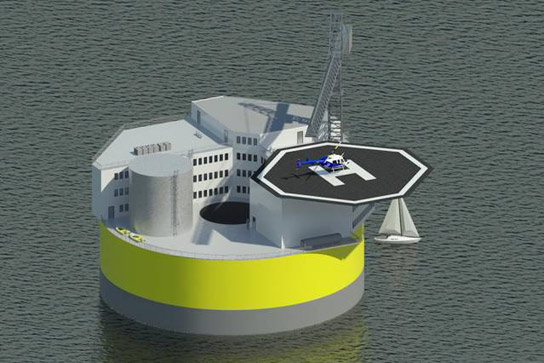
A floating platform several miles offshore, moored in about 100 meters of water, would be unaffected by the motions of a tsunami; earthquakes would have no direct effect at all. Meanwhile, the biggest issue that faces most nuclear plants under emergency conditions — overheating and potential meltdown, as happened at Fukushima, Chernobyl, and Three Mile Island — would be virtually impossible at sea, Buongiorno says: “It’s very close to the ocean, which is essentially an infinite heat sink, so it’s possible to do cooling passively, with no intervention. The reactor containment itself is essentially underwater.”
Buongiorno lists several other advantages. For one thing, it is increasingly difficult and expensive to find suitable sites for new nuclear plants: They usually need to be next to an ocean, lake, or river to provide cooling water, but shorefront properties are highly desirable. By contrast, sites offshore, but out of sight of land, could be located adjacent to the population centers they would serve. “The ocean is inexpensive real estate,” Buongiorno says.
In addition, at the end of a plant’s lifetime, “decommissioning” could be accomplished by simply towing it away to a central facility, as is done now for the Navy’s carrier and submarine reactors. That would rapidly restore the site to pristine conditions.
This design could also help to address practical construction issues that have tended to make new nuclear plants uneconomical: Shipyard construction allows for better standardization, and the all-steel design eliminates the use of concrete, which Buongiorno says is often responsible for construction delays and cost overruns.
There are no particular limits to the size of such plants, he says: They could be anywhere from small, 50-megawatt plants to 1,000-megawatt plants matching today’s largest facilities. “It’s a flexible concept,” Buongiorno says.
Most operations would be similar to those of onshore plants, and the plant would be designed to meet all regulatory security requirements for terrestrial plants. “Project work has confirmed the feasibility of achieving this goal, including satisfaction of the extra concern of protection against underwater attack,” says Todreas, the KEPCO Professor of Nuclear Science and Engineering and Mechanical Engineering.
Buongiorno sees a market for such plants in Asia, which has a combination of high tsunami risks and a rapidly growing need for new power sources. “It would make a lot of sense for Japan,” he says, as well as places such as Indonesia, Chile, and Africa.
This is a “very attractive and promising proposal,” says Toru Obara, a professor at the Research Laboratory for Nuclear Reactors at the Tokyo Institute of Technology who was not involved in this research. “I think this is technically very feasible. … Of course, further study is needed to realize the concept, but the authors have the answers to each question and the answers are realistic.”
The paper was co-authored by NSE students Angelo Briccetti, Jake Jurewicz, and Vincent Kindfuller; Michael Corradini of the University of Wisconsin; and Daniel Fadel, Ganesh Srinivasan, Ryan Hannink, and Alan Crowle of Chicago Bridge and Iron, based in Canton, Massachusetts.
Reference: “Offshore Small Modular Reactor (OSMR): An Innovative Plant Design for Societally Acceptable and Economically Attractive Nuclear Energy in a Post-Fukushima, Post-9/11 World” by Jacopo Buongiorno, Michael Golay, Neil Todreas, Angelo Briccetti, Jake Jurewicz, Vincent Kindfuller, Daniel Fadel, Ganesh Srinivasan, Ryan Hannink, Alan Crowle and Michael Corradini, 7 July 2014, ASME 2014 Small Modular Reactors Symposium.
DOI: 10.1115/SMR2014-3306
Never miss a breakthrough: Join the SciTechDaily newsletter.
Follow us on Google and Google News.
3 Comments
I just think of BP and the Gulf of Mexico and this idea for nuclear plants scares the heck out of me.
A possible out come on Fukushima Unit 4 (excerpt)
“This is highly concerning, as Unit 4 currently holds more than 1,500 spent nuclear fuel rods, and a collective 37 million curies of deadly radiation that, if released, could make much of the world completely uninhabitable. As some Natural News readers will recall, Unit 4 contains the infamous elevated cooling pool that was severely damaged following the catastrophic earthquake and tsunami that struck on March 11, 2011. ”
So this plant had every safety feature available. It was redundant. Mother nature took care of all that quite easily.
Now you want to fill our oceans full nuclear plants. Madness, absolute madness.
So if one gets cracked and breaks free, we will have a floating reactor bringing the goodness of radiation world wide…we must share, it’s only fair.
I live near the Crystal River, Fl nuclear reactors. They broke them both (to save money apparently accounting runs fixing of nuclear reactors), now they are decommissioning them. But first they have to build storage for all the radioactive junk. Which will sit on the Gulf Coast where it is at sea level. Think they are going to withstand a cat 5 hurricane. Of course they are just like Fukushima, built damage proof and absolutely safe.
Rouge waves?