
Close Menu
    Facebook X (Twitter) Instagram
    SciTechDaily
    • Biology
    • Chemistry
    • Earth
    • Health
    • Physics
    • Science
    • Space
    • Technology
    Facebook X (Twitter) Pinterest YouTube RSS
    SciTechDaily
    Home»Chemistry»Foldit Players Remodel Catalyst Enzyme for Diels-Alder Reactions
    Chemistry

    Foldit Players Remodel Catalyst Enzyme for Diels-Alder Reactions

    By DARPAJanuary 25, 2012No Comments3 Mins Read
    Facebook Twitter Pinterest Telegram LinkedIn WhatsApp Email Reddit
    Share
    Facebook Twitter LinkedIn Pinterest Telegram Email Reddit
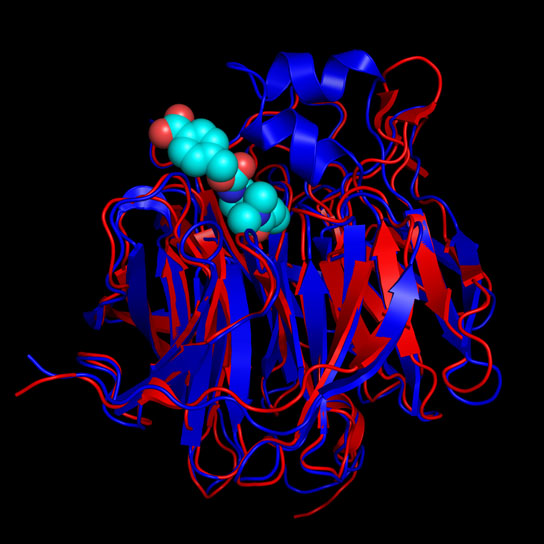
    Foldit Protein Folding Game Remodels Enzyme
    DARPA-funded Foldit is an online game with 240,000 players, allowing both experts and non-experts to collaborate in solving protein folding puzzles.

    The online community of Foldit has helped produce solutions that have evaded scientists for years. Initially funded by DARPA, this community consists of roughly 240,000 players comprised of exerts and non-experts collaborating and trying to solve protein folding puzzles. Foldit has provided researchers with the structure of a retroviral protease that causes AIDS in rhesus monkeys and protein inhibitors that block H1N1 and recently, Foldit players were able to remodel the structure of a catalyst enzyme for Diels-Alder reactions.

    Proteins are essential in almost all biological processes. The three-dimensional shape of the protein, which is essential to its function, is determined by protein folding. Foldit, which was initially funded by DARPA, is a game with an online community of 240,000 players that allows non-experts and experts alike to collaborate and solve protein folding puzzles. Solutions to these puzzles are sent to biochemistry researchers to analyze for advances in protein design prediction.

    Recent advances from Foldit include identifying the structure of a retroviral protease that causes AIDS in rhesus monkeys and protein inhibitors that block H1N1, a virus responsible for the 1918 pandemic and the 2009 flu pandemic. Through Foldit, the crowd has produced solutions that have evaded scientists for years.

    DARPA’s investment in Foldit continues to lead to advances as demonstrated by the latest paper published in Nature. The paper describes how players were able to functionally remodel the structure of a catalyst enzyme for Diels-Alder reactions, an important reaction in organic synthesis. The remodeling of the enzyme structure increases catalytic properties by 18 times, demonstrating that Foldit can be used not only for protein design, but also for protein function prediction, a more complex challenge that cannot be solved by automation.

    “Modeling an enzyme with significantly enhanced catalytic properties could lead to advances in organic synthesis,” explained Jay Schnitzer, director, Defense Sciences Office. “If enzymes used in pharmaceutical production can be remodeled with enhanced catalytic properties, production times should be shortened. For the DoD, this means getting medicines to the warfighter faster and at lower cost.”

    “One of the benefits to opening the aperture for non-expert participation is that they don’t come into a situation with preconceived notions of what has to happen or how, so they have an ability to see beyond the problem and identify potential new solutions from a different perspective,” said DARPA Deputy Director Kaigham Gabriel.

    Never miss a breakthrough: Join the SciTechDaily newsletter.
    Follow us on Google and Google News.

    Biochemistry DARPA Enzyme Protein
    Share. Facebook Twitter Pinterest LinkedIn Email Reddit

    Related Articles

    Why Eraser Enzymes Go Wrong and Lead to Cancer

    After More Than 40 Years, Evidence Found for Existence of Elusive ‘Metabolon’

    MIT Chemist Investigates How Diseases Are Linked to Flawed Protein Folding

    Gamers Accurately Design Folded Proteins As Realistic As Those Created by Experts

    Human Cells Made Magnetic With Engineered Protein Crystals

    Scientists Discover Tiny Protein Has Big Impact in Times of Stress

    Scientists See the Inner Workings of the Enzyme Telomerase for the First Time

    Scientists Identify Specific Enzyme Related to Colon Cancer

    Artificial Enzyme Reveals Never Before Seen Structure

    Leave A Reply Cancel Reply

    • Facebook
    • Twitter
    • Pinterest
    • YouTube

    Don't Miss a Discovery

    Subscribe for the Latest in Science & Tech!

    Trending News

    Textbooks May Need Rewriting After Researchers Debunk a Core Chemistry Concept

    Alzheimer’s May Start With a Surprising Symptom – Not Memory Loss

    The “Hobbits” Mysteriously Disappeared 50,000 Years Ago – Scientists Have Revealed What Happened to Their Home

    One Sugar Tells Your Brain You’re Full. Another Barely Does

    One of Arizona’s Largest Reservoirs Is Less Than 1% Full After Snowpack Collapse

    This 400-Year-Old Shark May Hold the Secret to Preserving Human Vision

    Your Daily Orange Juice Could Have an Unexpected Health Benefit

    Black Hole Shredded a Massive Star in the Most Powerful Stellar Explosion Ever Seen

    Follow SciTechDaily
    • Facebook
    • Twitter
    • YouTube
    • Pinterest
    • Newsletter
    • RSS
    SciTech News
    • Biology News
    • Chemistry News
    • Earth News
    • Health News
    • Physics News
    • Science News
    • Space News
    • Technology News
    Recent Posts
    • Scientists Discover a 5-Million-Year-Old Whale Graveyard Deep Beneath the Indian Ocean
    • Ancient DNA Reveals the Hidden Origins of China’s Mysterious Shimao Civilization
    • Scientists Finally Solve a 50-Year Mystery Hidden in Solid Nitrogen
    • Saturn’s Largest Moon May Hold the Resources for a Space Colony
    • New Wearable Patch Boosts REM Sleep Without Drugs or Surgery
    Copyright © 1998 - 2026 SciTechDaily. All Rights Reserved.
    • Science News
    • About
    • Contact
    • Editorial Board
    • Privacy Policy
    • Terms of Use

    Type above and press Enter to search. Press Esc to cancel.