
Close Menu
    Facebook X (Twitter) Instagram
    SciTechDaily
    • Biology
    • Chemistry
    • Earth
    • Health
    • Physics
    • Science
    • Space
    • Technology
    Facebook X (Twitter) Pinterest YouTube RSS
    SciTechDaily
    Home»Space»The Formation of Pluto and Its Moons
    Space

    The Formation of Pluto and Its Moons

    By Harvard-Smithsonian Center for AstrophysicsJanuary 20, 20141 Comment3 Mins Read
    Facebook Twitter Pinterest Telegram LinkedIn WhatsApp Email Reddit
    Share
    Facebook Twitter LinkedIn Pinterest Telegram Email Reddit
    Pluto and Its Moons
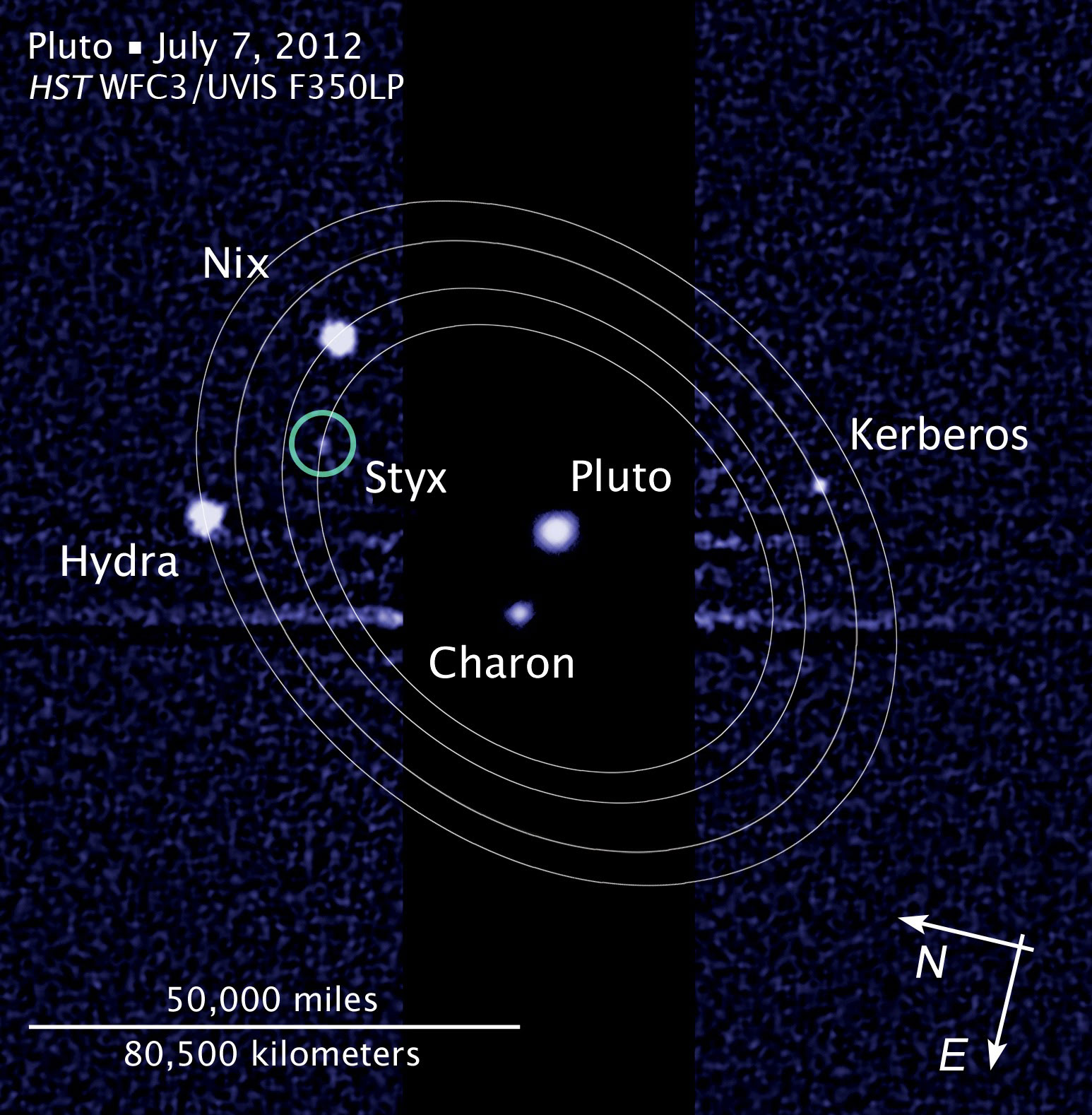
    An image of the Pluto system taken by Hubble, showing five moons (Charon plus four much smaller bodies) orbiting the distant, icy dwarf planet Pluto; added lines show the orbits of the outer four moons. A new numerical simulation of the system concludes that the smaller moons probably formed from a disk around the Pluto-Charon pair. Credit: NASA, ESA, and L. Frattare

    A newly published study looks at the formation of Pluto and its low-mass satellites, finding Pluto and Charon formed from particles that coalesced together in the disk around the Sun.

    In 1978, the dwarf planet Pluto was discovered to have a companion, called Charon. With a mass of about 12% of Pluto’s mass, Charon orbits its partner about seventeen Pluto-radii away (for comparison, our Moon has less than 2% of the Earth’s mass and orbits about sixty Earth-radii away). But that’s not all. By 2012 astronomers had added four other satellites to the Pluto family: Styx, Nix, Kerberos, and Hydra. Their masses are still very uncertain, but the combined mass is estimated to be a few millionths of the mass of Pluto.

    Astronomers wonder where these small satellites came from, how they acquired their stable configuration without first wandering off as their gravity perturbed one another, and how the answers to these questions can help clarify the formation and evolution processes of planetary systems in general. Current theories argue that the system formed from a giant impact between two icy objects with a total mass about 30% larger than Pluto’s current mass. Immediately after the event, Charon was much closer to Pluto, but then it drifted away over a period of about one to ten million years. Some versions of the model predict that the other four siblings also formed during the initial impact, and also moved away, but with so many bodies in the family that is not so easy to do yet hold together in the regular pattern observed. A competing theory argues that the Pluto-Charon pair, after the impact, had a circumbinary disk of small objects that gradually coalesced into the four sibling moons.

    CfA astronomer Scott Kenyon and his colleague Ben Bromley from the University of Utah performed numerical simulations (using codes they developed) to test these possibilities. They find that the most reasonable scenario is that Pluto and Charon formed from particles that coalesced together in the disk around the Sun – the same process that formed the Earth. Subsequently, there was an impact that left them with their current sizes as a gravitationally bound, binary pair. The collision left debris behind that accumulated in a circumbinary disk. Eventually the four smaller satellites, along with probably even more as-yet undetected siblings, formed from the coalescence of particles in the circumbinary disk. It remains unclear whether the satellites drift outward to their current orbits after they have formed or while they are forming, but future simulations should resolve this uncertainty. Conclusions from this new work are soon to be tested: The NASA “New Horizons” probe mission will fly by the system in July 2015.

    Reference: “The Formation of Pluto’s Low Mass Satellites” by Scott J. Kenyon and Benjamin C. Bromley, 26 November 2013, The Astronomical Journal.
    DOI: 10.1088/0004-6256/147/1/8
    arXiv:1303.0280

    Never miss a breakthrough: Join the SciTechDaily newsletter.
    Follow us on Google and Google News.

    Astronomy Astrophysics Harvard-Smithsonian Center for Astrophysics Planetary Science Pluto Styx University of Utah
    Share. Facebook Twitter Pinterest LinkedIn Email Reddit

    Related Articles

    Astronomers Puzzled by Detection of Strong X-Rays from Pluto

    Astrophysicist Scott Kenyon Shares His Thoughts and Reactions on New Horizons’ Flyby of Pluto

    Hubble Reveals That Two of Pluto’s Moons Wobble Unpredictably

    Planetary Scientists Debate: Is Pluto a Planet?

    Astronomers Discover Transiting Planets in Star Cluster NGC 6811

    Water Planets in the Habitable Zone: A Closer Look at Kepler 62e and 62f

    Preparing for Pluto’s Undiscovered Satellites

    Earth-like Planets May Have Older and More Evolved Life

    Kepler Data Suggests 17 Billion Earth-Sized Worlds in the Milky Way

    1 Comment

    1. W_R_Monger on January 20, 2014 10:17 am

      This is way cool stuff. I had believed that my wife and I would have the opportunity to set foot upon foreign planets but it seems more likely our daughter will.

      Reply
    Leave A Reply Cancel Reply

    • Facebook
    • Twitter
    • Pinterest
    • YouTube

    Don't Miss a Discovery

    Subscribe for the Latest in Science & Tech!

    Trending News

    Largest-Ever Study Finds Medicinal Cannabis Ineffective for Anxiety, Depression, PTSD

    250-Million-Year-Old Egg Solves One of Evolution’s Biggest Mysteries

    Living With Roommates Might Be Changing Your Gut Microbiome Without You Knowing

    Century-Old Cleaning Chemical Linked to 500% Increased Risk of Parkinson’s Disease

    What if Your Memories Never Happened? Physicists Take a New Look at the Boltzmann Brain Paradox

    One of the Universe’s Largest Stars May Be Getting Ready To Explode

    Scientists Discover Enzyme That Could Supercharge Ozempic-Like Weight Loss Drugs

    Popular Sweetener Linked to DNA Damage – “It’s Something You Should Not Be Eating”

    Follow SciTechDaily
    • Facebook
    • Twitter
    • YouTube
    • Pinterest
    • Newsletter
    • RSS
    SciTech News
    • Biology News
    • Chemistry News
    • Earth News
    • Health News
    • Physics News
    • Science News
    • Space News
    • Technology News
    Recent Posts
    • Scientists Discover Coral Reefs Are Teeming With Previously Unknown Life
    • Scientists Find Way to Reverse Fatty Liver Disease Without Changing Diet
    • Could Humans Regrow Limbs? New Study Reveals Promising Genetic Pathway
    • Black Hole Jets Pack Power of 10,000 Suns, Stunning New Study Reveals
    • A Cosmic Crash Turned This Nearby Galaxy Into Chaos
    Copyright © 1998 - 2026 SciTechDaily. All Rights Reserved.
    • Science News
    • About
    • Contact
    • Editorial Board
    • Privacy Policy
    • Terms of Use

    Type above and press Enter to search. Press Esc to cancel.