
Close Menu
    Facebook X (Twitter) Instagram
    SciTechDaily
    • Biology
    • Chemistry
    • Earth
    • Health
    • Physics
    • Science
    • Space
    • Technology
    Facebook X (Twitter) Pinterest YouTube RSS
    SciTechDaily
    Home»Space»Hubble Views Double Quasar QSO 0957+561
    Space

    Hubble Views Double Quasar QSO 0957+561

    By Hubble Space TelescopeJanuary 20, 2014No Comments2 Mins Read
    Facebook Twitter Pinterest Telegram LinkedIn WhatsApp Email Reddit
    Share
    Facebook Twitter LinkedIn Pinterest Telegram Email Reddit
    Hubble Views Double Quasar QSO 0957+561
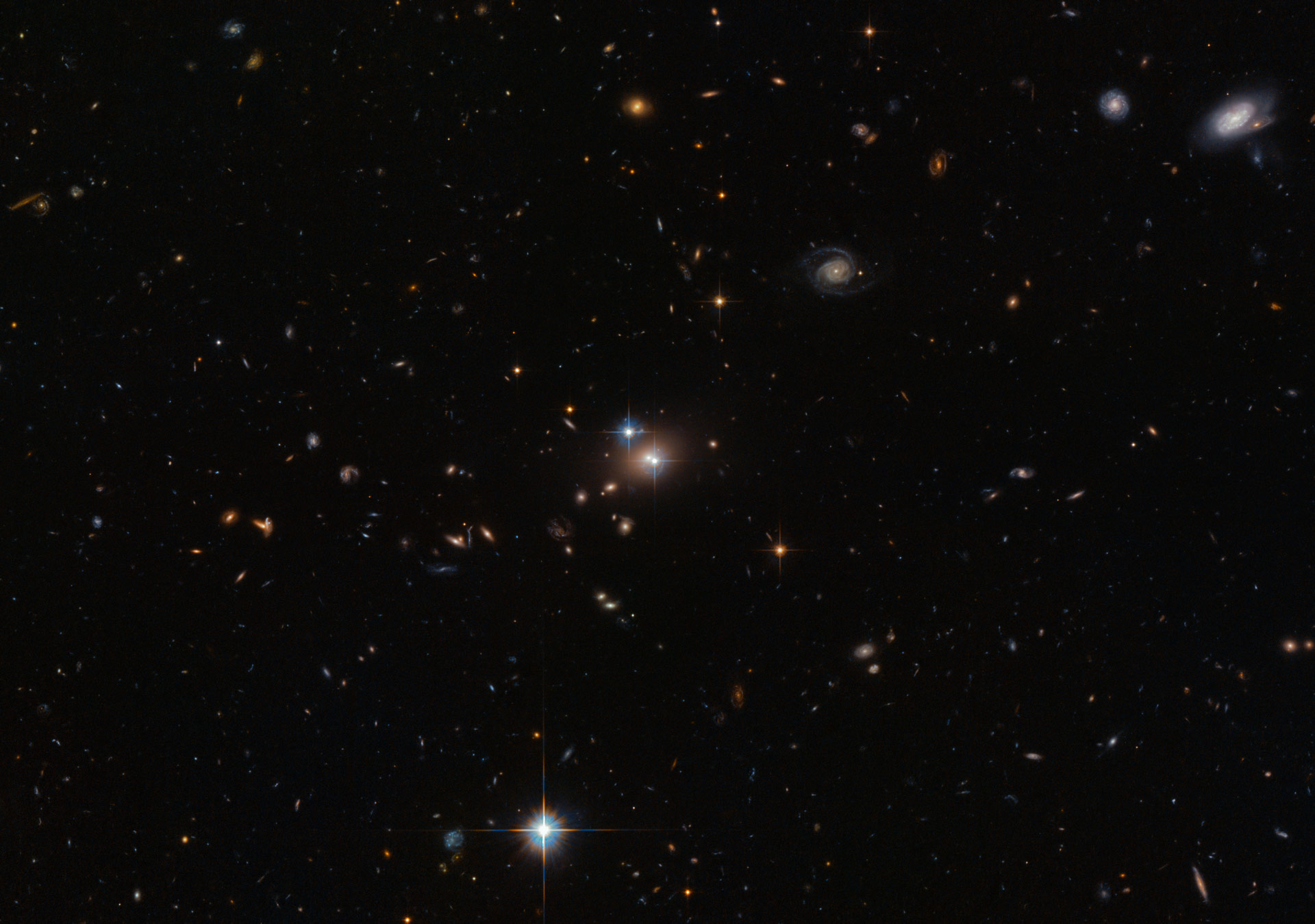
    Hubble captures the “Twin Quasar” QSO 0957+561, 14 billion light-years from Earth. Credit: ESA/Hubble & NASA

    This newly released Hubble image shows double quasar QSO 0957+561, also known as the “Twin Quasar,” which is located about 14 billion light-years from Earth.

    In this new Hubble image two objects are clearly visible, shining brightly. When they were first discovered in 1979, they were thought to be separate objects — however, astronomers soon realized that these twins are a little too identical! They are close together, lie at the same distance from us, and have surprisingly similar properties. The reason they are so similar is not some bizarre coincidence; they are in fact the same object.

    These cosmic doppelgangers make up a double quasar known as QSO 0957+561, also known as the “Twin Quasar,” which lies just under 14 billion light-years from Earth. Quasars are the intensely powerful centers of distant galaxies. So, why are we seeing this quasar twice?

    Some 4 billion light-years from Earth — and directly in our line of sight — is the huge galaxy YGKOW G1. This galaxy was the first-ever observed gravitational lens, an object with a mass so great that it can bend the light from objects lying behind it. This phenomenon not only allows us to see objects that would otherwise be too remote, in cases like this it also allows us to see them twice over.

    Along with the cluster of galaxies in which it resides, YGKOW G1 exerts an enormous gravitational force. This doesn’t just affect the galaxy’s shape, the stars that it forms, and the objects around it — it affects the very space it sits in, warping and bending the environment and producing bizarre effects, such as this quasar double image.

    This observation of gravitational lensing, the first of its kind, meant more than just the discovery of an impressive optical illusion allowing telescopes like Hubble to effectively see behind an intervening galaxy. It was evidence for Einstein’s theory of general relativity. This theory had identified gravitational lensing as one of its only observable effects, but until this observation no such lensing had been observed since the idea was first mooted in 1936.

    Never miss a breakthrough: Join the SciTechDaily newsletter.
    Follow us on Google and Google News.

    Astronomy Hubble Space Telescope NASA Popular
    Share. Facebook Twitter Pinterest LinkedIn Email Reddit

    Related Articles

    The Great Escape: NASA’s Hubble and MAVEN Help Solve Mystery of Mars’ Vanishing Water

    Webb and Hubble Unite: A Breathtaking 3D Journey Through the Pillars of Creation

    Stellar Sleuths: Citizen Scientists and AI Uncover Hidden Asteroids With Hubble

    Stellar Fireworks: Hubble Revisits a Strange Star’s 40-Year Nova Mystery

    Cosmic Geode: Hubble Captures the Birth of a Sun-like Star

    Hubble Celebrates 34th Anniversary With a Spectacular View of the Little Dumbbell Nebula

    Jupiter Unveiled: Hubble Captures the Giant’s Roaring Storms and Volcanic Moon Io

    Galaxies Collide, Stars Awaken: Hubble’s Stunning Revelation

    Hubble Spots Water Vapor in Small Exoplanet’s Atmosphere

    Leave A Reply Cancel Reply

    • Facebook
    • Twitter
    • Pinterest
    • YouTube

    Don't Miss a Discovery

    Subscribe for the Latest in Science & Tech!

    Trending News

    Breakthrough Parkinson’s Drug Targets Disease at Its Genetic Roots

    Just 4 Weeks of Simple Diet Changes Reversed Signs of Aging in Older Adults

    Scientists May Have Finally Solved Why Humans Are Right-Handed

    NASA’s Hubble Accidentally Witnesses a Comet Shattering in Space

    Researchers Discover the Body’s Hidden “Off Switch” for Inflammation

    Scientists Discover Metformin Doesn’t Work the Way We Thought

    Tea or Coffee? Your Daily Choice Could Affect Osteoporosis Risk

    Vitamin C May Fight Cancer in a Surprising Way

    Follow SciTechDaily
    • Facebook
    • Twitter
    • YouTube
    • Pinterest
    • Newsletter
    • RSS
    SciTech News
    • Biology News
    • Chemistry News
    • Earth News
    • Health News
    • Physics News
    • Science News
    • Space News
    • Technology News
    Recent Posts
    • Extra Weight Could Age Your Brain Faster, Study Warns
    • Scientists Warn: America’s Most Popular Cooking Oil May Be Harming Your Intestines
    • Scientists Unravel the Mystery of Angola’s Giant “Ghost Elephants”
    • Ancient DNA Shatters the Simple Story of Europe’s Origins
    • Scientists Say a 59,000-Year-Old Neanderthal Tooth Shows Evidence of Surgery
    Copyright © 1998 - 2026 SciTechDaily. All Rights Reserved.
    • Science News
    • About
    • Contact
    • Editorial Board
    • Privacy Policy
    • Terms of Use

    Type above and press Enter to search. Press Esc to cancel.