
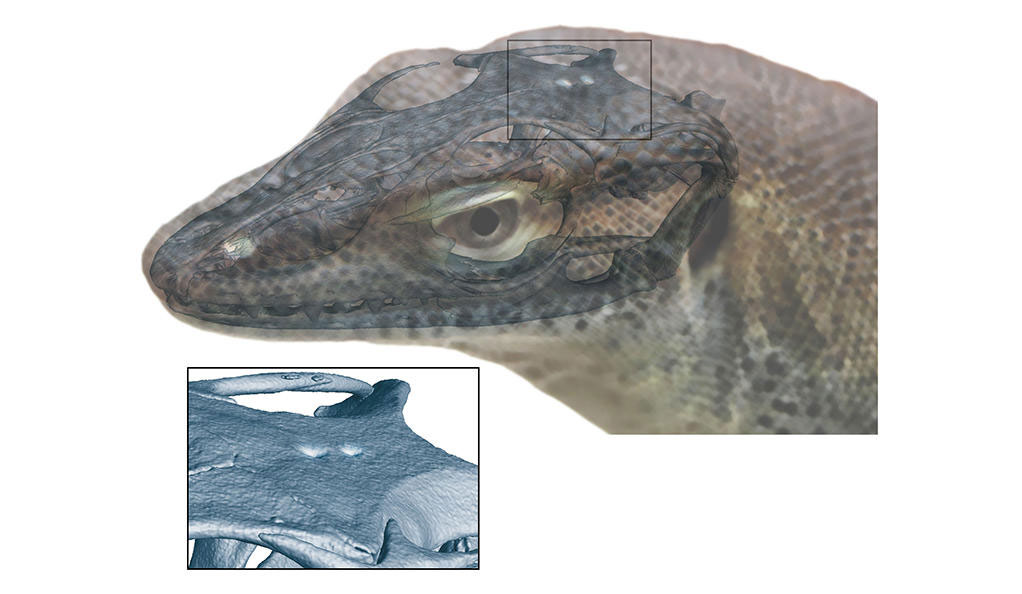
Researchers have found an ancient monitor lizard with a fourth eye — a discovery that may signal a new wrinkle in the way eyesight evolved in vertebrates.
“This tells us how easy it is, in terms of evolution, for a complex organ to self-assemble under certain circumstances,” said Yale paleontologist Bhart-Anjan Bhullar, co-author of a new study in the journal Current Biology. “Eyes are classically conceived of as these remarkably complex structures. In fact, the developing brain is just waiting to make eyes given the right signals.”
In the study, researchers from Yale and the Senckenberg Research Institute in Germany present evidence that pineal and parapineal eyes, located on the top of the head, were present simultaneously in Saniwa ensidens, an extinct monitor lizard that lived nearly 50 million years ago.
The “third eye,” as the pineal organ is sometimes called when it has a lens and retina, exists in a number of lower vertebrates such as fish and frogs, and was widespread in primitive vertebrates. Some scientists have suggested that most of the higher vertebrates — other than lizards — dispensed with the third eye independently, while other scientists have suggested that the lizard’s third eye develops from a different organ, the parapineal.
“By discovering a four-eyed lizard, in which both the pineal and parapineal organs formed an eye on the top of the head, we could show that the lizard’s third eye really is different from the third eye of other vertebrates,” said lead author Krister Smith, a former Yale graduate student now at the Senckenberg Research Institute.
Using CT-scanning technology, the researchers were able to study the structures of small, fragmentary fossils of Saniwa ensidens collected in the 1870s. This technique allowed the researchers to clarify that the pineal and parapineal eyes were not a pair generated by a single organ.
“It’s important to recognize that there’s nothing mystical about the pineal and parapineal organs,” Smith said. “They can sense light and play a role in the endocrine system. However, some of the abilities conferred by the pineal are really quite extraordinary. For instance, some lower vertebrates can sense the polarization of light with the third eye and use this to orient themselves geographically.”
Smith and Bhullar said the findings illustrate how little is known about the evolutionary timing of the so-called “lizard shift,” the appearance of the third eye in lizards. Further study is necessary, they said, in order to fully understand the development of eyesight in a variety of vertebrates.
“The eye is fundamentally a part of the brain,” Bhullar said. “The way an eye forms is that the developing brain comes in contact with part of the embryonic skin. This contact begins a self-sustaining molecular cascade that concludes in the formation of an eye with lens and retina.”
Additional co-authors of the study are Gunther Köhler and Jörg Habersetzer of the Senckenberg Research Institute.
The research was funded, in part, by grants from the National Science Foundation and the German Science Foundation.
Reference: “The Only Known Jawed Vertebrate with Four Eyes and the Bauplan of the Pineal Complex” by Krister T. Smith, Bhart-Anjan S. Bhullar, Gunther Köhler and Jörg Habersetzer, 2 April 2018, Current Biology.
DOI: 10.1016/j.cub.2018.02.021
Never miss a breakthrough: Join the SciTechDaily newsletter.
Follow us on Google and Google News.