
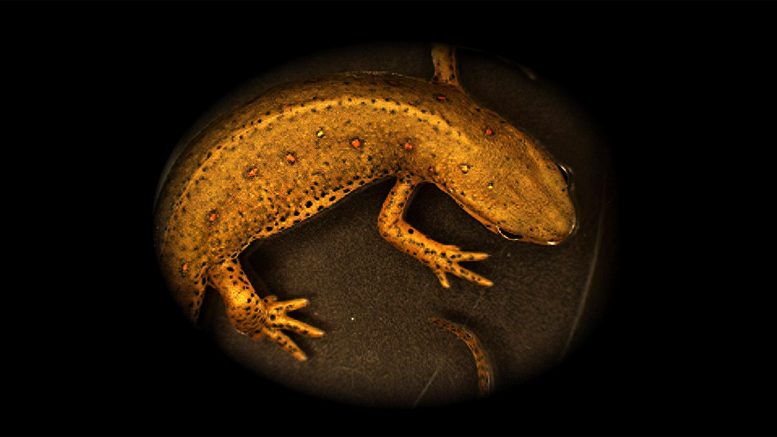
Scientists show that so-called senescent cells, i.e., cells that have permanently stopped dividing, boost production of new muscle cells to enhance regeneration of lost limbs in salamanders.
Senescent cells, linked to aging and disease, may also have regenerative properties. Studying salamanders, researchers found senescent cells accelerate limb regeneration by signaling muscle fibers to dedifferentiate, potentially leading to new treatments for age-related diseases.
Senescent cells are cells that have permanently stopped dividing in response to cellular stress but have not died. As organisms age, the number of senescent cells in the body increases. This accumulation is currently considered one of the hallmarks of aging and has been linked to a variety of diseases, including cancer. However, the true nature of these cells may be more complex and context-dependent.
A growing body of evidence suggests that senescent cells may also have beneficial effects, such as wound healing or preventing tissue scarring. “A few years ago, our group found that senescent cells were present at key stages of salamander limb regeneration. Interestingly, other groups subsequently found these cells in other regeneration contexts, including in mammals. We, therefore, wanted to find out whether these cells contribute in any way to regeneration itself,” explains Dr. Maximina Yun, research group leader at the Center for Regenerative Therapies Dresden (CRTD) and the Cluster of Excellence Physics of Life (PoL) at TU Dresden and the Max Planck Institute of Molecular Cell Biology and Genetics (MPI-CBG).
Senescent Cells Promote Regeneration
The researchers in Yun’s group study salamanders. These animals have unique regeneration abilities and are able to re-grow many organs of their bodies, including lost limbs. “Salamander limb regeneration is a fascinating process. In a matter of weeks, they re-grow a fully functional limb,” explains Dr. Yun.
To check if the presence of senescent cells influences the limb regeneration process, researchers in the Yun group found a way to modulate the number of senescent cells in the wound. The team observed that the presence of senescent cells enhanced the regeneration process.
“When more senescent cells were present in the wound, the animals developed a larger regeneration bud, or – as we call it – blastema. This is a collection of cells that are going to form all the needed tissues in the new limb. The larger the blastema, the more cells are there to regrow the limb and the quicker the regeneration process. The presence of senescent cells seemed to ‘fuel’ the regeneration process,” Dr. Yun says.
“Zombie” Signaling Promotes New Muscle Cells
Looking more closely at the blastema with and without the influence of the senescent cells, the Yun team uncovered a new mechanism that enhances the regeneration process and found that the presence of senescent cells increased the number of regenerating muscle cells. They showed that senescent cells secrete factors that stimulate nearby muscle tissue to take a developmental step back and produce new muscle.
“Our results show that senescent cells use cell-cell communication to influence the regeneration process. They secrete molecules that signal to mature muscle fibers to dedifferentiate into muscle progenitor cells. These cells can multiply themselves as well as differentiate into new muscle cells, thereby enhancing the regeneration process. This signaling appears to be an important part of promoting regeneration,” says Dr. Yun.
For now, the group focused on muscle, one of the most important tissues in the regenerating limb. However, the team is already investigating whether senescent cell signaling also contributes to the regeneration of other tissues.
Lessons From the Salamanders
Yun’s group is working with salamanders to study regeneration and aging processes. “Salamanders are one of the few animal species that seem to defy the natural aging process. They do not develop typical signs of aging and do not accumulate age-related diseases such as cancer. They also have extraordinary healing abilities,” says Dr. Yun. The animals can regenerate almost any organ in their body.
Studying salamanders is helping Dr. Yun and her colleagues at the CRTD understand the principles of the regeneration process and, in the long run, may help solve the puzzle of why humans have very limited regenerative abilities.
Reference: “Senescent cells enhance newt limb regeneration by promoting muscle dedifferentiation” by Hannah E. Walters, Konstantin E. Troyanovskiy, Alwin M. Graf and Maximina H. Yun, 6 April 2023, Aging Cell.
DOI: 10.1111/acel.13826
Never miss a breakthrough: Join the SciTechDaily newsletter.
Follow us on Google and Google News.