
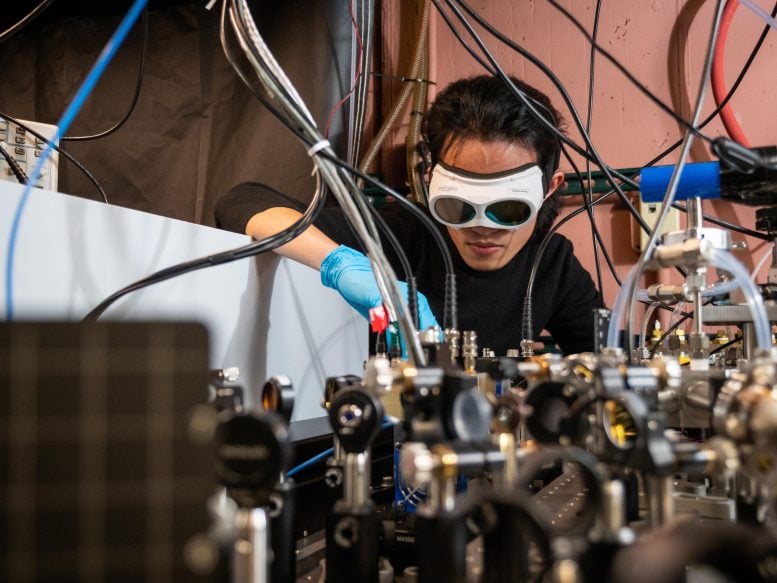
Quantum laser-based technology represents a significant advancement in the use of exhaled breath for diagnosing disease.
Each time we breathe out, we release over 1,000 unique molecules that create a specific “breathprint,” a chemical signature that provides valuable insights into our body’s internal conditions.
For years, researchers have been trying to tap into this wealth of information, utilizing the keen sense of smell in dogs, rats, and even bees to detect diseases such as cancer, diabetes, and tuberculosis.
Scientists from CU Boulder and the National Institute of Standards and Technology (NIST) have made an important leap forward in the quest to diagnose disease using exhaled breath, reporting that a new laser-based breathalyzer powered by artificial intelligence (AI) can detect COVID-19 in real-time with excellent accuracy.
The results were recently published in the Journal of Breath Research.
“Our results demonstrate the promise of breath analysis as an alternative, rapid, non-invasive test for COVID-19 and highlight its remarkable potential for diagnosing diverse conditions and disease states,” said first author Qizhong Liang, a Ph.D. candidate in JILA and the Department of Physics at CU Boulder. JILA is a partnership between CU Boulder and NIST.
The multidisciplinary team of physicists, biochemists, and biologists is now shifting its focus to a wide range of other diseases in hopes that the “frequency comb breathalyzer”—born of Nobel Prize-winning technology from CU—could revolutionize medical diagnostics.
“There is a real, foreseeable future in which you could go to the doctor and have your breath measured along with your height and weight…Or you could blow into a mouthpiece integrated into your phone and get information about your health in real-time,” said senior author Jun Ye, a JILA fellow and adjoint professor of physics at CU Boulder. “The potential is endless.”
A COVID-Born Collaboration
As far back as 2008, Ye’s lab reported that a technique called frequency comb spectroscopy—essentially using laser light to distinguish one molecule from another—could potentially identify biomarkers of disease in human breath.
The technology lacked sensitivity and, more importantly, the capability to link specific molecules to disease states, so they never tested it for diagnosing illness.
But Ye’s team has since improved the sensitivity a thousandfold, enabling the detection of trace molecules at the parts-per-trillion level. They’ve also harnessed the power of AI.
“Molecules increase or decrease in concentrations when associated with specific health conditions,” said Liang. “Machine learning analyzes this information, identifies patterns, and develops criteria we can use to predict a diagnosis.”
With SARS-CoV-2 ripping across the country and frustration mounting about long response times for existing tests, the time had come to test the system on people. As a physicist, Ye had never worked with human subjects, so he enlisted help from CU’s BioFrontiers Institute, an interdisciplinary hub for biomedical research that was heading up the campus COVID testing program.
The National Science Foundation and the National Institutes of Health funded the research.
Non-Invasive, Fast, Chemical-Free
Between May 2021 and January 2022, the research team collected breath samples from 170 CU Boulder students who had, in the previous 48 hours, taken a polymerase chain reaction (PCR) test, either by submitting a saliva or a nasal sample.
Half had tested positive, half negative. (For safety reasons, volunteer participants came to an outdoor campus parking lot, blew in a sample-collection bag, and left it for a lab tech waiting at a safe distance.)
Overall, the process took less than one hour from collection to result.
When compared to PCR, the gold standard COVID test, breathalyzer results matched 85% of the time. For medical diagnostics, an accuracy of 80% or greater is considered “excellent.”
The researchers suspect that the accuracy would likely have been higher if the breath and saliva/nasal swab samples were collected at the same time.
Unlike a nasal swab, the breathalyzer is non-invasive. And unlike a saliva sample, users are not asked to refrain from eating, drinking, or smoking before using it. It doesn’t require costly chemicals to break down the sample. And the new test could, conceivably, be used on individuals who are not conscious.
But there is still much to be learned, said Ye.
“With one breath, we can collect so many data points from you, but then what? We only understand how a few molecules correlate with specific conditions,” Ye said.
Building a Smaller Breathalyzer
Today, the “breathalyzer” consists of a complex array of lasers and mirrors about the size of a banquet table.
A breath sample is piped in through a tube as lasers fire invisible mid-infrared light at it at thousands of different frequencies. Dozens of tiny mirrors bounce the light back and forth through the molecules so many times that in the end, the light travels about 1.5 miles.
Because each kind of molecule absorbs light differently, breath samples with a different molecular make-up cast distinct shadows. The machine can distinguish between those different shadows or absorption patterns, boiling millions of data points down to—in the case of COVID—a simple positive or negative, in a matter of seconds.
Efforts are already underway to miniaturize such systems to a chip scale, allowing for what Liang imagines as “real-time, self-health monitoring on the go.” The potential does not end there.
“What if you could find a signature in breath that could detect pancreatic cancer before you were even symptomatic? That would be the home run,” said molecular biologist and co-author Leslie Leinwand, chief scientific officer for BioFrontiers and a co-author on the study
Elsewhere, scientists are working to develop a Human Breath Atlas, which maps each molecule in the human exhale and correlates them with health outcomes. Liang hopes to contribute to such efforts with a larger-scale collection of breath samples.
Meanwhile, the team is collaborating with pediatric and respiratory specialists at the CU Anschutz Medical Campus to explore how the breathalyzer can not only diagnose diseases but also enable scientists to better understand them, offering hints about immune responses, nutritional deficiencies, and other factors that could contribute to or exacerbate illness.
“If you think about dogs, they evolved over thousands of years to smell many different things with remarkable sensitivity,” said Ye. “We are just at the very beginning of training our laser-based nose. The more we teach it, the smarter it will become.”
Reference: “Breath analysis by ultra-sensitive broadband laser spectroscopy detects SARS-CoV-2 infection” by Qizhong Liang, Ya-Chu Chan, Jutta Toscano, Kristen K Bjorkman, Leslie A Leinwand, Roy Parker, Eva S Nozik, David J Nesbitt and Jun Ye, 5 April 2023, Journal of Breath Research.
DOI: 10.1088/1752-7163/acc6e4
The study was funded by the National Institutes of Health and the National Science Foundation.
Never miss a breakthrough: Join the SciTechDaily newsletter.
Follow us on Google and Google News.