
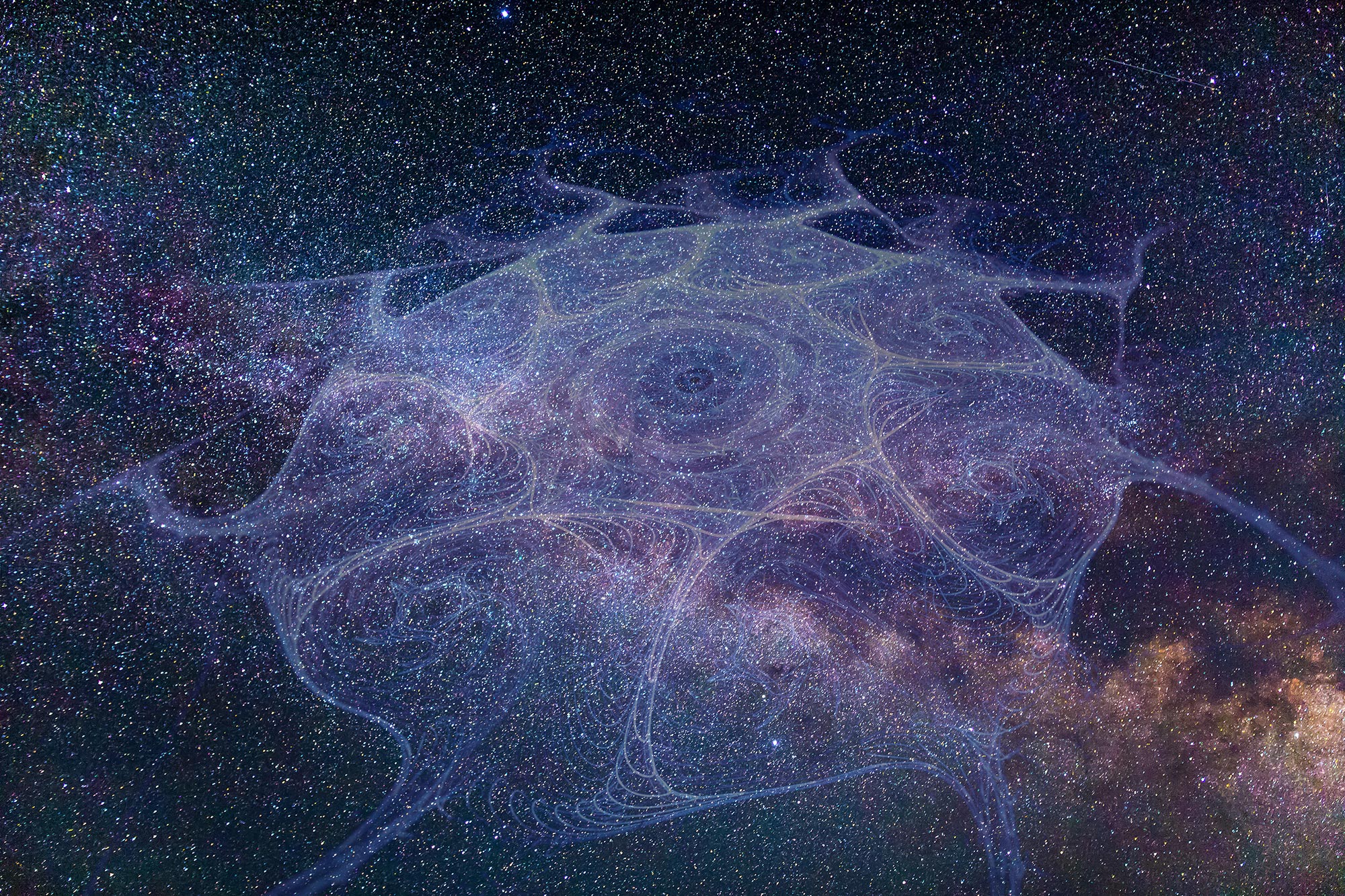
The tests targeted the existence of the elusive matter, although it has never been observed.
Computer simulations by astronomers, including those at the University of California, Irvine, support the existence of dark matter. Although dark matter has not been directly detected, many physicists believe it must exist to explain various phenomena in the observable universe.
The work addresses a fundamental debate in astrophysics – does invisible dark matter need to exist to explain how the universe works the way it does, or can physicists explain how things work based solely on the matter we can directly observe? Currently, many physicists think something like dark matter must exist to explain the motions of stars and galaxies.
Testing Models of the Universe
“Our paper shows how we can use real, observed relationships as a basis to test two different models to describe the universe,” said Francisco Mercado, lead author and recent Ph.D. graduate from the UC Irvine Department of Physics & Astronomy who is now a postdoctoral scholar at Pomona College. “We put forth a powerful test to discriminate between the two models.”
The test involved running computer simulations with both types of matter – normal and dark – to explain the presence of intriguing features measured in real galaxies. The team reported their results in Monthly Notices of the Royal Astronomy Society.
The features in galaxies the team found “are expected to appear in a universe with dark matter but would be difficult to explain in a universe without it,” said Mercado. “We show that such features appear in observations of many real galaxies. If we take these data at face value, this reaffirms the position of the dark matter model as the one that best describes the universe we live in.”
These features Mercado noted describe patterns in the motions of stars and gas in galaxies that seem to only be possible in a universe with dark matter.
Observational Consistency and Theoretical Support
“Observed galaxies seem to obey a tight relationship between the matter we see and the inferred dark matter we detect, so much so that some have suggested that what we call dark matter is really evidence that our theory of gravity is wrong,” said co-author James Bullock, professor of physics at UCI and dean of the UCI School of Physical Sciences. “What we showed is that not only does dark matter predict the relationship, but for many galaxies, it can explain what we see more naturally than modified gravity. I come away even more convinced that dark matter is the right model.”
The features also appear in observations made by proponents of a dark matter-free universe. “The observations we examined – the very observations where we found these features – were conducted by adherents of dark matter-free theories,” said co-author Jorge Moreno, associate professor of physics and astronomy at Pomona College. “Despite their obvious presence, little-to-no analysis was performed on these features by that community. It took folks like us, scientists working with both regular and dark matter, to start the conversation.”
Moreno added that he expects debate within his research community to follow in the wake of the study, but that there may be room for common ground, as the team also found that such features only appear in their simulations when there is both dark matter and normal matter in the universe.
“As stars are born and die, they explode into supernovae, which can shape the centers of galaxies, naturally explaining the existence of these features,” said Moreno. “Simply put, the features we examined in observations require both the existence of dark matter and the incorporation of normal-matter physics.”
Now that the dark matter model of the universe appears to be the leading one, the next step, Mercado explained, is to see if it remains consistent across a dark matter universe.
“It would be interesting to see if we could use this same relationship to even distinguish between different dark matter models,” said Mercado. “Understanding how this relationship changes under distinct dark matter models could help us constrain the properties of dark matter itself.”
Reference: “Hooks & Bends in the radial acceleration relation: discriminatory tests for dark matter and MOND” by Francisco J Mercado, James S Bullock, Jorge Moreno, Michael Boylan-Kolchin, Philip F Hopkins, Andrew Wetzel, Claude-André Faucher-Giguère and Jenna Samuel, 16 April 2024, Monthly Notices of the Royal Astronomical Society.
DOI: 10.1093/mnras/stae819
Funding came from a National Science Foundation MSP-Ascend Award AST-2316748 to Mercado. Mercado and Bullock were supported by NSF grant AST-1910965 and NASA grant 80NSSC22K0827. Moreno receives funding from the Hirsch Foundation. Collaborators include Michael Boylan-Kolchin (The University of Texas at Austin), Philip F. Hopkins (California Institute of Technology), Andrew Wetzel (University of California, Davis) and Claude-André Faucher-Giguère (Northwestern University) and Jenna Samuel (The University of Texas at Austin).
Never miss a breakthrough: Join the SciTechDaily newsletter.
Follow us on Google and Google News.