
Researchers from the University of Rochester who are interested in longevity genetics propose new targets to fight aging and age-related disorders.
Mammals that age at vastly different rates have been created through natural selection. Naked mole rats, for instance, may live up to 41 years, which is over 10 times longer than mice and other rodents of comparable size.
What causes a longer lifespan? A crucial component of the puzzle, according to a recent study by biologists at the University of Rochester, is found in the mechanisms that control gene expression.
Vera Gorbunova, the Doris Johns Cherry professor of biology and medicine, Andrei Seluanov, the first author of the publication, Jinlong Lu, a postdoctoral research fellow in Gorbunova’s lab, and other researchers looked into genes related to longevity in a recent paper published in Cell Metabolism.
Their findings indicated that two regulatory mechanisms governing gene expression, known as the circadian and pluripotency networks, are crucial to longevity. The discoveries have significance for understanding how longevity arises as well as for providing new targets to fight aging and age-related disorders.
Comparing Longevity Genes
With maximum lifespans ranging from two years (shrews) to 41 years (naked mole rats), the researchers analyzed the gene expression patterns of 26 mammalian species. They discovered thousands of genes that either correlated positively or negatively with longevity and were linked to a species’ maximum lifetime.
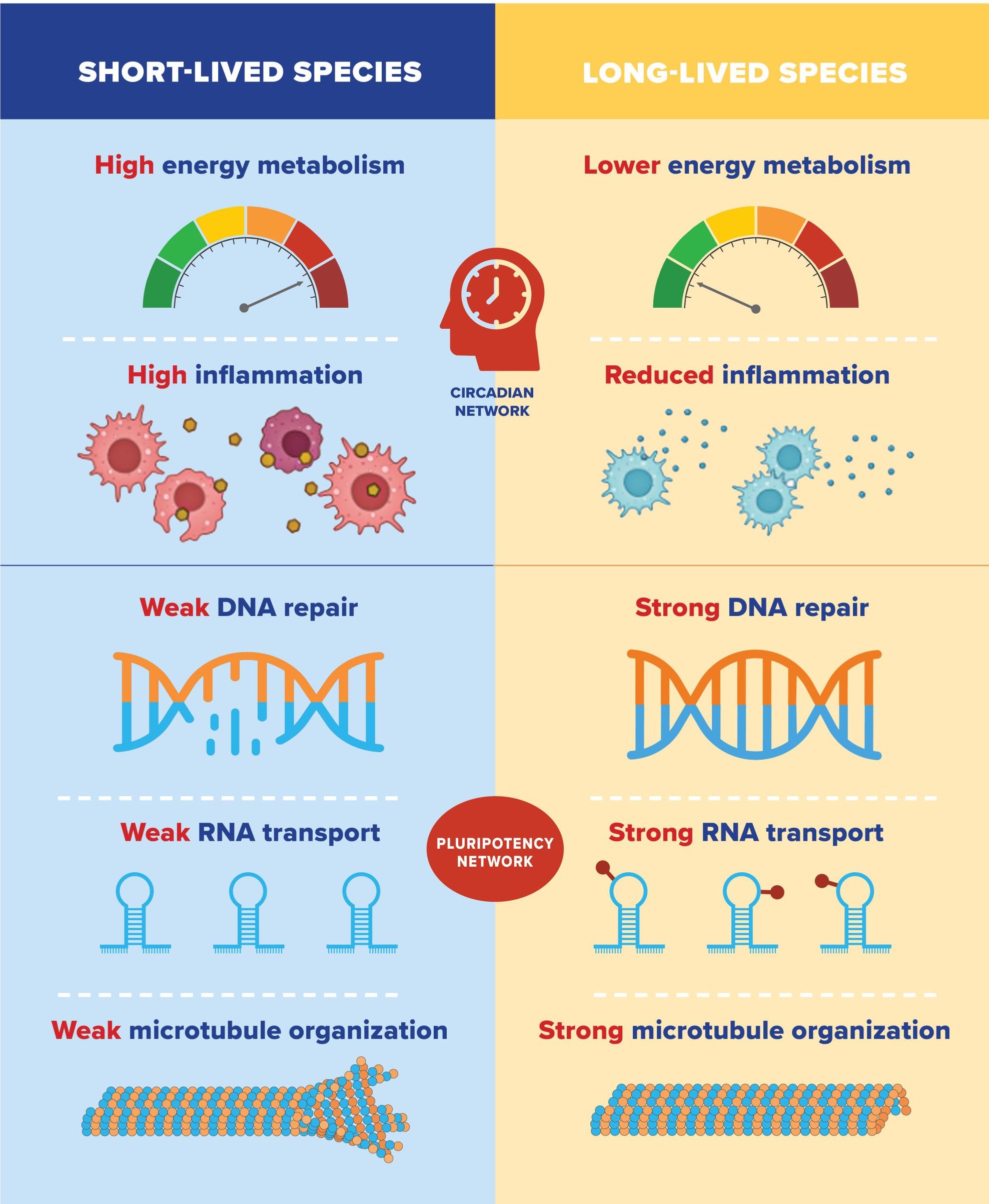
They found that long-lived species tend to have low expression of genes involved in energy metabolism and inflammation; and high expression of genes involved in DNA repair, RNA transport, and organization of cellular skeleton (or microtubules). Previous research by Gorbunova and Seluanov has shown that features such as more efficient DNA repair and a weaker inflammatory response are characteristic of mammals with long lifespans.
The opposite was true for short-lived species, which tended to have high expression of genes involved in energy metabolism and inflammation and low expression of genes involved in DNA repair, RNA transport, and microtubule organization.
Two Pillars of Longevity
When the researchers analyzed the mechanisms that regulate the expression of these genes, they found two major systems at play. The negative lifespan genes—those involved in energy metabolism and inflammation—are controlled by circadian networks. That is, their expression is limited to a particular time of day, which may help limit the overall expression of the genes in long-lived species.
This means we can exercise at least some control over the negative lifespan genes.
“To live longer, we have to maintain healthy sleep schedules and avoid exposure to light at night as it may increase the expression of the negative lifespan genes,” Gorbunova says.
On the other hand, positive lifespan genes—those involved in DNA repair, RNA transport, and microtubules—are controlled by what is called the pluripotency network. The pluripotency network is involved in reprogramming somatic cells—any cells that are not reproductive cells—into embryonic cells, which can more readily rejuvenate and regenerate, by repackaging DNA that becomes disorganized as we age.
“We discovered that evolution has activated the pluripotency network to achieve a longer lifespan,” Gorbunova says.
The pluripotency network and its relationship to positive lifespan genes is, therefore “an important finding for understanding how longevity evolves,” Seluanov says. “Furthermore, it can pave the way for new antiaging interventions that activate the key positive lifespan genes. We would expect that successful antiaging interventions would include increasing the expression of the positive lifespan genes and decreasing the expression of negative lifespan genes.”
Reference: “Comparative transcriptomics reveals circadian and pluripotency networks as two pillars of longevity regulation” by J. Yuyang Lu, Matthew Simon, Yang Zhao, Julia Ablaeva, Nancy Corson, Yongwook Choi, KayLene Y.H. Yamada, Nicholas J. Schork, Wendy R. Hood, Geoffrey E. Hill, Richard A. Miller, Andrei Seluanov and Vera Gorbunova, 16 May 2022, Cell Metabolism.
DOI: 10.1016/j.cmet.2022.04.011
The study was funded by the National Institute on Aging.
Never miss a breakthrough: Join the SciTechDaily newsletter.
Follow us on Google and Google News.
1 Comment
Genetics is of TOPMOST Importance to Humans; When I Search on Google Images for Monkeys or Apes, I get thousands of Photos of them. They are Closest to us than DOGS. How Come we haven’t yet got Whole Genome Sequences of Each of them yet? Once quantum computers arrive, they will emancipate our situation by multiple times. We cannot mess up with our genomes yet, yes. For eg., Spider Monkeys use their tails as 5th limb. All others have that same useless trash, causing a burden below them. DOGS wave them constantly to pleas their masters ! Try to find genes of Spider monkeys’ tails and transport that feature to other yielding species or genera of monkeys and apes to start with, please. Magnify Field of Genetics ASAP. Not just Megabridges, Space Stations…Whatever !